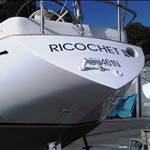
while sailing up from port hacking last week in weather I could really see what people meant by not using an outboard for serious cruising. I know people do it and thought "if they can, I can" but in the 2-3 metre confused southerly and winds gusting up to 30kn in my lil Tophat , I could see it as a real challenge to even fold the transom bracket down to start the motor, let alone what the swell might do to the outboard once it was down.
racking my brains on a solution and I'm thinking the most cost effective way would be to make a well in the rear of the cockpit For the outboard. This would still be a big job but wouldn't take up valuable space inside the cabin That an inboard would take up - which is my main concern. I wouldn't be able to turn the boat on a dime like I can now with the transom bracket and may end up with more water in the cockpit with the well, but it should be a bit like an inboard no? Opinions.?
When I was on the slip a few years back the bloke next to me had a 24 ft Endeavour with an
outboard in a well. He was having to change his motor because of lack of maintenance....too
hard to get to.
When the old motor came out it was discovered to have a plate sized oyster in the leg.
It seems that access is a major problem with outboards in wells.
Select to expand quotetwodogs1969 said..
You are not supposed to leave the motor in the well 24/7 saM
Which I wouldn't! probably pull it out even while sailing in calmer conditions, but have at the ready in more challenging situations, primed ready to go.t
Hi Sector Steve
all I can say, from my personal experience with the well in the Folky is, DON'T DO IT!!!
I'm actually intending going your way and having a bracket on the transom.
With a well, the outboard is either in or out....no in between, like raising the transom bracket. The leg stays in the water - racing, cruising, whatever - for as long as one is sailing. I'm sure some folks who are stronger than I am lift their motors out of the well whilst racing, however, it's not convenient to be lifting in and out all the time. My fear if it is out of the well, stored elsewhere, is that I may need the motor in a hurry...and then what do I do???
The well on my boat is in the lazarette and exhaust fumes are a big issue for me. I leave the hatches to the lazarette open, however, there's always an embarrassing amount of smoke emanating from there.
At the end of a sail with a transom leg, you can just raise the leg out of the water and be done with it. With a well, your day is not over until the motor is removed from the well and stored. For me - with now a 9.8 h.p. (read heavy!!) - this is proving to be untenable as I simply can't lift it out of the well myself. Don't tell anyone my dirty little secret, but I need a BLOKE to do this  .
.
Oh, with a well in any kind of sea, gallons upon gallons (frighteningly so) of water end up sloshing over the lip and into wherever the well is set - lazarette, cockpit. Scary the first time you see your fuel tanks upended and awash in the lazarette.
Just my two bobs worth.
Kind regards
Trace
Select to expand quotetwodogs1969 said..
You are not supposed to leave the motor in the well 24/7 sam.
The bloke in question had the capacity to tilt the motor but the leg wouldn't clear the water
which resulted in the large oyster. He said most of the time he couldn't be bothered
bending down to tilt it.
What is the shaft length of your outboard? I run an extra-long shaft on a Tohatsu 9.8 off the back of a 28'er and have never experienced significant cavitation offshore. Sometimes it did briefly cavitate when the boat was hit by big powerboat wakes from the rear quarter on Sydney Harbour, but only for a second or so. However, the lip of my transom is quite low.
Some people say that wells are bad for outboards since they end up ingesting their own exhaust.
I have a suspicion that bigger outboards reduce cavitation, because in rough conditions they can drive the boat close to hull speed so a significant quarter wave builds up at the stern, near the engine, lifting the water level by 6 inches or so. If the boat only has a small outboard it may be struggling to build up speed.
Hey there TheSelkie, have you considered setting up a block and tackle above you engine well, then you could lift your engine by yourself and put it onto a trolley in order to store it, then reverse the procedure to re-install it back into the well when you need to with out having to call upon the muscles of us cavemen type
Select to expand quoteSectorsteve said..
while sailing up from port hacking last week in weather I could really see what people meant by not using an outboard for serious cruising. I know people do it and thought "if they can, I can" but in the 2-3 metre confused southerly and winds gusting up to 30kn in my lil Tophat , I could see it as a real challenge to even fold the transom bracket down to start the motor, let alone what the swell might do to the outboard once it was down.
racking my brains on a solution and I'm thinking the most cost effective way would be to make a well in the rear of the cockpit For the outboard. This would still be a big job but wouldn't take up valuable space inside the cabin That an inboard would take up - which is my main concern. I wouldn't be able to turn the boat on a dime like I can now with the transom bracket and may end up with more water in the cockpit with the well, but it should be a bit like an inboard no? Opinions.?
A mate used to own a tophat which had an outboard in a well, built like that from new. Look around, I think many tophats were built with outboards in mind.
Cheers Bob.
I mounted a 5hp Honda obm on the back of my Tophat mk3 for a coastal run when the Diesel blew a Welch plug. It cavitated in moderate wave conditions. Most mk2 & 3 Toppies have an outboard in a well. You do get exhaust fumes, and wet feet at times, especially as most boats have excess gear on board that sits the hull lower than planned. Not an issue on a short trip off the mooring, but it's not something you want when cruising. The Tophat group forum has discussion and photos of various pulley systems to get your obm out of the well.
Things to think about for sure. Chris my outboard might not be extra long shaft. Not sure, but the prop is only submerged maybe 30cm underwater which I don't think is enough. The well sounds like it could be a pain. im thinking an extra long shaft OB could be the go. I do have a 30hp Johnson 2 stroke engine which really hauls. Not so much heavier than my Mercury 8, but def thirstier. It's something I need to seriously consider if I'm to venture up to queensland and beyond next year. The other day in the biggest seas I've been in and lotsa wind, I was fine, but the thought did cross my mind that while those seas were confused and coming from everywhere, it might be sketchy to get the OB in the water from its folded up position. I am pretty good at this though and agile. I can get the motor from its up position to started in about 5 seconds But maybe not with all e gear on and a tether.. It does involve a big burst of energy. but what if you're in a bit of pain or something. I was pretty exhausted as I'd sailed up and down between Pittwater, south west arm, Syd harbour, Woodford bay over 7 days. I like the transom bracket but I do want to be practical and safe ad I could see that it may be a mistake to set off with an OB. I'm just not sure. I will def do more trial runs, with my bigger engine in bigger seas.
Have you thought about making up your own out board bracket instead of one of the "Off the Shelf" types. I seen ones that are on slides and a winch to lower and raise them. This may enable you to set the depth of the prop to suit conditions and also lift it higher out of the water when not in use. Google up 'outboard brackets' and select 'images' to see what others have done.
Put the word 'slide' in your search
As said above, the OB in a well is standard for the Mk 2 and Mk3 TopHats, so it should be a simple mod. Search theTophat web site. I seem to remember someone posting on cutting the hole in the bottom, and the well was already there.
If you want to stay with a transom mount, the spring loaded adjustable height brackets are great. I just bought a 6hp Tohatsu Sailpro with ultralong shaft, and it is long! However in normal conditions I can operate it with the bracket raised, but if the sea is choppy, the bracket can easily be lowered, and the powerhead is still fairly far from the water.
The weight of the 6hp 4 stroke SailPro is 27kg, and that is the limit of what I can handle on my own. There is a 9.8hp version, and I think that is popular for TopHats. The Tohatsu exhaust is through the centre of the prop, so I would guess that the fume problem with mounting in a well would be minimised.
I really appreciate everyone's input. Given me a lot to ponder and research. I've found out I can get an extra 6 inches!! Just what my girl might need!!!
i mean a 6 inch conversion kit added to the existing leg!
Select to expand quoteSectorsteve said..
I really appreciate everyone's input. Given me a lot to ponder and research. I've found out I can get an extra 6 inches!! Just what my girl might need!!!
i mean a 6 inch conversion kit added to the existing leg!
I would suggest the 6 inch conversion and make a Korts nozzle out of plastic or alloy or lay up one with carbon fibre. Mount the outboard so the leg is close to the transom as possible. The Korts nozzle will give a large increase in thrust and stop any cavitation. Avoid the outboard in a well.
The outboard korts nozzle half way down the page in this link is similar to my tenders motor.
www.solarnavigator.net/kort_nozzle.htm
brilliant Ramona! it just gets better! so you think its better to have the outboard right on the transom on bracket as opposed to the transom bracket extended out (mine would go about 30-40cm off the transom) Im not sure how i would do this? with the bracket fully up, the motor is out of the water.
Please don't do a well, had one on a Thunderbird and hated it so much I installed a shaft drive yanmar - which sat under the fwrd end of the cockpit and in practice took up less room than the outboard well, and of course end of problems with lifting and storing the outboard.
All the posts about a longer leg with the transom mount make better sense.
Select to expand quoteSectorsteve said..
brilliant Ramona! it just gets better! so you think its better to have the outboard right on the transom on bracket as opposed to the transom bracket extended out (mine would go about 30-40cm off the transom) Im not sure how i would do this? with the bracket fully up, the motor is out of the water.
The closer the leg is to the stern the less it will be effected by pitching. This is where the outboard really suffers and you get severe cavitation when you really don't need it. The picture is of my previous yacht a M&W 26, 8hp Mariner with the engine mounted on a timber and fibreglass bracket. With the engine up the skeg was clear of the water, down it was close to the transom. It was pretty useless in a slop and would have benefited

greatly with a korts nozzle. I also had an extension rod into the cockpit for the gear change.
I should add here that I had an Endeavour 24 in the early 1970's with a volvo outboard in a well. It was a nightmare arrangement.
I had an outboard in the well on a Bluebird and it worked a treat. Only problem was fumes, and that was solved by piping the exhaust relief down to the water. (Bit of hose.) It is great to get good access to the motor for cleaning plugs or any other maintenance. If you are bouncing around at sea, you can do something with it. If it is out the back of the boat, no way.
Modern 4 strokes should be much better for the fumes. In the end, it is the design of the boat that determines whether a well works or not. The poor designs with motors stuck in some kind of cockpit locker/lazarette were bound to fail. The one on the Bluebird was tucked under the tiller, so not much space was lost.
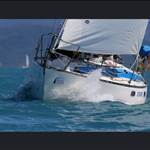
The Elan 210 I thought is a pretty cool approach to an Ob in a well, just a smart engineering approach to an old problem. Starts at 1:26 in the video!
'Hey Dave, wind is starting to get up! Why don't we stick our heads below our feet and put an outboard in the water'. Not for me anyway.....
Select to expand quoteShaggybaxter said..
The Elan 210 I thought is a pretty cool approach to an Ob in a well, just a smart engineering approach to an old problem. Starts at 1:26 in the video!
That is pretty awesome. 
Select to expand quoteJolene said..
That is pretty awesome.
I agree, it is pretty, but, sheesh ... $75000 for what is essentially a trailer sailer and that's the poverty pack model before you start ticking boxes.
I like the look of the elan but that outboard set up is comical IMO. Not really practical for general sailing. Look at the elliotts who have an outboard on the transom but it folds into the cockpit to keep the weight forward.
Or a well like an RL or Noelex.
I put a pair of mainsheet traveller cars on the cockpit floor. Some roller-bearing cars sliding on the tracks support a custom made bracket. The outboard is taken out of its locker and put onto the bracket inside the cockpit, then slides back and drops down. I'm happy with it.
Select to expand quoteChris 249 said..
I put a pair of mainsheet traveller cars on the cockpit floor. Some roller-bearing cars sliding on the tracks support a custom made bracket. The outboard is taken out of its locker and put onto the bracket inside the cockpit, then slides back and drops down. I'm happy with it.
is this your primary engine Chris? Do you stow it whilst sailing underway or leave it on the transom? what kinda conditions you been in with it, both on the back whilst sailing and motoring? got a pic?
Select to expand quoteLooseChange said..Jolene said..
That is pretty awesome.
I agree, it is pretty, but, sheesh ... $75000 for what is essentially a trailer sailer and that's the poverty pack model before you start ticking boxes.
I liked the way both rudders stalled as the bloke tried to bear away!
It's the primary engine, replacing a 13hp diesel. Underway, I kick it up and then normally slide it forward into the cockpit, just for looks. At anchor we sometimes leave it down (partly to increase the cockpit space, partly to use it as a ladder when swimming) and sometimes kick it up and roll it forward. I'm lucky because the standard design for my boat has a big locker at the stern which isn't very accessible, so by cutting it out and extending the cockpit back to the transom I didn't lose any usable space and actually gained a much better layout. When the engine is stored or rolled aft, we have a nice little aft cockpit behind the traveller. The cockpit around the engine doesn't get used much when the engine is lifted up and rolled forward, but it's a handy place to chuck stuff to keep it out of the working area.
The engine lives in a locker in one quarter when the boat is on the mooring. It is quite big and heavy to move around but since it's all done inside the cockpit, everything is much easier than in boats where you have to dangle over the back. One issue is that the Tohatsu 9.8 ultra long shaft is such a big engine that even with the tracks extending all the way to the rudder head and traveller, the foot of the outboard still sticks out the stern but it's only an aesthetic issue. It wouldn't be hard to rig up a pretty good locking system so you could leave the outboard on the bracket all the time, and it's probably less of a target for thieves because it's not as obvious.
I don't try to measure windspeed or estimate wave sizes since that's just so unreliable; I have met people who claimed to have had their No 1 headsails up in 60 knots! However, I have motored in to harbour at close to hull speed from about three to five miles offshore in a howling winter westerly that was unforecast and had built to the stage where the boat was overpowered with a #4 headsail and no main; the boat was fine but singlehanding in that stuff with a boat that hadn't been sailed for six months didn't seem to be a good idea; all you need is one thing to go wrong and it could get uncomfortable. It was about as strong as you get in a worse-than-usual Sydney to Hobart when you're down to storm trysail and maybe a storm jib, and yet the outboard pushed the boat dead into the breeze and a very nasty chop at maybe 4-5 knots without cavitation. I was very impressed with the way the outboard went, it was much better than I had hoped for.
I'd be quite happy taking an outboard set up like this across Bass Strait or up the coast. The only real issue is that you use more fuel than a diesel, but on the other hand you sail faster. And you can get a brand new outboard for a fraction of the cost of reconditioning an old inboard.
I haven't got any detail pics, sorry.
PS - My boat does has a low transom lip, so the engine is quite deep in the water. At times, some water does come over the transom lip, mainly when running at higher than hull speed or when we get stinkboats passing close by astern. However, if it was a serious problem you could just fit a mini bulkhead in front of the engine "bay", with one-way drains. I just haven't bothered yet, since down here at BB we don't get big stinkboats and if you're running that fast you're normally getting a bit of spray anyway.
PPS - I love Ramona's nozzle idea - not only would it increase motoring efficiency, it may make a convenient boarding step.