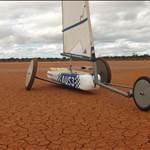
I have moved this thread from another beacuse I think it needs a tread of its own rather than getting mixed up with another subject.

Any explainations for speeds achieved by iceflyer/windflyer? From what i've seen and read performance is up there with a cl5, but pointing high enough is the issue. Would a traveler help? Think it would be awesome to have cl5 performance on a mini sized or smaller yacht.
A traveler will only give you an extra degree or 2 at best but that's assuming the rig is still working, but with sailboard rigs they will luff out early and not be able to be pushed just that bit further. A traveler in that sort of set up would be a waste of time.
The iceflyer is sailing on ice a surface that is very much lower in friction than soil, so the sail can be rigged up as a very flat sail on the rig before you get going, this in turn helps with top end speed.
On land I believe they run quite large sails 7-10 sqm compared to a cl5 which has 5.5 sqm and being a larger size yacht than a cl5 it would have more stability to utilize that area of sail.
Does anyone have info on how the iceflyer / windflyer goes against a cl5 with both running the same size sail on the same surface?
You need to compare apples with apples.... Not apples with oranges. As the saying goes.
Howdy all. I have my mini buggy all but built and now ready to cut a W/Sail to fit but need a little help. I have a Killwell CF two section mast which has a parallel lower half with tapered top half and is quite rigid. I don't see how I can use Pauls method to change the luff using his tables. My problem being -- "just how much bend must I induce in this CF mast to re-cut the luff"
I tried pulling the mast into a partially bent position, then into a hard bent position and it is obvious that the correct amount of bend needed to recut the luff is quite critical. Do I just set it up for a small bend as if I was running light or downwind??...or pull it on hard and then look at the luff bend??. If I did the latter then the sail would set horrible when lightly loaded.
I used plastic tape as a temporary reshape of the luff when lightly loaded and then pulled the sheet on hard. The sail appeared to flatten and tolerate the mast bend ok.
Appreciate any suggestions... Warren
Thanks Paul. By that do you mean that I should lay the mast horizontal and supported by the base and then hang 30kg off the top end and then observe the bend? I think the way I started in just causing a small amount of bend may give me a very soft sail. I did it by mounting the mast in the buggy and laying mast over horizontal on it's side, then pulled some curve in by the sheet rope. Then I taped the sail to fit the luff curve, allowing a small amount of belly. I'll set it up again in the morning and pull more bend on and then match the sail to it. I was a bit worried that the sail would end up a lousy shape when the load was off such as in running. I can see this exercise isn't going to be easy.
Regards...Warren
Yeah! Wok,
I will stick my bib in here, Paul also said that the Sticky at the top of the page on Sail cutting will give you a quite suitable Mast Curve to work with.. I followed his instructions using a heavy Paper (Light Card) and transferred his measurements directly to the paper I then cut it out and laid it directly upon the sail where it was to be cut traced the curve and cut the sail.. It was very much a Blind Faith job but it worked perfectly.. Using suggestion and Common Sense I chose the Foot and Head lengths to suit Occum's Razor.. Hear Paul and you won't go wrong..
Ron


Thanks Paul and Ron and TP1, I shall go back to the drawing board and start again. I now understand how the luff lines are drawn and the use of the weight to determine the bend. I'm not sure now if my mast is a CF or coloured glass.. no markings to say so but it sure is stiff. I have a shorter 2 piece tapered black Killwell which is also quite stiff and a blue tapered onepiece fibreglass mast which is much more flexible. I'll hang the 30kg (that's less than 1/3 my body weight!) on the mast centre and see what it shows first then compare it to the luff chart -- meantime I'll hide the scissors away. (Golden woodworking rule my Dad taught "leave it as long as you can for as long as you can"). Plodding on....Wok
the blue mast is probably an original windsurfer, very flexy, graet for kids yachts and for shoving up bigger 1 peice masts as a stiffener
with a 30kg weight in the middle of a glass or carbon mast ,if you get a deflection of about 180mm that is just about right. our ally class 5 masts have a deflection of 150mm (stiff) to 180mm (soft) length of 5-5.2m
A question on mast rake. I notice that all the L/yachts have mast rake almost to an extreme angle whereas water based yachts have near vertical masts except that some Cats do have some rake.
Is it to position centre of pressure rearward or does it provide helpful wind flow? An old colleague and experienced sailor friend has suggested that in the case of Cats it can help lift the bows to avoid a nose dive. I would think that is not a problem with the landyachts as a more vertical mast placed rearward would achieve the same thing.
Have tried my newly built mini out several times on the carpark of our local marina and am a little pumped. Scared the bejees out of me initially in a gust but eventually settled down and had a great few hours - didn't hit a car or kerb. Glad I'm back into it.
Am trying a few other mono film sails using a windsurfer boom to see if I can get another sail going without having to do a re-cut. Might also try a curved boom to lay below the sail foot rather than the windsurfer boom. Anyone have any thoughts on those two options, I'm sure it has been tried??....wok
both will work fine,especially if your zapping round a carpark,
probably better
re the mast rake, its probablyto do with moving the CE back , but may well be simply a habit we have got into
What a wonderful venue.. and it would seem that an unmodified SB Sail is ample for that type of sailing, seem to have really "Cut the Mustard"
Ron
Good one oldMXer and a great empty car park too. Following is my suit of sails bought a little while ago. Only had a few hours sail so far.
Pink one is a re-cut 5.5 which works just ok (just) so I'll put it down to experience

4.2m square top should be good for speed on hard surfaces

5.0m

I'd like to fit this 5.9m for some extra grunt on the beach sand we have here. Yet to set it up and will try a windsurfer boom. I have started fabricating a curved laminated wooden boom as well for an alternate way of doing things. Need many more hours sailing yet before getting too serious.

This 6.5m would be good for ending upsdide down on my little Mini!!!

As you can see things are in a great state of "uncertainty" Would welcome any comments and suggestions....wok
Wokeelliot, think that 4.2 sail looks awesome. Put a wishbone boom on and go! Set downhaul tight. Big issue we found was mast damage at the base from setting proper downhaul (no wrinkles). We now run a 1/4 inch bolt thru mast and wood stiffener 2" from bottom, trimmed flush. Take the time to fit wood stiffener as snugly as possible and epoxy in place. We now trim flat and place a racquetball in bottom of mast step. Works great and really quiets a lot of chassis noise. Use a nice small double block to set downhaul, makes it so much easier to do. Set outhaul by the numbers, maybe a bit more. We attach block with a small link directly to outhaul lines, keeps connection short, least amount of sail distortion it seems. Have fun!
Having fun I am Today I'll set that 4.2m up properly and have a go. I had been advised to strengthen the mast base and have done just that. The racketball I gather is to allow the mast to swivel due to the fact that the mast boom clamp will rotate the mast? I have started to do something similar and have enough room to glue a thin Stainless Steel shim to the mast where it exits from the mast post, a little lubricant will help there. A few PM's I received seem to suggest I don't have a problem with mast rake and it has the advantage that it looks really sexy Enjoy your machine too, don't hit any of those light posts...wok

Well they say you will never know until you try it!! So to satisfy myself about the effect of changing the CE by altering the mast rake I took to the Mini's mast post with my trusty angle grinder and welded up an adjustable mast post. It can now be easily changed from 13 to 3 degrees rake as shown in the photo. Given some wind in the next few days I'll give her a burst at the local Marina carpark again. Sussed out the vehicle parking area at the local airport the other day, looks good and now will proceed carefully to get the right person onside to allow me to use it....wok
Came across some good discussion points here. Enjoy www.boatdesign.net/threads/rotating-wing-mast-%E2%80%93-theoretical-discussion.14714/
Winter is here, work has slowed down, time to consider new build. Trying to wrap my head around an idea posted couple years back by my buddy, the aft-mast designed luna rig. At the time we did not like the overall size of cart layout due to the stay requirements. After watching video of present cart with leaf spring rear axle, confirmed gut feeling that sail does not really twist to leeward, just leans, then eventually lifts a wheel. Thinking now modified prout setup, mainsail used as back stay, induce a little curvature in mast, cut down on windage induced by bare mast, no side stays, somewhat high profile head sail with boom and center sheeting, 5' foot roughly. Mainsail with 2' foot, probably no control, just rig for a little side to side movement. From what i've read luna setup on a boat does not produce as much heeling as other rigs, might be able to reduce width and put into length, still fit in 5.6 rule. 
A few images to illustrate sail plan that i'm working on. Need some ideas on mast step. Hope to bolt on if possible. Stayed front to rear, torque tube side to side. 
 Tape measure represents front stay position.

rear mounted sails--Iceflyer--and alike, preformance lot of it comes from being able , to carry huge sails in low wind and the high speeds come from the design and being able run in real big winds---I built a scaled down tubeular version of Wally Hall's iceflyer and was very empressed on the performance, mine was the same size as a c-5 and really scooted along on a reach and off wind, BUT they really struggle pointing up wind and that is dew to sheeting and down haul and out haul.. of the windsurfing sail. if one could do the adjustment on the fly then you would have a great machine. I ran Sailworks "Huckers" it was my first build. super fun yacht.. I miss it. it gave you a special feeling of freedom because you where out in front of all the stuff. that yacht was filmed every where I went with it. OldMKer where are you located? I really like your thinking and your builds..
Trying to set chassis up to test a delta rig, my buddy and his dad put the idea up here a couple years ago and I just want to try it. Didn't research it until recently but from what i gather Sailrockets development included some delta rigs early. I'm in Indiana, winter storm is coming in tonight, snow and high winds we'll try to get some footage
This is the thread this modification is inspired by. www.seabreeze.com.au/forums/Land-Yacht-Sailing/General/New-Wood-Landyacht-Concept/?page=1
Mast step is mounted, ready for sail design. Flat or shaped?


Just going through this thread and found this posting that could do with some expanding.....


[

img]
Seasons greetings oldMXer. I think that white stuff is soap suds from your kids Xmas party water pistol fight ! The only white stuff we have here is talc powder, soap suds, salt or cotton wool!!
Question on the leaf spring suspension--- compared to my trailer for the alli dinghy on top of the car.
I had to clamp on my axle stubs, your setup looks like the springs are fabricated with a turned-up end, drilled, welded and then has been heat treated..is that how it was done?
Also the leaf spring I used was the longest I could find many years ago and it is too short as an axle for a mini. Did you use two half springs clamped into a centre boxed section to gain width?
I still love those wheels, and the suspension must be the softest ever...wok
Wokeelliot, nice effort on the boat trailer. I'm sure it is a very smooth ride. My springs are from a '77 toyota pickup. Cut exactly in half to yield a right and left axle. Bolted to rectangular box steel to gain width. Axle bolts are welded directly to spring with a 3/4 inch washer tacked in place for wheel hub bearing to ride against. No heat treating, no bending of spring steel, etc...

Hi Eric, thanks for that info re your leaf springs. I never thought of getting away with welding that material without spoiling the spring characteristics.
Now that I think about it, the bending moment at the point where the stubs are welded has very little force on it if the stub is short (as it is on yours) and joining the two half leaves is simple, well done, great idea.
Tomorrow I'll do some trial welds and see if there is any cracking of the leaf material or weld using my MS electrodes, then I'll get serious about modifying my chassis. After building my boat trailer I had no doubts about the ability of the leafspring to resist twisting so I know there isn't a problem there.
That now opens up more methods of constructing soft floating rear axles of any length and as a means of soft linking the front wheel steering assembly to the main frame.
Cheers, keep up the good work, it's looking good...wok
PS: I have another photo of my trailer up on the car that I'm not posting as it shows a very embarrassing situation with the car stuck halfway through my neighbours fence after it rolled down the drive