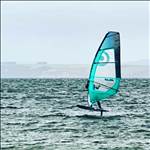
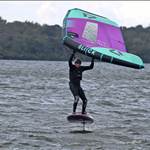
I've got an Appletree Apple Slice V2 for winging and like it, and I like that they use a closed cell foam that prevents any water intrusions from dings (see vid of them explaining it). I've had some pretty hairy exits on rocky shores, and can't imagine navigating that with a more fragile board (although I'd probably just get good with the epoxy stick). [Some reviews also talk about the stiffness of these boards, and the very direct feel for the foil they give (?!)]
Anyway...how much of an issue is water intrusion on regular EPS foam boards in your experience, and why don't more board makers switch to closed cell foam?
Any other examples? (I believe Takoon also uses a closed cell foam too, also manufactured in Portugal, I believe, like Appletree).
Appletree Tech Talk on board foam:
I used to build windsurf and surfboards out of XPS, it it good stuff with some drawbacks: The good is what you said above, it's stiff, waterproof and fairly strong. The drawbacks are that it's difficult to shape (although these days with machine shaping that wouldn't be as big an issue), it is prone to delamination due to residual blowing agent and it's less resilient compared to EPS.
The biggest issue historically is the delam problem, when a board gets hot the residual blowing agent can activate and blow a delam. XPS surfboards actually punch little holes in the board to let the gas out. When I built boards, I found that leaving the blank very rough and bagging on the lamination a bit dry would leave air channels under the lamination giving the gas somewhere to go. I'm not sure what Appletree is doing. It's possible that they have a source that uses a different blowing agent that isn't as active as what's been available in the past in the US.
Compared to EPS, XPS isn't available in densities below 1.5 lb that I'm aware of. EPS is usually 1.0lb for sandwich boards and 1.5lb or 2.0lb for monolithic skin boards. EPS varies a lot in quality and bead fusion, 1.5 or 2lb with good fusion will not suck very much water when a ding is left open, while 1.0 lb with bad fusion will drink it up.....
JL
Select to expand quoteJonahL said..
I used to build windsurf and surfboards out of XPS, it it good stuff with some drawbacks: The good is what you said above, it's stiff, waterproof and fairly strong. The drawbacks are that it's difficult to shape (although these days with machine shaping that wouldn't be as big an issue), it is prone to delamination due to residual blowing agent and it's less resilient compared to EPS.
The biggest issue historically is the delam problem, when a board gets hot the residual blowing agent can activate and blow a delam. XPS surfboards actually punch little holes in the board to let the gas out. When I built boards, I found that leaving the blank very rough and bagging on the lamination a bit dry would leave air channels under the lamination giving the gas somewhere to go. I'm not sure what Appletree is doing. It's possible that they have a source that uses a different blowing agent that isn't as active as what's been available in the past in the US.
Compared to EPS, XPS isn't available in densities below 1.5 lb that I'm aware of. EPS is usually 1.0lb for sandwich boards and 1.5lb or 2.0lb for monolithic skin boards. EPS varies a lot in quality and bead fusion, 1.5 or 2lb with good fusion will not suck very much water when a ding is left open, while 1.0 lb with bad fusion will drink it up.....
JL
Super helpful, thanks...now...how to tell the quality of the EPS each board is made of???
Take the new Sunova Carver for instance...they tout their EPS has having light weight and good flex characteristics, with vague references to density... and that's about all I could find just poking around...
Select to expand quoteSpokeyDoke said..JonahL said..
I used to build windsurf and surfboards out of XPS, it it good stuff with some drawbacks: The good is what you said above, it's stiff, waterproof and fairly strong. The drawbacks are that it's difficult to shape (although these days with machine shaping that wouldn't be as big an issue), it is prone to delamination due to residual blowing agent and it's less resilient compared to EPS.
The biggest issue historically is the delam problem, when a board gets hot the residual blowing agent can activate and blow a delam. XPS surfboards actually punch little holes in the board to let the gas out. When I built boards, I found that leaving the blank very rough and bagging on the lamination a bit dry would leave air channels under the lamination giving the gas somewhere to go. I'm not sure what Appletree is doing. It's possible that they have a source that uses a different blowing agent that isn't as active as what's been available in the past in the US.
Compared to EPS, XPS isn't available in densities below 1.5 lb that I'm aware of. EPS is usually 1.0lb for sandwich boards and 1.5lb or 2.0lb for monolithic skin boards. EPS varies a lot in quality and bead fusion, 1.5 or 2lb with good fusion will not suck very much water when a ding is left open, while 1.0 lb with bad fusion will drink it up.....
JL
Super helpful, thanks...now...how to tell the quality of the EPS each board is made of???
Take the new Sunova Carver for instance...they tout their EPS has having light weight and good flex characteristics, with vague references to density... and that's about all I could find just poking around...
You can't really evaluate the quality of EPS unless you have a piece of the foam. If you have a piece of foam, basically you break/pull it apart by hand and see if the beads shear through the middle (good) or break apart from one another (bad). It's the interstitial space between the beads that soaks up water, so if there's no space between the beads, no water will get in. There's always some space but the fusion between beads is a good indicator of how much space there is. Really well fused, higher density EPS can have the same issues as XPS with blowing agent causing delams.
Drained 1.2 l out a very thin 4cm crack in the rail of a Cabrinha code. Had the crack covered in tape for a week as I was away at the time. Was stupidly under the impression that EPS did not absorb water - clearly that is not the case. I now fix any ding ASAP and wouldn't take a chance on any board.

Local board repair shop absolutely hate the magic "blue" foam, mostly because of the crap building techniques a lot of the companies are using. They are using the higher density foams as impact protection and then using only glass and minimal volumes of it to make boards cheap. Trouble is they are still weak for any substantial loads. Can't beat a good EPS, PVC, carbon laminated board.
Select to expand quoteSpokeyDoke said..JonahL said..
I used to build windsurf and surfboards out of XPS, it it good stuff with some drawbacks: The good is what you said above, it's stiff, waterproof and fairly strong. The drawbacks are that it's difficult to shape (although these days with machine shaping that wouldn't be as big an issue), it is prone to delamination due to residual blowing agent and it's less resilient compared to EPS.
The biggest issue historically is the delam problem, when a board gets hot the residual blowing agent can activate and blow a delam. XPS surfboards actually punch little holes in the board to let the gas out. When I built boards, I found that leaving the blank very rough and bagging on the lamination a bit dry would leave air channels under the lamination giving the gas somewhere to go. I'm not sure what Appletree is doing. It's possible that they have a source that uses a different blowing agent that isn't as active as what's been available in the past in the US.
Compared to EPS, XPS isn't available in densities below 1.5 lb that I'm aware of. EPS is usually 1.0lb for sandwich boards and 1.5lb or 2.0lb for monolithic skin boards. EPS varies a lot in quality and bead fusion, 1.5 or 2lb with good fusion will not suck very much water when a ding is left open, while 1.0 lb with bad fusion will drink it up.....
JL
Super helpful, thanks...now...how to tell the quality of the EPS each board is made of???
Take the new Sunova Carver for instance...they tout their EPS has having light weight and good flex characteristics, with vague references to density... and that's about all I could find just poking around...
Nearly all SUNOVA boards are produced with a 1.0lb EPS core, with the exception of our Kite Tec construction.
The boards are manufactured using a sandwich construction process so a higher density core is not required.
As JL stated above, lighter cores will absorb more water, and if you do ding a SUNOVA board it will suck water because of the core density. However, it may not suck as much as other brands using the same density foam.
There can be huge variations in the fusion of EPS beads, even within the same density blocks. If you blow foam in smaller mould it will be packed/fused a lot tighter than if you were using a larger one, then sliding blanks out of it.
The best way to get lightweight, water resistant EPS blanks is to blow the foam directly into a mould that is the shape of the finished board. These are ridiculously expensive though and brands would need to sell 1000's of the same shape to recoup their investment. So there is very few examples of these on the market.
I think PPC make moulded EPS blanks, is that right?
The Appletree construction sounds good but I am skeptical that a single carbon skin board will ever be as stiff and strong as a PVC/Carbon sandwich construction like most of the good windsurf boards. The PVC sandwich does make the board more water tight if its cracked but I have spent months trying to dry out sandwich boards and they almost never get back to original weight. So for sure they will suck up water just the same as a single skin if you crack the PVC shell. Also there are very few full sandwich boards around, deck, bottom and rails as I guess its expensive to make them. Most brands publish a simple cross section drawing and talk a load of quasi tech rubbish to convince customers their brand is best.
I guess getting PVC sandwich to bond to the blue foam is just too expensive/hard to do.
Appletrees secret sauce isn't necessarily the foam (it's xps as described above, which is readily available), it's how they bond the skin to the foam. I wouldn't say appletree boards are tougher than good eps boards but the stiffness and the fact that they don't take on water is the benefit. I've traveled a lot with my appletree board and it has had airport dings, but I can tape it and ride it without any issues and fix it when I get home. The box stiffness on appletree boards is also the best around. Lots of boards get sloppy boxes after a lot of aggressive use (did I actually just write that?) like jumping but I have an appletree board that I've used for almost 3 years and it's still bombproof.
I can't remember which pod cast it was, Maybe "The Generic Foiling Podcast"
anyway someone on there stated that all the pros are riding custom PVC carbon sandwich boards as the production ones can't handle the abuse they put them through.
The main issue I have with the closed cell foam boards is weight. In larger sizes the difference to eps becomes substantial.
There can be unseen damage that allows water intrusion but if you keep an eye on them and weigh new and occasionally there'll be no issues.
This is all super educational for me, thanks all...
...although I now feel a bit lost thinking about my next board...
Agreed, jonah is onto it
Not a fan of XPS either
There are plenty of ways to make a strong board but only one to make it strong and light..... sandwich.
The sandwich essentially becomes an I-beam like used in buildings and thats why we do it.
That then means the EPS has no function other thsn to keep the skins apart so to a great extent it is irrelevant to strength (ignoring heel dents from jumping)
Spokey if you're in WA come have alook
Mark
MOzCustoms
42 Daly St South Fremantle
The solution to XPS delam: don't laminate! I found this post of a DIY XPS board entertaining.
foil.zone/t/building-an-unlaminated-xps-foam-wingfoil-board/16880