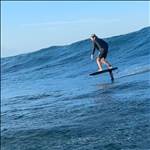
Summer is just about here and the seabreezes are Shweeeet.
Here's a quick session I did after work yesterday Winging upwind from Fisherman's Beach to North Mona Vale head then Free-Winging nearly all the way back DW. So much fun. So many epic sections, perfect bumps, long glides, high speeds - too good.
I was riding the Naish Hover 110 with Jet 1400HA/310HA/75 and the 6m Wing-Surfer with Mono- Harness line (makes life upwind easy).


Select to expand quoteJB said..
Summer is just about here and the seabreezes are Shweeeet.
Here's a quick session I did after work yesterday Winging upwind from Fisherman's Beach to North Mona Vale head then Free-Winging nearly all the way back DW. So much fun. So many epic sections, perfect bumps, long glides, high speeds - too good.
I was riding the Naish Hover 110 with Jet 1400HA/310HA/75 and the 6m Wing-Surfer with Mono- Harness line (makes life upwind easy).
Here's a few of the stats for those interested,
The entire run.
Just the upwind. The linear distance was 7.2km at a bearing of 25 degrees, so a little North of NE.
Downwind leg was soo much fun. Good speeds, and lots of surfing. Bearing 202 which is great. (180 + 25 = 205). But If I take out that little dog leg at the end 192 which shows I did surf left a little more than right, but in general, pretty straight DW.
DW winging is definitely a ton of fun, no car drops, fun on the sail upwind, plus you can hunt out to sea to start your run and really line the bumps up. I am riding about 2.5+km's offshore.
Please ride within your ability, ensure your gear and you are up to the task. Always be prepared to swimm what ever distance you are off shore and most definitely wear a leash! (also suggest a helmet and floatation).
Enjoy,
JB
Awesome video 
Agree JB - downwinding is the best, we get awesome windswells here in Perth when it's blowing.
Super-stoked to see so many wingers this year - plenty of ocean out the back for everybody 
Here's a recent 5 km downwinder in SSW 22 knots
Max speed 43.94 kmh
37 kmh average for the 5 kms
Too many carves to count 
4.5m sail, 65 cm front wing (840 cm2)

Select to expand quoteazymuth said..JB said..
Summer is just about here and the seabreezes are Shweeeet.
Here's a quick session I did after work yesterday Winging upwind from Fisherman's Beach to North Mona Vale head then Free-Winging nearly all the way back DW. So much fun. So many epic sections, perfect bumps, long glides, high speeds - too good.
I was riding the Naish Hover 110 with Jet 1400HA/310HA/75 and the 6m Wing-Surfer with Mono- Harness line (makes life upwind easy).
Here's a few of the stats for those interested,
The entire run.
Just the upwind. The linear distance was 7.2km at a bearing of 25 degrees, so a little North of NE.
Downwind leg was soo much fun. Good speeds, and lots of surfing. Bearing 202 which is great. (180 + 25 = 205). But If I take out that little dog leg at the end 192 which shows I did surf left a little more than right, but in general, pretty straight DW.
DW winging is definitely a ton of fun, no car drops, fun on the sail upwind, plus you can hunt out to sea to start your run and really line the bumps up. I am riding about 2.5+km's offshore.
Please ride within your ability, ensure your gear and you are up to the task. Always be prepared to swimm what ever distance you are off shore and most definitely wear a leash! (also suggest a helmet and floatation).
Enjoy,
JB
Awesome video
Agree JB - downwinding is the best, we get awesome windswells here in Perth when it's blowing.
Super-stoked to see so many wingers this year - plenty of ocean out the back for everybody
Here's a recent 5 km downwinder in SSW 22 knots
Max speed 43.94 kmh
37 kmh average for the 5 kms
Too many carves to count
4.5m sail, 65 cm front wing (840 cm2)
Smoking Averages and peak! WOW!!! This is Windsurf Foiling right?
Soo much fun. How deep are you getting off the wind. By the look of your trail you're still quite broad. This is the real challenge I find. I think I was within the real of 10-15degrees which is awesome (a little slower, but basically surfing the whole way). I think my last WSfoiling session I could actually go quite deep just not for very long.
Yep, so much ocean out there to play in. Gonna be an epic Summer.
Keep shredding,
Regards,
JB
Hey JB
great video and trace - it was a good seabreeze yesterday in Sydney wasn't it.
I started same place but went the opposite direction .... some whales out there too
RobJ

Select to expand quoteJB said..Smoking Averages and peak! WOW!!! This is Windsurf Foiling right? Soo much fun. How deep are you getting off the wind. By the look of your trail you're still quite broad. This is the real challenge I find. I think I was within the real of 10-15degrees which is awesome (a little slower, but basically surfing the whole way). I think my last WSfoiling session I could actually go quite deep just not for very long.
Yep, so much ocean out there to play in. Gonna be an epic Summer.
Keep shredding,
Regards,
JB
Yep, windsurf foiling.
By the way I owe you a huge thanks, your early vids inspired me to start foiling about 3 years ago
I can go dead downwind but to keep max speed I'm s-turning. Carving back crosswind on the swell when I'm losing speed and then carving (slingshotting) back down the swell - using sail and swell power.
Probably average about 160 degrees to the true wind
You guys are getting way better upwind angles than anybody winging around here (including me). It's approaching what I get on a kite foil.
Is there any single factor that contributes to your upwind performance? HA foils? Harness lines?
Select to expand quoteazymuth said..JB said..Smoking Averages and peak! WOW!!! This is Windsurf Foiling right? Soo much fun. How deep are you getting off the wind. By the look of your trail you're still quite broad. This is the real challenge I find. I think I was within the real of 10-15degrees which is awesome (a little slower, but basically surfing the whole way). I think my last WSfoiling session I could actually go quite deep just not for very long.
Yep, so much ocean out there to play in. Gonna be an epic Summer.
Keep shredding,
Regards,
JB
Yep, windsurf foiling.
By the way I owe you a huge thanks, your early vids inspired me to start foiling about 3 years ago
I can go dead downwind but to keep max speed I'm s-turning. Carving back crosswind on the swell when I'm losing speed and then carving (slingshotting) back down the swell - using sail and swell power.
Probably average about 160 degrees to the true wind
Windsurf foiling is definitely still quicker (for now  ). Stoked you're loving it. Yew, I am obviously still foil brained
Yes, I was going to say about 160. Would be interesting to work out your VMG both up and down wind. Do you have your linear's and times?
My upwind is just over 9kmh and DW is about 19kmh. Pretty quick really. Longer mast I maybe could have gone harder upwind, 75cm I blew the tip a few times particularly on Port tack which is more into the swell. Actually came off the foil 2 or 3 times going up wind, so could have been quicker. Down wind is all about running deep to get efficient.
Keep sharing your stats, interesting to see the similarities and diffs.
Ride safe,
JB
Select to expand quoteGorgo said..
You guys are getting way better upwind angles than anybody winging around here (including me). It's approaching what I get on a kite foil.
Is there any single factor that contributes to your upwind performance? HA foils? Harness lines?
Upwind performance will come as you get comfortable riding faster. My bearings (roughly) were Port tack average 95 degrees and Std tack average 335. This would make you assume the wind direction was 35 degrees (NNE) and that I am getting about 60 degrees to the wind actual (likely pointing at about 50 then you get slip).
Getting good angles in my opinion is all about speed and lift. I like to get my rig/wing as vertical as possible, sometimes even have the leading edge against the board (hard to do in swell). Then canting my board over to windward as far as possibly without blowing your wingtip. This day I used my 75cm mast, and I blew the wing tips a few times. I think I actually came off foil about 3 times on that upwind leg as a result, most of the time I recovered (but you lose ground to do so). With an 85cm mast you can cant over just that little bit more and/or blow your tip less. On flat water or bay conditions it is much easier, but in the ocean and particularly with decent swell it is tricky and you have to ride off on your rises and lift your falls while at the same time managing your altitude. I can put up a video of some more upwind riding from yesterday if you like, but it's pretty boring. Plus I am on the 75cm so not that canted over. Here's a pic from the vid kind
Key things IMO.
1. Get your wing vertical. It is more efficient for forward drive and loads the foil more.
2. Cant your board over to windward. Then the lift produced by your foil also contributes to your upwind drive. Be careful of breeching a wingtip, it is really easy to do.
3, If you're up to it, use aa longer mast. This will help you clear any bumps and allow you to ride more canted over.
4. Probably most important so I really should have put it as #1, ride fast. The faster you can ride often the higher you will go.
5. A harness line will help in relieving some arm load. When I am harnessed, I barely have any load at all in my arms. This can also help is loading up your foil more.
Hope this helps,
Ride safe,
JB
Select to expand quoteKA643 said..
Hey JB
great video and trace - it was a good seabreeze yesterday in Sydney wasn't it.
I started same place but went the opposite direction .... some whales out there too
RobJ
Yes Rob, Soo good. Looks like a few more coming too.
Looks like you had some fun at Butterbox and the Bommies. Nice .
It's gonna be a fun Summer I think!
Yew,
JB
Hi J B is there a reason your on a hover 110 and not a smaller board like the hover 95 with your skill level . I was thinking that the hover110 would be more stable to get up on in ocean swells.
Select to expand quoteWindgenuity said..Gorgo said..
You guys are getting way better upwind angles than anybody winging around here (including me). It's approaching what I get on a kite foil.
Is there any single factor that contributes to your upwind performance? HA foils? Harness lines?
Upwind performance will come as you get comfortable riding faster. My bearings (roughly) were Port tack average 95 degrees and Std tack average 335. This would make you assume the wind direction was 35 degrees (NNE) and that I am getting about 60 degrees to the wind actual (likely pointing at about 50 then you get slip).
Getting good angles in my opinion is all about speed and lift. I like to get my rig/wing as vertical as possible, sometimes even have the leading edge against the board (hard to do in swell). Then canting my board over to windward as far as possibly without blowing your wingtip. This day I used my 75cm mast, and I blew the wing tips a few times. I think I actually came off foil about 3 times on that upwind leg as a result, most of the time I recovered (but you lose ground to do so). With an 85cm mast you can cant over just that little bit more and/or blow your tip less. On flat water or bay conditions it is much easier, but in the ocean and particularly with decent swell it is tricky and you have to ride off on your rises and lift your falls while at the same time managing your altitude. I can put up a video of some more upwind riding from yesterday if you like, but it's pretty boring. Plus I am on the 75cm so not that canted over. Here's a pic from the vid kind
Key things IMO.
1. Get your wing vertical. It is more efficient for forward drive and loads the foil more.
2. Cant your board over to windward. Then the lift produced by your foil also contributes to your upwind drive. Be careful of breeching a wingtip, it is really easy to do.
3, If you're up to it, use aa longer mast. This will help you clear any bumps and allow you to ride more canted over.
4. Probably most important so I really should have put it as #1, ride fast. The faster you can ride often the higher you will go.
5. A harness line will help in relieving some arm load. When I am harnessed, I barely have any load at all in my arms. This can also help is loading up your foil more.
Hope this helps,
Ride safe,
JB
Footstraps help as well.
I wonder if the ability to foil through tacks would give wingers an upwind VMG advantage over windfoil on short courses?
Select to expand quoteGrantmac said..
I wonder if the ability to foil through tacks would give wingers an upwind VMG advantage over windfoil on short courses?
This ability to tack on foil is a big reason I am transitioning over to winging. I don't enjoy windfoil tacking. Well that and being able to get the wing out of the way going downwind.
Select to expand quoteGone to dark side said..
Hi J B is there a reason your on a hover 110 and not a smaller board like the hover 95 with your skill level . I was thinking that the hover110 would be more stable to get up on in ocean swells.
Pretty close on. I have answered this Q a lot and for me, I prefer a bigger board. I've ridden as small as my 5'4" x 22' prone at 45ltrs and all the way up. I love to ride offshore and do long missions. I also live in Sydney where the wind seems to never play nicely. On 95ltrs I sink to a point that is quite difficult to grovel home (I am 6'2" @ 90kgs add board add foil add wing and you pretty quickly go past 95ltrs).
When you've riding for hours at a time and long ways offshore stability in restarting and recovering from stacks is essential. You can go down hill real quick when you're exhasted.
But also (and more importantly IMO) I find I can turn a bigger board harder and at more speed! I think too many people to small to be cool and end up riding on egg shells. With my 110 setup correctly (and I spend a lot of time setting my boards up) it is weightless, has plenty of powerful lift (most can not ride my board the way I set it up) that I can throw around as hard as anything else, ride faster in control and always get home on.
I would even consider riding bigger for DW paddle foiling for more hull speed/length.
While it does feel cool to ride a tiny board, don't just do it because it seems like the likely move as you progress. There is a lot of advantages to keep some volume and a lot of advantages to keeping some length.
Hope this helps,
JB
Select to expand quoteWindbot said..Grantmac said..
I wonder if the ability to foil through tacks would give wingers an upwind VMG advantage over windfoil on short courses?
This ability to tack on foil is a big reason I am transitioning over to winging. I don't enjoy windfoil tacking. Well that and being able to get the wing out of the way going downwind.
I think unless you consistently have really high wind that a wing is harder to downwind than a windfoil. Any time the swell is running at an angle to the wind they seem to have a big edge in maneuverability.
Select to expand quoteGrantmac said..Windbot said..Grantmac said..
I wonder if the ability to foil through tacks would give wingers an upwind VMG advantage over windfoil on short courses?
This ability to tack on foil is a big reason I am transitioning over to winging. I don't enjoy windfoil tacking. Well that and being able to get the wing out of the way going downwind.
I think unless you consistently have really high wind that a wing is harder to downwind than a windfoil. Any time the swell is running at an angle to the wind they seem to have a big edge in maneuverability.
I wouldn't say this is entirely accurate. Both are confronted with the same issues as they run away from the wind. Both can overcome these with similar practice. The seemingly 4th dimension of the wing definitely helps as I find I can actually use carving to pull past the eye of the wind then recover with relative ease. I also find Windsurf Foiling I have to round up further to regain sail lamination after pulling away. In this video I am down winding in super light winds, so light I could barely stay on the foil when I was heading upwind (which is why I turned around early in fear of the wind dropping). The wind was a little east of NE, so using the telemetry you can see some of the angles. Pretty much anything around SW in this light a breeze if bloody good IMO.
Great info JB thanks, Any advantages in using 75 mast instead of 85 ?
Do you find better wind swell further out ( 2-3 k instead of 0.2k - 1k )
Is the HA better to learn DW or big surf foil.
If you lose a wave do you always look behind for next one , or sometimes try to pump over the one in front to keep going ? Sorry for all questions,I'm only one in my area DW atm so lots to learn but having a ball !
Select to expand quotekobo said..
Great info JB thanks, Any advantages in using 75 mast instead of 85 ?
Do you find better wind swell further out ( 2-3 k instead of 0.2k - 1k )
Is the HA better to learn DW or big surf foil.
If you lose a wave do you always look behind for next one , or sometimes try to pump over the one in front to keep going ? Sorry for all questions,I'm only one in my area DW atm so lots to learn but having a ball !
Hey Kobo,
All good.
75cm (and smaller) have a lessor trajectory swing, meaning you can change angles faster and with more ease (the longer the mast the further you are travelling from side to side as is your foil when you change sides). Also there comes a point depending on your skills where the advantage over the lift of your foil can favour your foil. This generally doesn't happen much with short masts, but as you go longer, when you power up it will become harder to keep the foil down relative to a shorter mast. In many ways a shorter mast is actually better, but the key thing is clearance! Hull tapping and glancing is not ideal and either is breeching. And the only way round these is with a longer mast a lot of the time. As you start riding faster, it will become near impossible to navigate big swells and drops without a longer mast. In saying this, 85cm is a long as I will go with Surf foils, I actually love 81cm through trial and error. 90cm is overpowering and difficult to manage lift. 85cm is a good go to size with heaps of power, but still manoeuvrable as you could see in my video.
Swell and wind chops all get better further out. They become much more groomed and the pattern is cleaner and clearer. But they can also be faster (so experience is recommended before going too far out). The swell is much bigger, especially when you get a good 4-5kms out. In closer the chops can be confused, but this also means more pyramids and apexes which can be very helpful for getting up on the foil, they can also be fun for cutting in and out (like a foil park), but they will generally be a little less powerful and a bit messier.
Riding HA vs LA is all down to what you want the foil to do. HA foils are very efficient but need to be ridden fast, and they are a little more twitchy and potentially unpredictable compared to a LA foil in the hands of a novice. A LA or surf foil can handle being ridden at much slower speeds with heaps of stability and power, they are more predictable and intuitive and more manoeuvrable. For learning a big LA/Surf foil will really help as you'll stay up on foil longer when you miss gates and make mistakes and the stability helps with quick direction changes. Once you find yourself hungry for more speed and find you never come off the foil, then HA's will become very inviting and you will work out how to turn them harder as you use them.
Generally don't look back! everything you need to read the ocean is in front of you. Without going into too much detail, the back of the chop/swell infront of you will replicate the front of the swell behind you. So as you're riding you are always looking across and infront as to what is going to happen next. Also swells are a transfer of energy and when you see a chop/swell up ahead cap and "break" so will the next one and the one after in that same/similar place. As you get better, you will read the backs of the chops like a road map as to where you need to go. It is generally a bit of a pattern and one you get in the groove it all makes sense. This said a bad day is like driving blind LOL.
Basically the more you do the more you learn. It does take time and patience. but it is so much fun.
Enjoy the journey, I hope this helps a little. There is so much more to it, but it would be pages and pages.
Ride safe,
JB
Select to expand quoteWindgenuity said..kobo said..
Great info JB thanks, Any advantages in using 75 mast instead of 85 ?
Do you find better wind swell further out ( 2-3 k instead of 0.2k - 1k )
Is the HA better to learn DW or big surf foil.
If you lose a wave do you always look behind for next one , or sometimes try to pump over the one in front to keep going ? Sorry for all questions,I'm only one in my area DW atm so lots to learn but having a ball !
Hey Kobo,
All good.
75cm (and smaller) have a lessor trajectory swing, meaning you can change angles faster and with more ease (the longer the mast the further you are travelling from side to side as is your foil when you change sides). Also there comes a point depending on your skills where the advantage over the lift of your foil can favour your foil. This generally doesn't happen much with short masts, but as you go longer, when you power up it will become harder to keep the foil down relative to a shorter mast. In many ways a shorter mast is actually better, but the key thing is clearance! Hull tapping and glancing is not ideal and either is breeching. And the only way round these is with a longer mast a lot of the time. As you start riding faster, it will become near impossible to navigate big swells and drops without a longer mast. In saying this, 85cm is a long as I will go with Surf foils, I actually love 81cm through trial and error. 90cm is overpowering and difficult to manage lift. 85cm is a good go to size with heaps of power, but still manoeuvrable as you could see in my video.
Swell and wind chops all get better further out. They become much more groomed and the pattern is cleaner and clearer. But they can also be faster (so experience is recommended before going too far out). The swell is much bigger, especially when you get a good 4-5kms out. In closer the chops can be confused, but this also means more pyramids and apexes which can be very helpful for getting up on the foil, they can also be fun for cutting in and out (like a foil park), but they will generally be a little less powerful and a bit messier.
Riding HA vs LA is all down to what you want the foil to do. HA foils are very efficient but need to be ridden fast, and they are a little more twitchy and potentially unpredictable compared to a LA foil in the hands of a novice. A LA or surf foil can handle being ridden at much slower speeds with heaps of stability and power, they are more predictable and intuitive and more manoeuvrable. For learning a big LA/Surf foil will really help as you'll stay up on foil longer when you miss gates and make mistakes and the stability helps with quick direction changes. Once you find yourself hungry for more speed and find you never come off the foil, then HA's will become very inviting and you will work out how to turn them harder as you use them.
Generally don't look back! everything you need to read the ocean is in front of you. Without going into too much detail, the back of the chop/swell infront of you will replicate the front of the swell behind you. So as you're riding you are always looking across and infront as to what is going to happen next. Also swells are a transfer of energy and when you see a chop/swell up ahead cap and "break" so will the next one and the one after in that same/similar place. As you get better, you will read the backs of the chops like a road map as to where you need to go. It is generally a bit of a pattern and one you get in the groove it all makes sense. This said a bad day is like driving blind LOL.
Basically the more you do the more you learn. It does take time and patience. but it is so much fun.
Enjoy the journey, I hope this helps a little. There is so much more to it, but it would be pages and pages.
Ride safe,
JB
This is golden for newbies like me JB.Thanks.
If you feel like explaining more about how you read and ride the chop please don't hold back...i know it is very difficult to put these dynamics into written words but any info is very helpful.
Awesome info thanks JB, You should do a podcast on the progression project, save on all the typing.
Might hit you up a little later on after I have a few more DW kms under my belt, I'll keep looking forward and not back from now on haha.Someone called the cops on the last DW ,reporting that a "windsurfer" was in trouble out to sea, might have to log in and tell sea rescue when we go out so they don't come looking for us.I take a mobile in a waterproof case , and strap a paddle to the wing but that's all.
Cheers Kobo.
Select to expand quoteWindgenuity said..kobo said..
Great info JB thanks, Any advantages in using 75 mast instead of 85 ?
Do you find better wind swell further out ( 2-3 k instead of 0.2k - 1k )
Is the HA better to learn DW or big surf foil.
If you lose a wave do you always look behind for next one , or sometimes try to pump over the one in front to keep going ? Sorry for all questions,I'm only one in my area DW atm so lots to learn but having a ball !
Hey Kobo,
All good.
75cm (and smaller) have a lessor trajectory swing, meaning you can change angles faster and with more ease (the longer the mast the further you are travelling from side to side as is your foil when you change sides). Also there comes a point depending on your skills where the advantage over the lift of your foil can favour your foil. This generally doesn't happen much with short masts, but as you go longer, when you power up it will become harder to keep the foil down relative to a shorter mast. In many ways a shorter mast is actually better, but the key thing is clearance! Hull tapping and glancing is not ideal and either is breeching. And the only way round these is with a longer mast a lot of the time. As you start riding faster, it will become near impossible to navigate big swells and drops without a longer mast. In saying this, 85cm is a long as I will go with Surf foils, I actually love 81cm through trial and error. 90cm is overpowering and difficult to manage lift. 85cm is a good go to size with heaps of power, but still manoeuvrable as you could see in my video.
Swell and wind chops all get better further out. They become much more groomed and the pattern is cleaner and clearer. But they can also be faster (so experience is recommended before going too far out). The swell is much bigger, especially when you get a good 4-5kms out. In closer the chops can be confused, but this also means more pyramids and apexes which can be very helpful for getting up on the foil, they can also be fun for cutting in and out (like a foil park), but they will generally be a little less powerful and a bit messier.
Riding HA vs LA is all down to what you want the foil to do. HA foils are very efficient but need to be ridden fast, and they are a little more twitchy and potentially unpredictable compared to a LA foil in the hands of a novice. A LA or surf foil can handle being ridden at much slower speeds with heaps of stability and power, they are more predictable and intuitive and more manoeuvrable. For learning a big LA/Surf foil will really help as you'll stay up on foil longer when you miss gates and make mistakes and the stability helps with quick direction changes. Once you find yourself hungry for more speed and find you never come off the foil, then HA's will become very inviting and you will work out how to turn them harder as you use them.
Generally don't look back! everything you need to read the ocean is in front of you. Without going into too much detail, the back of the chop/swell infront of you will replicate the front of the swell behind you. So as you're riding you are always looking across and infront as to what is going to happen next. Also swells are a transfer of energy and when you see a chop/swell up ahead cap and "break" so will the next one and the one after in that same/similar place. As you get better, you will read the backs of the chops like a road map as to where you need to go. It is generally a bit of a pattern and one you get in the groove it all makes sense. This said a bad day is like driving blind LOL.
Basically the more you do the more you learn. It does take time and patience. but it is so much fun.
Enjoy the journey, I hope this helps a little. There is so much more to it, but it would be pages and pages.
Ride safe,
JB
Coming from a surfski downwind background - this is the most eloquently and accurately put description of reading the ocean while going downwind...thanks for taking the time JB!