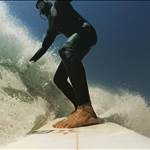
Catch them by turning in front of them or overtake them from the back? Or both?
Any tips on breaching? I seem to be doing a lot of that when the wave gets steeper and seemingly randomly. I can't seem to judge where to slot myself. So much easier on a regular surfboard to feel where the power is. Everything looks so much flatter from mast height.
For reference, I mostly get wind swell. Mostly when we have groundswell coming our way, the winds are straight off-shore.
Its hard to give specific advice on how to catch a wave because it depends so much on the wind direction vs wave direction. Usually I'm sheeting in to get some speed up, then luffing as soon as I have speed to match the wave (but before I've actually caught it). That might mean coming at the wave from the side, coming at the wave and then turning, or (less often) coming at the wave from behind. Usually on more gradual swell I'm aiming to stall close to the peak (staying on foil), pick my line, then drop. The strategy can be much different in punchier waves.
Except when the waves are very weak, I never have any real power in the wing while Im on the wave. That might mean fully luffing from the leading edge handle, or it might mean "half-luffing" from the front strut handle (without power in the wing). This also depends on the wind vs wave direction.
As far as breaching, its just a matter of practice. Its always most efficient to ride high on the mast, but the tradeoff is breaches are more common. When the wave is predictable you can generally ride pretty high, but if the waves are more choppy, or pitchy, then ride lower on the mast to give a better margin of error. With time, you will start to figure out when a wave is getting ready to pitch or speed up, at which point you can add more front foot pressure, lower down on the mast and prepare for the acceleration (happens quickly, but its generally predictable with experience). Play around with mast position in these conditions as well. If you are overfoiling all the time, you might just be on a foil that doesn't match the conditions (too big or lifty).
You didn't ask this, but most importantly, work the face and avoid the troughs.
When going over the wave I am just bringing the wing and my weight forward a bit and point the wing downward, which helps to pull the nose of the board down. There's an example of doing this at 01:36
I try and turn with as much speed as possible then flag as I turn sideways onto the wave.
also try and ride the face as sideways as possible. If you go straight down it beaching can more easily happen.
The breaching on dropping into a wave challenge is the area where gear has made the most obvious difference for me. Unfortunately, it basically boils down to getting good enough to ride a more pitch unstable setup with higher stall speed - thinner, smaller area front wings and smaller, flatter stabs, in order of how I progressed my gear (and thus riding skill).
I've gone back to my big thick beginner wing and even with a much smaller, higher performance, stab I still couldn't keep it down on steeper waves so it isn't just me progressing in skill. Likewise the small, thin, main foil - it remained a bit sketchy in steep chest high and up waves until I went to a much smaller and lower drag stab.
I'll add. once on a wave there are endless nuances to keeping speed (way you hold the wing, section you target, when where and how you pump your board). Arguably, the best advice is "keep practicing" and see if others who are riding like you want to at your site can tell you their formula. You will get there if you just stick to it and keep an open mind to trying new things when you're stuck.
For me, sup foil and surf foil came before winging, so the dropping in feel was already there. So that's one suggestion if you have the possibility: try one or both option for non-wind wave riding, then you'll get the feeling of dropping in dialed. Similar to surfing or skateboarding, it's about committing with front foot pressure, then quickly finding the balance point as the speed increases.
Early days winging were with massive thick front wings -- which got up on foil easily and stayed there with minimal stall speed. But at the cost of explosive wipeouts from breaching when gaining speed on bigger waves. You can try to manage this over-power by using a smaller hand wing and by really focusing on more front foot pressure, but as noted above, ultimately you probably need to use a smaller front foil (particularly if you're on a thick wide lower aspect wing)....which trades off ease at the low-end for better performance at the high-end.
Not sure where you're at in the learning progression, but a general tip is to spend as much time as possible gliding downwind with the wing luffed, no power from it. With speed, you will overtake swells, get used to feeling of dropping in. Turn down the line and glide on them a ways. You'll find it's quite a bit like surfing, in finding the sweet spot where you gain the wave's power -- vs no power in the flats or too much power closer to lip. You'll also start to get a feel where adding a little pump can help get some additional oomph, to maybe connect to the wind swell bump behind. [but resist the urge to constantly pump when luffed....style violation...embrace the glide, that's what this is all about!]
These are great tips. Thanks everyone. My first big takeaway is "you probably need to use a smaller front foil".
I am on a 1800 HA. I'm going to get a 1200 MA - or should I go lower? Waist high waves at the moment.
I'll work on all the nuances you all have mentioned after I solve this gear problem.
Reviving this thread as it addresses a current challenge...beginner on flat water trying to ride the occasional boat wake...watched lots of videos and understand a number of the basic ideas (in my head only)...but man, every time I get set up and approach a set of wakes, I end up breaching or just getting tossed around and losing control. Even trying to ride down the line as if I'm surfing, my steering just seems to suck and find it difficult to control my position.
Been doing this on a Sabfoil Leviathan 1150 I just got to work on learning to pump, and I'm thinking all that lift is a bit much for my 63kg to handle (at least at this point). Just want to confirm that line of thinking and get any other pointers and handling first encounters with (even small) waves...
Any idea how fast the boats that make your waves are traveling? If they are going relatively fast, your foil may be too slow, since waves are traveling at close to boat speed (82% of it, according to one source). Your foil is quite big for your weight, so chances are you're typically moving around at close to 10 knots, or perhaps even lower, unless you're using waves from big boats that move relatively slowly.
Select to expand quoteboardsurfr said..
Any idea how fast the boats that make your waves are traveling? If they are going relatively fast, your foil may be too slow, since waves are traveling at close to boat speed (82% of it, according to one source). Your foil is quite big for your weight, so chances are you're typically moving around at close to 10 knots, or perhaps even lower, unless you're using waves from big boats that move relatively slowly.
That's a helpful thought - might be best to pass on the faster ones...it varies a lot, but most are pretty slow since is is right by the boat launch ramp...