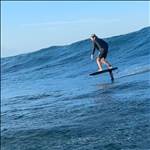
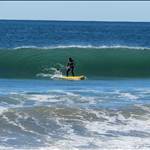
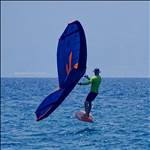
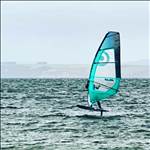
I've had my first sessions on a super light, airinside board - 3.7 kg, 72 liters, 4'11. The experience has been very positive. The board feels more precise, stiffer, and lighter to ride than my previous 4.0 kg, 47L, Gong Lethal prone foil board.
My second board for lighter wind days has been an 80L, 6.4 kg XPS Takoon Glide. But now I'm starting to wonder - do I even need two boards anymore?
The bigger Airinside Superfly 84L is also supposedly under 4 kg, so it probably would've worked well for me too, especially in even lighter conditions.
Some questions that come to mind:
Could a relatively expensive, ultra-light board actually be the most cost-effective solution in the long run? Is there really any benefit in a slightly shorter sinker board (in wave riding, for example) if it's still heavy?
Also interesting is the upcoming Starboard HOLLOW Foil Board - Ace Foil ZERO, and the potential for smaller boards using the same tech. Surely other board manufacturers are also eagerly working on new constructions, materials, and high-tech solutions.
Here are my first impressions of the Airinside Superfly 72L.
Weight is only one benefit of a smaller board. Smaller volume boards can be more stable in chaotic surface conditions. They can also be easier to paddle through (or under) breaking waves.
I think lighter is almost always better, although I know some riders feel that a heavier board has better drive (probably only relevant for speed) and can feel more stable in huge wave conditions. Those are exceptions though and lower swing weight will benefit most riders.
I understand one of the benefits of these airinside boards is that if you ding them the core can't retain any water. So you just drain any water out through the ding and then slap a patch on. dings are more of an issue with cores that can trap moisture. If you have a big break though you are sunk (literally)!
I have a two year old 6 3 x 21 x 95l Ben Tardrew custom that is 4.7kg and still going strong. Light is good.


Very cool, love seeing the equipment developing!
The honeycomb design looks really cool, I wonder what the actual manufacturing costs are vs foam. Are they making just as good of a profit or are they stuck with tight margins?
I don't jump but the tracks for inserts looks like a great idea. I get all my boards without inserts to save weight so, perhaps a freestyler could comment on that.
For your questions:
"Could a relatively expensive, ultra-light board actually be the most cost-effective solution in the long run? Is there really any benefit in a slightly shorter sinker board (in wave riding, for example) if it's still heavy?"
I think this comes down to durability. If the board is able to hold up and stay stiff for maybe 10,000km I'd say there's no question it's worth the investment. As far as shorter vs heavy: I think it's pretty subjective. Shorter and lighter definitely matters, but width, thickness, stiffness matter as well. For me, tiny ultralight boards are awesome with bigger foils. With smaller foils I don't mind a little more weight and length to chill the foil out a bit. So, it all comes down to the user, their quiver, and their style I think?
Select to expand quoteBob_along said..
OK, I've gotta ask - what happens if you get a hole in it?
Here's the answer
Now an Airinside board with a hatch fitted so that you could pack your foil and wing inside to travel, that's an idea :)
Seriously the boards look great and I am very impressed with the nomex honeycomb construction.
A totally hollow board is going to be much more repairable than EPS, provided you can get a hand inside to lay the repair laminate(but there's ways around this even). Any board that doesn't come with a hatch(for storing sandwiches, etc) will need one for repair etc. Sure beats drying out EPS. This is nothing new, boats, including high performance carbon racing sailboats, are all made like this.