Usually I don,t ask about the performances of other guys girlfriends, but how is she?
Select to expand quoteJeroensurf said..
Usually I don,t ask about the performances of other guys girlfriends, but how is she?
Best ride ever... hahaha
How is that board for taking off in light wind? It seems like the huge step would create a lot of drag in displacement mode.
One expert in another forum claims the tail is going to "sink like a rock" when shlogging. Can you confirm or deny this claim? Do you need to reset your feet due to the "radically biased volume distribution to the front"?
It seems to me that KT is innovative and has a team of highly skilled test riders. It's unlikely they would release such a radical design without extensive testing.
My feeling is that this design is heavily weighted towards not lurching on high speed touchdowns on big waves - I read something somewhere that that is what Kai Lenny was after . So the design makes sense from this perspective, given that he foils massive Hawaiian waves . What doesn't make sense is claiming easy foil-up in light winging conditions - in this respect the full tail/ sharp release designs that are currently so prevalent make more sense to me, esp with the latest HA foil wings. The Ginxu is diametrically opposite to this in its design philosophy, so either there is some voodoo going on or they have traded off early foil-up for the undoubted benefits of smoother touchdowns. I'm happy to be proven wrong of course !!
Select to expand quoteradair said..
One expert in another forum claims the tail is going to "sink like a rock" when shlogging. Can you confirm or deny this claim? Do you need to reset your feet due to the "radically biased volume distribution to the front"?
It seems to me that KT is innovative and has a team of highly skilled test riders. It's unlikely they would release such a radical design without extensive testing.
Different boards have vastly different volume distribution and for sure the Ginxu does not behave exactly as some other shapes that have lots of volume in the back, and lots of volume in the corners of the board. I have used Ginxu 54 L and did not find any issues with the tail sinking too much.
That said, even my Quatro Wing Drifter 80 L sinks quite a bit under me when shlogging (I am 72 kg + a thick 6/5/4 wetsuit and boots and everything). All it takes is to step forward a bit with a back leg while shlogging, and as soon as there is some speed the board levels up nicely. I could set up my stance differently on this board - to stand a little bit further forward, or to use a bit narrower stance, but I find that the way I currently have it makes the most sense to me. The stance is quite wide, almost precisely the same I have on my wave windsurf boards.
To recap, when standing still and putting both feet in the straps the tail of my board would sink. But as soon as there is power in the wing, so it starts making sense to get going, I can put my back leg in the strap and by that time the board starts moving a bit and the tail sinking is no longer an issue. The feeling with the Ginxu was pretty similar.
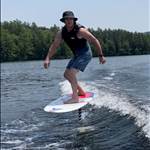
Here's a picture and a video clip:

Select to expand quoteTaavi said..
Different boards have vastly different volume distribution and for sure the Ginxu does not behave exactly as some other shapes that have lots of volume in the back, and lots of volume in the corners of the board. I have used Ginxu 54 L and did not find any issues with the tail sinking too much.
So how does the the Ginxu feel when you are trying to get it going in lighter stuff? I can see that if there is enough wind the step would clear and it would get up on foil pretty easily, its the drag of the step when the wind is really borderline that concerns me.
I played around with stepped boards a lot in the early days of windsurfing and they had some real advantages and some real disadvantages, feeling like you were glued to the water in lighter conditions being one of them.
My stepped board under construction for the 1980 Weymouth Speed Trials shown below, a lot of similarities to the step design of the Ginxu:

Tucker is riding one of these boards at the 4:25 mark of this video -- maybe he'll do a review of the board:
Waiting on Tucker's review!!! Matt seemed to be riding better with it, but he wanted to point out how unstable it was. I am looking for a mid size board. Something between my 39L and 90L. I weigh about 188. Once tried the Takuma TK 75L and. thought it was super stable. I fell like my 90L is too big in the surf. Thinking a board for 18+
I've been discussing this with a few people here on Maui, some of whom are using this as a sinker and others as a just-enough-volume-to-float-er. IMO, I think it's intended to be used as a sinker. The extra volume in the nose does (and probably, should) help to get going when balancing the board beneath the surface. I spoke to one guy who got a custom 75L Ginxu (5'0"x26"x4.25"). I use the Armstrong FG 75L and he was saying that the volume distribution when compared to the FG 75L makes knee starts very difficult, that the board feels a lot smaller than it is. He and I both weigh about 82kg. The rider does feel more connected to the foil but in a way that takes some getting used to-Kai Lenny and other KT riders probably had no issue with adjusting but they can probably shred on a dinner plate, as one rider said to me.
Select to expand quoteNicoDC said..
SPOT ON
Sorry I haven't got back sooner for a view.
Wanted to give it a good go and not get caught up in the hype.
Few things I would like to add is I'm 95Kg and the 5'0 at 82L is fine.
I can float it in fine when the wind drops off.
Knee starts are more forward on the board and once you find the sweet spot all is good
Board is very responsive and it feels like you are running a smaller foil underneath than it actually is.
Love it
Finally a windy day, and my first ride with the Ginxu 32, using Sabfoil w699/s370. I like it!
Select to expand quotePacey said..Taavi said..
Different boards have vastly different volume distribution and for sure the Ginxu does not behave exactly as some other shapes that have lots of volume in the back, and lots of volume in the corners of the board. I have used Ginxu 54 L and did not find any issues with the tail sinking too much.
So how does the the Ginxu feel when you are trying to get it going in lighter stuff? I can see that if there is enough wind the step would clear and it would get up on foil pretty easily, its the drag of the step when the wind is really borderline that concerns me.
I played around with stepped boards a lot in the early days of windsurfing and they had some real advantages and some real disadvantages, feeling like you were glued to the water in lighter conditions being one of them.
My stepped board under construction for the 1980 Weymouth Speed Trials shown below, a lot of similarities to the step design of the Ginxu:
At first I thought this picture was with the board upside down and you were doing cutouts in the 80s, then I figured it out. That is an impressive step. Tell us more about how the board was!