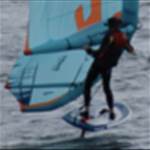
I couldn't believe it when I found this footage and wanted to share it with the community. It's a surprisingly decent capture of the phenomena of hydrofoil ventilation, cavitation, and its consequences.
No injuries were sustained.
Hope you enjoy!
-Stuart
I did something similar 3 years ago when I chopped by HS1250 to see how it performed:
Select to expand quoteMark _australia said..
Ventilation. Not cavitation I imagine 
Pretty normal to see cavitation on foils once you hit 60 knots. you need to up your game Mark
Select to expand quoteCH3MTR4IL5 said..Mark _australia said..
Ventilation. Not cavitation I imagine
Pretty normal to see cavitation on foils once you hit 60 knots. you need to up your game Mark
Definitely ventilation. Who's hitting 60knots?
What's happening? Is air creeping down mast, foil or dtab breaking surface, what?
Ventilation, you see the left tip breaching and sucking air.
Definitely NOT cavitation.
Cavitation is very limited in scope, and the shock of the water re-connecting to the foil surface would have made a a loud bang, and would have probably damaged the surface. See (and hear) at 14'40"
Select to expand quoteSubsonic said..CH3MTR4IL5 said..Mark _australia said..
Ventilation. Not cavitation I imagine
Pretty normal to see cavitation on foils once you hit 60 knots. you need to up your game Mark
Definitely ventilation. Who's hitting 60knots?
joke over your head 
Select to expand quoteBoardMaverick said..
I couldn't believe it when I found this footage and wanted to share it with the community. It's a surprisingly decent capture of the phenomena of hydrofoil ventilation, cavitation, and its consequences.
No injuries were sustained.
Hope you enjoy!
-Stuart
Bernoulli and Newton were definitely working. Just not in the way you desired. 
- your chatty parking lot friend 
Here's one where I ventilated and you can watch the bubble hang onto the foil for quite some time before it sheds. sorry not letting me imbed the video
photos.app.goo.gl/jVpgRptctCvJ86VM8
Select to expand quotecolas said..
Ventilation, you see the left tip breaching and sucking air.
Definitely NOT cavitation.
Cavitation is very limited in scope, and the shock of the water re-connecting to the foil surface would have made a a loud bang, and would have probably damaged the surface. See (and hear) at 14'40"
"The bubble implosion generates a high amplitude
pressure shockwave and a microjet. In a cavitation cloud, this shock-
wave destabilises surrounding cavitation bubbles, thus creating a bubble
implosion wave."
discovery.dundee.ac.uk/ws/portalfiles/portal/118858024/1-s2.0-S0043164824000656-main.pdf
Thanks a bunch for sharing that cavitation video! I really enjoyed watching it and learned a lot about the phenomenon. I agree that my video doesn't show cavitation (water turning into vapor because of changes in pressure). My foil isn't going faster than 60 kts!
I think what we're observing with my foil is an example of a "ventilated cavity" described in your video at 21:56, which resembles the turbulent effect of cavitation / water vapor, but is caused instead by the introduction of air.
What fascinates me is how the ventilated air is squeezed out from the trailing edge of the foil as an endless series of little bubbles. It's as though the air is trapped under the foil and only able to release a few bubbles at a time. Could this be explained by the relative pressures of air and water (surface pressure)?
Anyway, all this is to say - trim your foils, my friends!
Best,
-Stuart
Select to expand quotePaducah said..BoardMaverick said..
I couldn't believe it when I found this footage and wanted to share it with the community. It's a surprisingly decent capture of the phenomena of hydrofoil ventilation, cavitation, and its consequences.
No injuries were sustained.
Hope you enjoy!
-Stuart
Bernoulli and Newton were definitely working. Just not in the way you desired.
- your chatty parking lot friend
Paducah??
Aren't YOU suppose to be working!?
;)
Select to expand quoteVelocicraptor said..
Here's one where I ventilated and you can watch the bubble hang onto the foil for quite some time before it sheds. sorry not letting me imbed the video
photos.app.goo.gl/jVpgRptctCvJ86VM8
If I'm seeing this correctly, the ventilation appears to be continuously emitting bubbles all the while being stuck to the foil, and then somehow releases and is completely swept away in an instant. Very cool.
Here's an engineering challenge - invent an anti-ventilation feature (like anti-lock brakes) that shakes off ventilation bubbles when they appear ;)
Select to expand quoteBoardMaverick said..Velocicraptor said..
Here's one where I ventilated and you can watch the bubble hang onto the foil for quite some time before it sheds. sorry not letting me imbed the video
photos.app.goo.gl/jVpgRptctCvJ86VM8
If I'm seeing this correctly, the ventilation appears to be continuously emitting bubbles all the while being stuck to the foil, and then somehow releases and is completely swept away in an instant. Very cool.
Here's an engineering challenge - invent an anti-ventilation feature (like anti-lock brakes) that shakes off ventilation bubbles when they appear ;)
Yea, its almost like the bubble hangs onto the foil until speed increases to a point where it sheds. I was just happy to ride out of it!
Select to expand quoteAUS220 said..Subsonic said..CH3MTR4IL5 said..Mark _australia said..
Ventilation. Not cavitation I imagine
Pretty normal to see cavitation on foils once you hit 60 knots. you need to up your game Mark
Definitely ventilation. Who's hitting 60knots?
joke over your head
Or below it.
sorry my bad. I didn't think wingfoilers knew 60knots was a thing.
Select to expand quoteBoardMaverick said..
Here's an engineering challenge - invent an anti-ventilation feature (like anti-lock brakes) that shakes off ventilation bubbles when they appear ;)
There are already ways to design foils to mitigate ventilation when breaching a tip.
For instance, look at the posts by "KDW" in forum.progressionproject.com/t/breach-performance-foil-tip-ventilation-and-recovery/1361/18
Select to expand quotecolas said..BoardMaverick said..
Here's an engineering challenge - invent an anti-ventilation feature (like anti-lock brakes) that shakes off ventilation bubbles when they appear ;)
There are already ways to design foils to mitigate ventilation when breaching a tip.
For instance, look at the posts by "KDW" in forum.progressionproject.com/t/breach-performance-foil-tip-ventilation-and-recovery/1361/18
Hey Colas,
Thanks again for another excellent reference; it's good knowing how wide spread and well-studied this phenomenon is.
The linked high-speed 400fps video capture by Yvonvite AXIS@youtube
Cool videos! In the video colas posted, the term cavitation is used both for bubbles formed from actual water vapor, and for bubbles formed when small air bubbles in the water expand in the low pressure region. The crash in Stuart's video clearly starts with ventilation at the front wing, with air getting sucked down from the surface when the tip breaches. But later in the under-water footage, there's no more air travel from the surface visible. Instead, the bubbles seem to travel along the fuselage, and seem to grow quickly, especially after the mast and the tail wing. This looks a lot like the growth of the larger bubbles in the "nucleation" part of the cavitation video. Looks like ventilation-induced cavitation to me .
Select to expand quoteMark _australia said..
Everything is new again haha
New craft, different people, same ole twaddle
Select to expand quoteboardsurfr said..
the bubbles seem to travel along the fuselage, and seem to grow quickly, especially after the mast and the tail wing.
This is also air sucked from the surface, along the mast. You can see how the mast has a problem as it creates such a big wake, redirected upwards meaning that air has been displacing the water to get down the mast.
100% Ventilation.
Note that this is how ventilation that plagued windsurfers in the 80s / 90s was eliminated, by designing fins and board tails to prevent creating a depression that could create a path for the air to go around the rails & hulls and onto the fin base.
Select to expand quotecolas said..
This is also air sucked from the surface, along the mast. You can see how the mast has a problem as it creates such a big wake, redirected upwards meaning that air has been displacing the water to get down the mast.
100% Ventilation.
Perhaps. But in this case, there's no evidence of that in the video. Here's a screen shot from the video (with slightly enhanced contrast): There are no bubble visible that travel down the most. There are still bubbles near the front wing, which may be from original ventilation event. There are more and/or larger bubbles further back, towards the stabilizer. It's possible that these bubble were pulled down when the stab got really close to the surface, which would make it "tail ventilation", not cavitation.
The comparison to the Axis tip breach movie is very interesting. In the Axis movie, I did not see any stab ventilation at all, and he seems to keep control after the tip breaches. With all the bubbles around the tail wing, it would loose lots of lift, leading to the nose dive and crash, as opposed to a slower descent from loosing only front wing lift.
Select to expand quoteMark _australia said..
Everything is new again haha
Just wait until you get older, and you get that feeling all the time . Although you're never sure if it's an "again" or not.