I'm looking at getting a new board, currently using the 95L Sky Wing I learnt on. Looking into a midlength because that seems to be good for what I like (swell riding, maybe parawing one day), and I want something more compact than a full DW board.
I understand the advantages of a longer + narrower board for pumping at takeoff, so I'm not asking about that.
What I want to understand is what effect (if any) a different board has on being able to pump better/further when I'm riding swell.
Naively, it seems like there should be barely any effect. The wing isn't touching the water, and it doesn't seem like there's a huge amount of wind resistance (compared to e.g. racing upwind). But I do see claims of "better glide" for midlengths, and I don't understand why that would be true.
But I tried a Smik Breeze (85L) and it did genuinely seem like I could glide and pump further on swell, so why is that?
If I'm only trying to optimise how well/long I can pump on swell, and I'm only looking at changing boards (happy with my 900cm^ glide 2.0 foil) what are the board variables I would focus on? weight? shape? stiffness (construction material)?
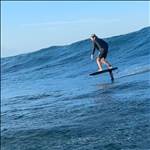
What kind of and how small swell you have, that you need to pump? Just make lots of turns and this keeps the speed up and keeps the foil happy and flying. Zero pumping here for example:
Select to expand quotetimbertson said..I would focus on? weight? shape? stiffness (construction material)?
yes
my experience has shown that the smaller the board i use, the better pump i get, and therefore the better glide. for example, my Cabrinha Swift midlength board at 6'2" 100L is harder to pump then my Appletree DW Prone 5'7" 57L board. But the Swift is obviously much easier to get up in light conditions. Smaller (and stiffer) boards are more responsive to your input, and therefore seem easier for pumping...at least, that how it works for me.
It depends on the weight distribution. The skywing has a relatively long nose and the boxes quite far back so its not a good pumper. A midlength with the boxes more centered and a more centered stance (equal length nose and tail) pumps easier because it is more balanced and has less inertia. In the end though, smaller (lighter) and more balanced boards will always pump better. Generally the 40-50L version of the same traditional shape board has a comparatively way smaller nose so is also a lot more balanced and simply lighter.
Honestly its hard to say which is the better pumper, not knowing what type or length of board you're opting for. I'd say generally the shorter midlength boards are probably the better pumpers, but if you're going into the 6'5"+ realm im not sure it would be better compared to your skywing.
> What kind of and how small swell you have, that you need to pump?
Port Phillip bay, so only windswell and smaller compared to ocean like you've got in the video there. People do downwinders here, but they're usually pumping a fair bit.
> Honestly its hard to say which is the better pumper, not knowing what type or length of board you're opting for
I'm looking for something that's still quite easy to get up on at 80KG, right now the main options I'm looking at are the smik breeze 6' and the duotone skybrid 5'8 (both 85L). Maybe there's not much in it between those two options, both are fairly well-balanced and similar overall size. I'm just trying to get a better understanding of what can make a difference.
Weight: Lighter pumps better.
Shape: Narrow pumps better (your energy input is in line with the mast)
Length: Shorter pumps better.
Stiffer pumps better.
Also...
Mast: Stiffer with carbon core and deeper chord pumps better.
Tail: UHA tails glide better, so you pump less.
Just don't forget that it's not all about the pump. You want to have fun with the board and be maneuverable for your style. The goal should be to get so good at positioning that you have minimal pumping.
I am guessing you mean better glide for mid lengths compared to wing boards and this is in some way true. The effect is more noticeable on a DW sup board where the board length seems to carry momentum when up and overing bumps. It defies logic but i feel its because the longer board makes you more pitch stable and interruptions to pitch cause loss of efficiency and you can feel it straight away when swapping between DW and midlength boards.
Less swing weight will make pumping less tiring and demanding so in that way it is making it easier but if you can pump one correctly you can pump the other.