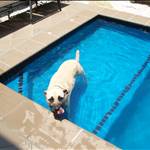
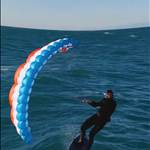
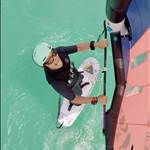
Got targeted pretty hard on Instagram for this. Looks like it will be pretty cool for foiling-
www.indiegogo.com/projects/hoverair-aqua-first-waterproof-self-flying-camera#/
Pay for something that you may never get. You can loose all your money. Better wait for review. CS doesn't seems good, what i heard from fb.
I'd wanna see the real world reviews about how it handles real wind ... wearing floaties is going to increase the wind interference..?
If dji haven't done it, I doubt anyone else can do it, specially with high wind resistance (battery consumption!) I hope this will trigger dji to make drone like this.
According to indiegogo.com, the drone has achieved production status and is expected to be delivered by December.
But honestly, why would you invest in a product that lacks reviews and firsthand experiences, especially when it has numerous flaws from the start?
- It doesn't have obstacle avoidance sensors, which means it could crash into anything nearby.
- There's no return to home (RTH) feature, making it difficult to safely land the drone on land , if you launched it from the water and are constantly on the move.
- The maximum flight time is 23 minutes under ideal conditions, which translates to about 15 minutes in real-world scenarios.
- What happens if the battery drains quickly and the drone lands automatically, unable to reach you/your beacon?
- While it has a waterproof body and sealed internal electronics, there's no mention of its resistance to saltwater or long-term durability.
- The cost is $299 for a care refresh or free replacement in case of damage.
My brother had a hoverAir x1 drone and when walking across a suspended bridge with the drone following him, it lost contact and control and fell in the the deep ravine. .. just like that.  He's now very happy with his DJI. Not the same concept but reliable
So good luck to whoever buys a hoverAir.
My other thought - having flown RC helicopters that are actually difficult lol - is the floaties means the structure and therefore CoG is above the props. this means there is no self-righting .. Rather, having the CoG above the props means it is naturally trying to roll in gusts. A normal drone with weight lower, is somewhat self-righting. Thus, it's using a lot of power to stabilise itself all the time. May be wrong. but it just looks real hard to make it stable for any floating drone?
This virtual tether is what was missing so far in any other application.Not being dependent on a visibility connection between drone and rider.I do have hope that this is a real leap forward.