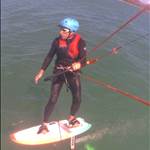
Hey any tips or tricks for getting through dumping shore break .on the wingboard.!!
Always keep your foil and wing seperate, opposite hands, opposite directions. If you don't have a bottom handle, you can hold the mast with the board under your arm. Always have the wing down wind of you.
Control he foil at all costs (never let go). As long as your holding the foil/mast/board in a good spot where you can control the foil, it won't hit you or the wing. If you get worried, ditch the wing only.
When you decide to go, go! don't fluff around. Obviously wait for a lull. But when you do go, make it fast, get deep enough, throw your wing (on leash) get on your board and paddle as quickly as possible to clear the shorey.
Once clear of the shorey, gather back your wing and prepare to go.
Always ride within your means and skill levels and remember a challenging launch normally also means a challenging return to shore too. Plan ahead and know how you're going to come in.
Ride safe,
JB
I'm still perfecting my technique but this is what has worked for me with no serious drama yet..up to head high, side shore on just cross on. (onshore find somewhere else)
A small board with a bottom handle is key and the front foot strap on.
Best to find a spot near the edge of a rip and drop in upwind but if not available then you have to smash out.
Fly your wing one handed on the upwind side with board on the downwind by the bottom handle and start walking out.
Once past knee depth put the board on its side and hold by the front foot strap and keep it square to the waves.
As a wave comes to you dive though the back holding your wing hand up clear of the wave and drag the board though by the strap.
Once you are deep enough quickly put the board upright get on and start sailing out sitting or kneeling, speed is key here. You can get over shoulder high broken waves in this mode if you have power.
As soon as you have a gap get to your feet and go.
I use the echo with boom which is easy to fly one handed I can even use it to pull me out while still lying in the water, not sure how handles would go with my method.
Also wear a helmet in case it goes wrong.
I have not gone out in waves yet but it does worry me :)
I will try this method, having the board downwind makes sense for a quick mount but is it very hard to keep the wing from flapping onto the foil tip?.
For coming in, same in reverse or do you dismount downwind of the board?
Thx!
Mcrt,
I've not had any issues contacting the foil holding the wing upwind but you must have complete control flagged into wind one handed. You must not let the wing contact the water.
With the board upwind side I've had a wave take the board and spin around straight into me due to the wind and current. If the same thing happens on the downwind side the board moved away from you.
As JB said though hold onto the board as hard as you can. In bigger waves where I've had to go deep with the board to survive I throw the wing up over the wave just as its about to hit. You need a long leash but so far that has worked a treat.
Coming in I pick a gap in the set and a smaller wave and ride it all the way to the beach with the foil high, jumping off upwind in knee deep water. (I run 85cm mast). You have to be quick again one hand controls the wing the other gabs the bottom handle and walk out. Don't try to dismount in deep water and go back though the shore dump that is asking for damage.
cheers KB7
Select to expand quoteKB7 said..
Mcrt,
I've not had any issues contacting the foil holding the wing upwind but you must have complete control flagged into wind one handed. You must not let the wing contact the water.
With the board upwind side I've had a wave take the board and spin around straight into me due to the wind and current. If the same thing happens on the downwind side the board moved away from you.
As JB said though hold onto the board as hard as you can. In bigger waves where I've had to go deep with the board to survive I throw the wing up over the wave just as its about to hit. You need a long leash but so far that has worked a treat.
Coming in I pick a gap in the set and a smaller wave and ride it all the way to the beach with the foil high, jumping off upwind in knee deep water. (I run 85cm mast). You have to be quick again one hand controls the wing the other gabs the bottom handle and walk out. Don't try to dismount in deep water and go back though the shore dump that is asking for damage.
cheers KB7
Good info,thx!
Interesting you hold your wing upwind of you. Maybe you have cleaner wind or more side shore than where I ride.
Be cautious in all accounts that often as a wave comes there will be less wind in your wing, and it will likely drop down or even change direction and pendulum.
If you choose the Wing upwind method, please please watch your wing on your foil. It can happen so quickly and takes such little contact to tear/cut even to the best of riders. I have personally not done it, but I have witnessed it many many times, and it is always from having the wing upwind of your foil and the wind blowing it into it.
In an instance as KB describes if you get spun, always just let go of the wing. The wing will go with the wave faster than you holding your board. It if all goes pear shaped you can ditch the wing (they're tough and will handle a small beating in the shorey, your foil wont).
Key points,
- Control your board/Foil at all costs.
- Be aware of where your wing is in relation to your foil at all times.
- If there's a safer entry point down or up the beach (like a wide rip or gulley) us it every time.
- Watch the sets, time the lulls.
I've seen a lot of wings get torn, so watch thing, wait and when you go, go!!!
Ride safe,
JB
Yes I'm at Wanda so have much better wind than you North Shore guys. Plus I only try to wingsurf in over 15 knots with a 5m Echo so I have reasonable power. Any less and I kite foil.
Thinking about what you have said and my learning process which used both methods. The reason the wing upwind works for me is because of the boom has so much control over the wing one handed even in gusty or zero wind.
I've only tried the Wasp with handles which was harder to control one handed, therefore I would agree it you are learning to go out in surf to start use JB method with the board upwind because you don't want to let the wing get anywhere near the foil.
I'm hoping as the sport develops the wings will be such that we can water start a wing like a windsurfer soon.
A couple of extra tips to add to JB list ,
-Before you walk into the water check your leashes are on correctly and not tangled or twisted.
-Put your wing leash on the arm that will hold the wing walking out. (important if you have to throw the rig up up over a bigger wave to get though)
-Use straight leashes not coil on the wing for extra throwing length. (see above)
-Fit a front foot strap so you have something solid to pull the board though the wave as you dive though.
-Never let the board/foil get between you and the wave.
Cheers KB7.