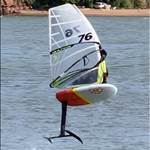
Hi Guys, I just bought a bigger Frontwing (1780 Phantom Carbon F-One), I am used to surf with a 1080 Fronting (also Phantom F-One) but I am going to some spots with really low wind so I bought the bigger Frontwing for those conditions. Now I was wondering if it is a problem that I have a 250 Stabilizer and a XXS Fuse. Can those work with the bigger frontwing? Or how do they affect each other? Thanks for your help!
In my case, when I use the small stabilizer with too big foil, it behaves fine when I go very slow but when I try to speed up, the nose wants to dive.
I don't know if this is a brand/model-related behaviour - in my case this was Gong Fluid XXL-T (1950 cm2 / 105 cm span) with Fluid M H stab (220 cm2 / 42 cm span). This stabilizer is a good match for my Fluid M H foil (1000 cm2 / 92 cm span) but it doesn't work with the bigger foil so I ordered a bigger stab for a bigger foil.
Select to expand quotekvek said..
In my case, when I use the small stabilizer with too big foil, it behaves fine when I go very slow but when I try to speed up, the nose wants to dive.
I don't know if this is a brand/model-related behaviour - in my case this was Gong Fluid XXL-T (1950 cm2 / 105 cm span) with Fluid M H stab (220 cm2 / 42 cm span). This stabilizer is a good match for my Fluid M H foil (1000 cm2 / 92 cm span) but it doesn't work with the bigger foil so I ordered a bigger stab for a bigger foil.
This makes some sense - but you can often remedy this by tuning more angle (lift) into the stabilizer with shims.
Select to expand quotekvek said..
In my case, when I use the small stabilizer with too big foil, it behaves fine when I go very slow but when I try to speed up, the nose wants to dive.
Does anyone know what causes this? I run the Naish 1240HA with a chopped down 280 stab and it does exactly the same at speed - the nose wants to dive. I'm reluctant to shim the stab as it will slow it down.
I tried it with a 220 stab and it did the same thing....
Select to expand quoteMilesH said..kvek said..
In my case, when I use the small stabilizer with too big foil, it behaves fine when I go very slow but when I try to speed up, the nose wants to dive.
Does anyone know what causes this? I run the Naish 1240HA with a chopped down 280 stab and it does exactly the same at speed - the nose wants to dive. I'm reluctant to shim the stab as it will slow it down.
I tried it with a 220 stab and it did the same thing....
freds'up from Gong mentioned on the Gong forum:
> A stabilizer will help with stability and lift, it will counteract the natural tendency of a front wing to dive, provided that the surfaces are balanced. Therefore, the stabilizer must be proportional to the front wing.
But I also wonder what is causing this behaviour. Shouldn't the front wing have a stronger tendency to go up when the speed increases (not to dive / go down)?
Select to expand quotekvek said..MilesH said..kvek said..
In my case, when I use the small stabilizer with too big foil, it behaves fine when I go very slow but when I try to speed up, the nose wants to dive.
Does anyone know what causes this? I run the Naish 1240HA with a chopped down 280 stab and it does exactly the same at speed - the nose wants to dive. I'm reluctant to shim the stab as it will slow it down.
I tried it with a 220 stab and it did the same thing....
freds'up from Gong mentioned on the Gong forum:
> A stabilizer will help with stability and lift, it will counteract the natural tendency of a front wing to dive, provided that the surfaces are balanced. Therefore, the stabilizer must be proportional to the front wing.
But I also wonder what is causing this behaviour. Shouldn't the front wing have a stronger tendency to go up when the speed increases (not to dive / go down)?
That's my take on it as well which is why I dont understand why it's happening. I'm not mismatching wing and stab and they are what Naish recommend?
Select to expand quoteMilesH said..kvek said..MilesH said..kvek said..
In my case, when I use the small stabilizer with too big foil, it behaves fine when I go very slow but when I try to speed up, the nose wants to dive.
Does anyone know what causes this? I run the Naish 1240HA with a chopped down 280 stab and it does exactly the same at speed - the nose wants to dive. I'm reluctant to shim the stab as it will slow it down.
I tried it with a 220 stab and it did the same thing....
freds'up from Gong mentioned on the Gong forum:
> A stabilizer will help with stability and lift, it will counteract the natural tendency of a front wing to dive, provided that the surfaces are balanced. Therefore, the stabilizer must be proportional to the front wing.
But I also wonder what is causing this behaviour. Shouldn't the front wing have a stronger tendency to go up when the speed increases (not to dive / go down)?
That's my take on it as well which is why I dont understand why it's happening. I'm not mismatching wing and stab and they are what Naish recommend?
I guess the issue is with the "chopped down 280 stab" - if it is chopped down it is smaller than recommended.
Select to expand quotekvek said..MilesH said..kvek said..MilesH said..kvek said..
In my case, when I use the small stabilizer with too big foil, it behaves fine when I go very slow but when I try to speed up, the nose wants to dive.
Does anyone know what causes this? I run the Naish 1240HA with a chopped down 280 stab and it does exactly the same at speed - the nose wants to dive. I'm reluctant to shim the stab as it will slow it down.
I tried it with a 220 stab and it did the same thing....
freds'up from Gong mentioned on the Gong forum:
> A stabilizer will help with stability and lift, it will counteract the natural tendency of a front wing to dive, provided that the surfaces are balanced. Therefore, the stabilizer must be proportional to the front wing.
But I also wonder what is causing this behaviour. Shouldn't the front wing have a stronger tendency to go up when the speed increases (not to dive / go down)?
That's my take on it as well which is why I dont understand why it's happening. I'm not mismatching wing and stab and they are what Naish recommend?
I guess the issue is with the "chopped down 280 stab" - if it is chopped down it is smaller than recommended.
It did the same thing before it was chopped - the chopping has made no difference (other than making it faster  )
)
There are three effects:
Drag from foil: NOSE DOWN, increases as square of speed
Lift from Stabiliser: NOSE UP, increases as square of speed, but also due to increased AoA on the stab, so a bigger effect at high speed than drag.
This should result in more NOSE UP at speed, however there is a further factor: Centre of Pressure.
The Centre of Pressure of the front foil (where the lift is coming from), moves backward at high speed. This results in more NOSE DOWN. But this is foil specific, some do it a lot, others not so much. The opposite is true as the foil stalls, which is why you get it rapidly pitching up just before you stall.
It is the interaction of these three that determine the Balance Point of the foil setup. Generally, Big stabilisers +long fuselages = NOSE UP at high speed, and Tiny stabs+fuses can mean NOSE DOWN at high speed.
250 is still a big stabiliser, so should be fine.
Select to expand quoteBritWinger said..
There are three effects:
Drag from foil: NOSE DOWN, increases as square of speed
Lift from Stabiliser: NOSE UP, increases as square of speed, but also due to increased AoA on the stab, so a bigger effect at high speed than drag.
This should result in more NOSE UP at speed, however there is a further factor: Centre of Pressure.
The Centre of Pressure of the front foil (where the lift is coming from), moves backward at high speed. This results in more NOSE DOWN. But this is foil specific, some do it a lot, others not so much. The opposite is true as the foil stalls, which is why you get it rapidly pitching up just before you stall.
It is the interaction of these three that determine the Balance Point of the foil setup. Generally, Big stabilisers +long fuselages = NOSE UP at high speed, and Tiny stabs+fuses can mean NOSE DOWN at high speed.
250 is still a big stabiliser, so should be fine.
That BritWinger that's a really useful post and a great explaination!
Select to expand quoteBritWinger said..
Drag from foil: NOSE DOWN, increases as square of speed
How does drag from the foil push the nose down? I thought that drag forces for foils are generally at a right angle to the lift.
Select to expand quoteBritWinger said..
There are three effects:
Drag from foil: NOSE DOWN, increases as square of speed
Lift from Stabiliser: NOSE UP, increases as square of speed, but also due to increased AoA on the stab, so a bigger effect at high speed than drag.
This should result in more NOSE UP at speed, however there is a further factor: Centre of Pressure.
The Centre of Pressure of the front foil (where the lift is coming from), moves backward at high speed. This results in more NOSE DOWN. But this is foil specific, some do it a lot, others not so much. The opposite is true as the foil stalls, which is why you get it rapidly pitching up just before you stall.
It is the interaction of these three that determine the Balance Point of the foil setup. Generally, Big stabilisers +long fuselages = NOSE UP at high speed, and Tiny stabs+fuses can mean NOSE DOWN at high speed.
250 is still a big stabiliser, so should be fine.
When you say NOSE UP and NOSE DOWN I assume you mean more front foot pressure versus more rear foot pressure - not actual movement of the nose up or down. If you are travelling in level flight at the same speed with same front wing its AoA should be practically identical regardless of fuse length or stab size.
I tune the stab angle/size to minimise front/rear foot balance changes across speeds from slow to fast. Your points about AoA influence on the stab and centre of pressure changes are interesting and perhaps the reason way you can't get perfectly stable front/rear foot pressure across all speeds.
Select to expand quoteboardsurfr said..BritWinger said..
Drag from foil: NOSE DOWN, increases as square of speed
How does drag from the foil push the nose down? I thought that drag forces for foils are generally at a right angle to the lift.
Drag acts directly backwards on the foil wings, fuselage and mast whereas the thrust from the rider holding the wing acts in the opposite direction but approximately 5 - 8 feet higher (i.e. height of mast and height at which wing is held above the board). This creates a rotational torque that tries to pull the nose down and has to be counteracted by rear foot pressure and/or downforce from the stab.
You can feel this effect as soon as a small piece of weed wraps around your foil increasing drag. You immediately need to increase your rear foot pressure to counteract the resulting torque and keep the board flying level.
Yep, NOSE UP as in more front foot pressure. Many people say "lift", but not differentiating two very different things: overall upward lift, and front foot pressure.
As SimonP says, you can really feel the drag NOSE DOWN effect when you collect weed.
You can try and keep the Balance Point of the foil setup as fixed as possible over a wide range of speeds, though it is not always easy.
For example, my Sabfoil w799 has a strong NOSE UP at high speed, yet with the same fuse/stab, the w730 doesn't. The w730 is a bit slower, so this limits the high speed NOSE UP from the stabiliser, but I think that the Centre of Pressure moves back a bit more at higher speed with the w730, but doesn't on the w799.
Strong NOSE UP at speed is great for jumping, but not for flying down steeper swell.
Select to expand quotesimonp65 said..
You can feel this effect as soon as a small piece of weed wraps around your foil increasing drag. You immediately need to increase your rear foot pressure to counteract the resulting torque and keep the board flying level.
Thanks, that's a useful explanation. I envision it like a balance of forces on a seesaw, where increased drag adds "weight" on the below-the-water side. Or as similar to hitting a stationary object in the water with the foil .
Select to expand quoteboardsurfr said..BritWinger said..
Drag from foil: NOSE DOWN, increases as square of speed
How does drag from the foil push the nose down? I thought that drag forces for foils are generally at a right angle to the lift.
Foils generate a lifting force (up) and a pitching moment (forward), the purpose of the tail is to counter balance the forward pitching moment.
Ideally a balanced setup with good front to back proportions will roughly provide an even foot pressure (pitching moment) across a wide range of useful speeds.
A small tail with more angle of attack can be setup to balance, likewise a larger tail with less angle can achieve a similar result.
A small tail on a longer fuse can be setup to balance similar to a larger or more aggressive tail angle on a short fuse.
A longer fuse provides more stability in pitch at the expense of a wider turning radius.
The wider span the tail gets, the more stability in roll axis. This can be good or bad be depending on what you are trying to achieve.
 @Britwinger, haha sooo true about the foil suddenly pitching up before stall - this happens so brutally on the GF M200 (big fat old school foil) and I used think I just really sucked when losing speed into the gybe, but better to understand the physics than to fight them, I managed to tune it out somewhat with a small negative shim, giving me more nose down which I can ride out at speed with more back foot pressure, also made pumping more effective with the back foot rather than just the front foot, OP may want to try shimming the mast as a tuning option if other options don't give the desired result
As Ju-foil said. If it wasn't held horizontal by the fuse, mast, board and you the front foil would nose dive due to high pressure underneath near the trailing edge. The stab is matched to counteract the nose diving torque.