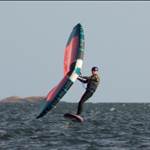
I'm using a Takuma Helium, 110 liter Tabou Magic Carpet and Slick 5.0. I have close to 30 foiling sessions on the wing and some prior windfoiling experience + over 40 years of windsurfing experience.
One of my goals is to be able to use this gear in what I consider light winds (average 10 knots, gusting to 12 knots would be good enough) and I think in just the past week, I have made a lot of progress. However, I don't think it's all due to improved technique though, although that does play a part. In the past few days, I have been experimenting moving the foil mast back a bit on the tracks and it's now actually closer to the back of the tracks than the front. To my surprise, I found that the board seems much more eager to release from water and get up on foil when I'm pumping.
I'm not exactly sure how to explain it though...obviously there's less wetted surface behind the foil mast, but I'm not sure if that matters. Assuming I'm standing further back, I guess it could mean that I'm able to sink the back of the board more easily and I think that's where the improvement is coming from (I weigh 70kg). It's also possible that I'm getting more drive from the mast itself (as if it was a large windsurfing fin). Whatever it is, I think it's working for me.
The KD Maui method for mast placement focuses entirely on the center of mass of the board and foil, which seems to matter when carving turns while foiling. I'm not at a stage where that would matter at all, so for me, making the foil work in marginal conditions outweighs pretty much everything else.
Everyone says mast forward gives you more lift, but that's really relative to your feet, so when you are sailing strapless, I don't think it matters...you find the a balaned position for your feet relative to the foil. That's why I was mostly sailing with the mast forward on the track, thinking it would help me lift off earlier. Now I think it may have been holding me back a bit.
I sometimes feel like I'm pushing the nose down into the water if I move the mast too far forward and thereby slowing the board down again at the end of the pump, dont know if that sounds familiar?
Still I run the mast fairly far forward, its a matter of mms to max 1cm of trimrange for me, depending on conditions, but mostly on which wing i'm riding (Swing V2 offers more downforce than the Strike hence I run the mast further forward with the Swing, if I dont my jibes and tacks are all off). Ofcourse mast position is also very much kit dependent.
Also talking strapless by the way!
Agree that the more/less lift is less useful without straps (my case also). Also raising the board by the foil was not useful for me.
I just started at the front and kept moving back until the board felt balanced on the water. I found a great spot both for the sideways balance, when hit by the chop, and the front back when pumping, as the earlier poster said. After many sessions (over 5) at some point my back foot just clicked. The forward foot is more forgiving, in my experience.
In my final setup the mast foot in 1inch from the back, depends on the foil and board manufacturers.
I suppose like everything their is an optimal mast position that allows early foil lift (further back) but too far back without speed you will do the dreaded dolphin. Too far back you will comprimise turn ability, pumpability, have more swing weight at the front relarive to feet and also produce leg burn especially if wave riding keeping that nose up.
really depends on a lot of factors hey.
The Kd method is great for finding your boards center of balance with foil lift. That way the board is neither weighted forward nor aft on foil, and you can then fine tune for what works. Foils lift the same whether in the rear or full forward, the difference is where you need to stand to be balanced. Full forward on a long windwing board will make the board feel shorter on foil and thus smoother, but on a shorter board or while using foot straps, it's just a matter of finding the correct balance. Ideally, winging, you want your slog position to be very close to your flying position. This hopefully is the same point as the Kd method. The newer high aspect foils require less "dolphin" and more initial speed, so a board with a wide tail, no chine, and hard edges will make planing speed easier and the less wetted area may come in to play at lift off, but for a Helium and your long board and no straps, I'd keep it pretty far forward, but not as forward as say an Armstrong and that will start a whole new thread on mast to foil spacing and effect on lift while turning...
Well my son and i both set our mast position using the KD method (on our armstrong prone boards) and to be honest we both eventually had the mast moved much further forward. To the point the board is angled significantly up (ie mast needs to come back a fair way). But over a longer and bigger wing board maybe this works well.
Select to expand quoteHwy1North said..
The Kd method is great for finding your boards center of balance with foil lift. That way the board is neither weighted forward nor aft on foil, and you can then fine tune for what works. Foils lift the same whether in the rear or full forward, the difference is where you need to stand to be balanced. Full forward on a long windwing board will make the board feel shorter on foil and thus smoother, but on a shorter board or while using foot straps, it's just a matter of finding the correct balance. Ideally, winging, you want your slog position to be very close to your flying position. This hopefully is the same point as the Kd method. The newer high aspect foils require less "dolphin" and more initial speed, so a board with a wide tail, no chine, and hard edges will make planing speed easier and the less wetted area may come in to play at lift off, but for a Helium and your long board and no straps, I'd keep it pretty far forward, but not as forward as say an Armstrong and that will start a whole new thread on mast to foil spacing and effect on lift while turning...
+1!!
Manufacturers tried to simplify things by putting those +lift and -lift at the front and back of the foilboxes.Which is a well meant lie that kinda works but really does not and has everyone thoroughly confused :).
A given foil only gives more lift if you increase one or both of the following:
-Speed
-Angle of Attack
That's it.
(Getting nitpicky a bigger stab at a bigger downangle creates a downforce that substracts overall lift.But it is marginal.
The stab main effect is in foil drag, balance and how it reacts to speed changes.)
Select to expand quotemcrt said..
Manufacturers tried to simplify things by putting those +lift and -lift at the front and back of the foilboxes.Which is a well meant lie that kinda works but really does not and has everyone thoroughly confused :).
A given foil only gives more lift if you increase one or both of the following:
-Speed
-Angle of Attack
That's it.
(Getting nitpicky a bigger stab at a bigger downangle creates a downforce that substracts overall lift.But it is marginal.
The stab main effect is in foil drag, balance and how it reacts to speed changes.)
I wouldn't say they "lied" if you go back a few years... wingers, stop reading now... the first prone board I had was a John Amundson 5'6" with rocker through the tail and twin boxes. He (maybe first?) put the +/- and if you were paddling into a wave and found yourself getting launched on a powerful wave with the low aspect and high lift foils of a few years ago, then moving the mast back did reduce initial lift by changing the angle of attack in relation to the board while paddling as the rocker would lower or raise the angle as you moved the mast back or forward. Relevent to todays boards, which have nice flat rockers at mast tracks and parrallel to the deck, the only bennefit is the balance point. Getting launched, move it back so you have more weight forward when you pop up and unweight your board. I have a very flat rockered prone board and a Takuma foil that I now shim the front of the plate so that I have less angle of attack while paddling into waves and to allow for a higher nose while bottom turning. Works wonders. Without doing that, I can't pop up in time to control the lift. If I wing on the same board, I don't shim the mast as I can easily control the lift taking off, by the speed I am building with the hand wing. Same goes if winging in waves as I am already up and foiling so I don't need any angle of attack adjustments of the foil to the board, I can do that with my weight. I also don't see a lot of bennefit with shimming the tail winging, as then you are just adding drag, until you are spending a lot of your time riding waves with the hand wing by your side. Prone, it can really make a difference in feel, and balancing on a short prone board without a paddle or a wing to hang onto is a lot more difficult so minor changes can make some huge improvements. Then you buy a high aspect foil or a different brand and have to figure it all out again!
Kane DeWilde posted this video on light wind winging about 2 weeks ago. It just mentions placing the mast rather forward.