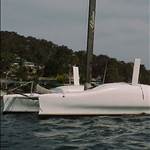
Looks like all of the America's cup teams will have bustles/skegs on their hulls to aid liftoff and touchdowns. Wondering if this would work on a foil board?
www.sailingworld.com/racing/hulls-of-the-modern-americas-cup/
Maybe the skinny DW'er boards can be looked at as being the bustle without having the upper flair? 
2 years ago the consensus was that fancy bottom shapes were pointless. For example, Fanatic went from a complex double- concave bottom to a flat slalom board rocker with hard rails. Now fancier bottom shapes are back in favour.
^^ Agreed
Neither the PPC nor Omen are anything like the massive rib under a America's Cup yacht. Further, they do it in AC so as to counter some of the hull design rules they are constrained by - not because it is 'best'. Can't see any way it is applicable to foil boards unless you're racing with continual touchdowns in turns
Measured the bottom planing surface of my 29" Smik and it's 20" wide, so I guess it's doing something similar. I'm certainly able to pop it up in fairly light wind. I'd still like to chop those 100mm wide bevels in half though so I'm less likely to catch a rail when I'm sending it

Sunova Carver has an aggressive chin. The width of the board is only 20"www.totalwing.com/wp-content/uploads/2023/11/sunova-carver-tom-poseidon-sports-12.png' />
Select to expand quoteTaeyeony said..
Sunova Carver has an aggressive chin. The width of the board is only 20"www.totalwing.com/wp-content/uploads/2023/11/sunova-carver-tom-poseidon-sports-12.png' />
Measure the widest part of the flat bottom of the Carver it is only about 13.5".
So when the board is moving the foil will gradually lift the board up so less waterplane area

Still nothing like the AC boats, nor the reasoning for it
Fair bit of 'coolest kid down the beach' stuff happening in winging unfortunately
It is the same concept. Reduce waterplane area while moving. For namal boat without foil you need planing to do the same but for hydrofoil watercraft you can do this to help take off.
We can't expect the board with only 4-6in thick to look like a boat hull.
Just look at a foiling International moth Hull and how it's developed over last 10 or so years. Getting foiling early is paramount to them winning.
Mike
Select to expand quoteTaeyeony said..
It is the same concept. Reduce waterplane area while moving. For namal boat without foil you need planing to do the same but for hydrofoil watercraft you can do this to help take off.
We can't expect the board with only 4-6in thick to look like a boat hull.
Its only that extreme on the AC yachts as it is the best way to win, given the design rules about width.
No such requirement in foiling
No ability to have multiple adjustments to foil and power source with crew members doing it ongoing when you're alone on the board
The original question is would this work in foiling. No. Less width on centreline yes of course but not like an AC boat that sorta has to be that extreme due to other rules.
I did this a couple of years ago with my 5'8" wing board, a narrow centre section flaring out to a greater beam at the rail. Worked really well, certainly better than any equivalent flat bottomed board I tried of similar dimensions. Amazing the number of people who told me at the time that complex bottom shapes were a waste of time and flat was best.
And yes Mark, it was inspired by the concepts from the most recent America's Cup, whose centre hull sections evolved specifically to minimise drag on takeoff and touchdowns.


So given that width it would need about a foot of rib thing hanging down to be analagous.....
No, all that is required is that when the board starts lifting a bit the side sections clear the water and reduce the wetted surface rapidly. Conceivably for a longer, narrower hull the centre portion could be rounder and deeper, so you get some beam and stability at rest but the hull shape rapidly sheds wetted surface area as it starts moving and the foil starts lifting.
Ripper board Pacey. Love the build.
But people are posting pics of wonderful new board bottoms that work. They are using them.
The question was in fact would this work:

That is pictured the article referred to. I say no, it wouldn't be useful in current winging boards..