I'm after advice on getting up on foil in choppy sea conditions with a HA1400 foil.
I was out the other day and it was gusty, maxed at some points underpowered at others. heading out into the swell I struggle to get on foil, a lot of rising up stall, fall. Did not feel like I could control the foil. When full powered I headed off down wind then soon as on foil carved back into wind, no pumping needed, talking seconds.
coming back in was so much easier, point, speed, foil.
Was a heavy swell running and gusty wind. On foil felt like I was been pushed around a bit.
question, what technique do ppl use to get up on foil with HA wings in challenging conditions. thanks In advance.
Don't think I have a 'technique' , but have found that my HA foil is excellent in 'smooth' water conditions, but becomes a handful when it's windy enough for the wavelets to line up into very short period waves. (25/30 Knot conditions in very large harbour area).
Turning down wind a little to start, the foil comes up easily and not as suddenly,
Turning up wind a little to start, the foil can come up faster than is comfortable to handle. unless you get your weight over the front foot quickly enough.
I'm starting to think it's a property of High Aspect ratio foils, that their Lift generation is very dependant on the speed of water flow over the foil, that might sound obvious!, but when riding into big 'chop, or small short period waves I can feel the foil pushing up more and more, then when turning across the chop, the Lift becomes steadier, then carving back into the wave, I have to watch out for that extra surge in Lift.
Two days ago, I tried the new Naish MA 1200 foil, back to back with my Naish HA 1240 foil, The MA foil was much smoother through the small waves/big chop, but took a little more wind/board speed to get up on foil.
High Aspect for me is great when it's flat, or I imagine, when it's smooth between 'proper' waves,
The problem comes from "bouncing" onto foil from the chop when you don't have enough forward speed to maintain flight. As you found out , going downwind will help.
Select to expand quotenimo1972 said..
The problem comes from "bouncing" onto foil from the chop when you don't have enough forward speed to maintain flight. As you found out , going downwind will help.
Agreed, it's all about board/foil speed. HA foils don't usually allow you to "ollie" onto foil like low to mid-aspect foils. Get board speed up, point slightly downwind for extra boost and gradually lift off. Then you can turn upwind and go.
Edited to add that current can play a huge role. Getting on foil while running against a current is SO much easier than going in the same direction as the current, as the apparent foil speed is so much higher. Just like an airplane taking off/landing against a headwind. Better to go against the flow, get up to speed, then jibe or tack to reverse direction. Diagonal or side currents can be tricky.
Select to expand quoteradair said..nimo1972 said..
The problem comes from "bouncing" onto foil from the chop when you don't have enough forward speed to maintain flight. As you found out , going downwind will help.
Agreed, it's all about board/foil speed. HA foils don't usually allow you to "ollie" onto foil like low to mid-aspect foils. Get board speed up, point slightly downwind for extra boost and gradually lift off. Then you can turn upwind and go.
Edited to add that current can play a huge role. Getting on foil while running against a current is SO much easier than going in the same direction as the current, as the apparent foil speed is so much higher. Just like an airplane taking off/landing against a headwind. Better to go against the flow, get up to speed, then jibe or tack to reverse direction. Diagonal or side currents can be tricky.
That's at odds with my experience, going into the swell it was tough. But it was gusty lumpy conditions. I found running with the swell was much smother getting on foil compared to fighting it going in to swell.
As said above I think it's a trait of HA foils, maybe better in flat water. I go to an inland reservoir where it's sooo much easier.
Select to expand quotejonysan said..
Don't think I have a 'technique' , but have found that my HA foil is excellent in 'smooth' water conditions, but becomes a handful when it's windy enough for the wavelets to line up into very short period waves. (25/30 Knot conditions in very large harbour area).
Turning down wind a little to start, the foil comes up easily and not as suddenly,
Turning up wind a little to start, the foil can come up faster than is comfortable to handle. unless you get your weight over the front foot quickly enough.
I'm starting to think it's a property of High Aspect ratio foils, that their Lift generation is very dependant on the speed of water flow over the foil, that might sound obvious!, but when riding into big 'chop, or small short period waves I can feel the foil pushing up more and more, then when turning across the chop, the Lift becomes steadier, then carving back into the wave, I have to watch out for that extra surge in Lift.
Two days ago, I tried the new Naish MA 1200 foil, back to back with my Naish HA 1240 foil, The MA foil was much smoother through the small waves/big chop, but took a little more wind/board speed to get up on foil.
High Aspect for me is great when it's flat, or I imagine, when it's smooth between 'proper' waves,
That sounds exactly the experience I have on the HA1400, it's a wrestle at times, flat water is so nice.
Are you going for a MA to cover those conditions when it does get a bit bumpy and lumpy with a lot of power in the swell. I'm thinking of getting something to cover those days.
Select to expand quotergmacca said..radair said..nimo1972 said..
The problem comes from "bouncing" onto foil from the chop when you don't have enough forward speed to maintain flight. As you found out , going downwind will help.
Agreed, it's all about board/foil speed. HA foils don't usually allow you to "ollie" onto foil like low to mid-aspect foils. Get board speed up, point slightly downwind for extra boost and gradually lift off. Then you can turn upwind and go.
Edited to add that current can play a huge role. Getting on foil while running against a current is SO much easier than going in the same direction as the current, as the apparent foil speed is so much higher. Just like an airplane taking off/landing against a headwind. Better to go against the flow, get up to speed, then jibe or tack to reverse direction. Diagonal or side currents can be tricky.
That's at odds with my experience, going into the swell it was tough. But it was gusty lumpy conditions. I found running with the swell was much smother getting on foil compared to fighting it going in to swell.
As said above I think it's a trait of HA foils, maybe better in flat water. I go to an inland reservoir where it's sooo much easier.
I don't mean swell when I say current. Current as in moving water like in a river mouth, not swell. Whether tide is incoming or outgoing can have a huge effect on how easy you get up on foil.
As you describe above, wind direction sounds like what is controlling. You need to be 90 degrees to the wind no matter which direction the swell is running. Then point slightly downwind to get a boost.
The bigger the HA in choppy seas, the harder they are to handle. Finding the right size for the conditions can help, but takeoff can be harder in some cases.
One tip is 'light feet' for the first 5 seconds or so of flight until you are really moving.
Select to expand quotergmacca said..jonysan said..
Don't think I have a 'technique' , but have found that my HA foil is excellent in 'smooth' water conditions, but becomes a handful when it's windy enough for the wavelets to line up into very short period waves. (25/30 Knot conditions in very large harbour area).
Turning down wind a little to start, the foil comes up easily and not as suddenly,
Turning up wind a little to start, the foil can come up faster than is comfortable to handle. unless you get your weight over the front foot quickly enough.
I'm starting to think it's a property of High Aspect ratio foils, that their Lift generation is very dependant on the speed of water flow over the foil, that might sound obvious!, but when riding into big 'chop, or small short period waves I can feel the foil pushing up more and more, then when turning across the chop, the Lift becomes steadier, then carving back into the wave, I have to watch out for that extra surge in Lift.
Two days ago, I tried the new Naish MA 1200 foil, back to back with my Naish HA 1240 foil, The MA foil was much smoother through the small waves/big chop, but took a little more wind/board speed to get up on foil.
High Aspect for me is great when it's flat, or I imagine, when it's smooth between 'proper' waves,
That sounds exactly the experience I have on the HA1400, it's a wrestle at times, flat water is so nice.
Are you going for a MA to cover those conditions when it does get a bit bumpy and lumpy with a lot of power in the swell. I'm thinking of getting something to cover those days.
The MA 1200 would work with my HA280 Stabiliser, and that's what I might get? From a test ride it seems to smooth out the 'porpoising' in chop that I get with the HA1240 foil, and it feels incredibly loose, easy to turn, and carve. also very solid/stable in a straight line. BUT. it definitely feels draggy and needs a couple more knots of wind to get on foil than the HA1240, so for marginal winds on the reservoir, I would still need to keep the HA1240 foil, as it gets on foil earlier. hope that makes sense!
I'm learning to ride my HA foil as well. Scooting and "micro-pumping" helps in getting up.
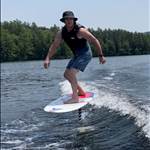
The same technique both with the higher aspect and mid aspect wings. First example is at sea, aspect ratio 7.6, the second one on a lake, aspect ratio 5.8. Just be gentle with the board, gather some speed first and start pumping the foil only once you have some board speed.