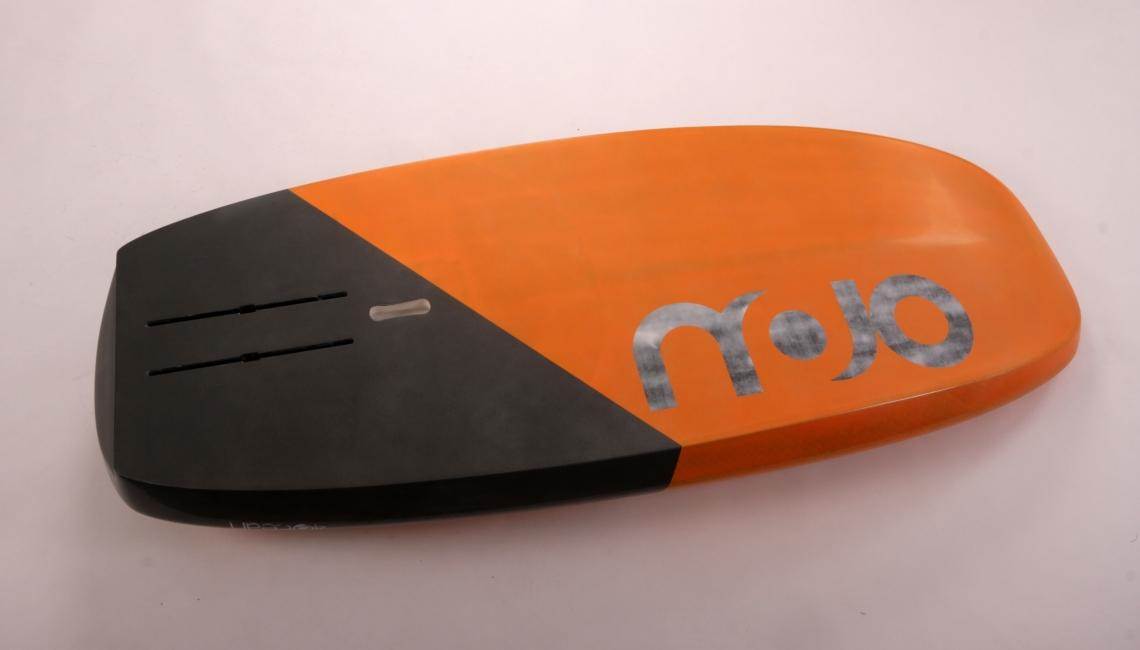
First off I'm about 78kg butt naked, and around 80Kg in a spring suit. So I just switched from what you might consider to be a traditional wing board design (FoilSurfMachine 5'1" x 26" x 90L) with beveled sides and a strong rear bevel for pumping up on foil, to a new smaller FoilSurfMachine board (4'9" x 24.5" x 75L) called the V4R (version 4 rocket) that is basically all straight edge (no bevel ) on the rear half of the board. It's intended to work with the new thin, high aspect speed foils that just don't pump like those early fat/slow foils. Paired up with my Veloce XL, I have to say that it's really impressive; 15L smaller than my tradional beveled shape board and it just builds planing speed quickly and pops me up on my Veloce foil faster than my bigger board. It's almost a strange feeling to come up on foil so quickly on a smaller board
I spoke to Matt Nuzzo briefly at Real Watersports the other day and he has word that Armstrong is also coming out more straight edge style wing boards to go with these fast high aspect foils........so maybe a trend....
A video of some flat water riding on my new board, and first sessions on the 4m Slick as well. I'm way too old (62) with bad knees to aspire to a strapped 20L sinker, but my feeble opinion is that these new smaller "knee start" boards work great for everyday wingers progressing to faster HA foils. Cheers!


Awesome riding
Love my bumble bee that has pretty straight rails and no bevel. 5 6 105l for my 105kg
My wife had a board custom built by one of the local shops. The shaper, who is a wing foiler, told us that the beveling and concaving actually creates more surface area on the bottom of the board, thus more suction that needed to be overcome. Made sense to us.
Select to expand quoteGoofcat said..
My wife had a board custom built by one of the local shops. The shaper, who is a wing foiler, told us that the beveling and concaving actually creates more surface area on the bottom of the board, thus more suction that needed to be overcome. Made sense to us.
Fully agree, we seen this cycle before.
I have Fanatic 95l and it's flat as, and almost no bevels.
Select to expand quotedejavu said..
DW has been there and done that:
Just in case anyone is confused, DW and FoilSurfMachines are one in the same. The board in the video is the exact model/size I just got. One other item that is unique about these FSM boards is the 100% Innegra vacuum bag construction. Innegra is amazing stuff (very stiff, lightweight and bomber durability) and Dwight is a master at using it.
Horses for courses....
Bevels gives more clearance when edging up wind harder. It is the whole purpose of having bevels
Concaves helps with touch down recoveries (arguably) and contribute to strengthen the board.
It is wayyyyyy easier to build a board without concave or bevels, so in theory they should be considerably cheaper too.
Not sure whether no bevels on the HA wing is gonna be a thing though. With greater wing span comes greater chances of breaching tips so in theory bevels should help keeping the wings under water. Probably not an issue for the conservatives riders but for the ones pushing toward the higher end of their HA wing, I reckon it would make a difference.
IMHO vertical sided rails are more stable than big bevels,so you can shape a narrower board with the same stability and turn clearance and gain better glide,water release and upwind slog behaviour.
Kalama,DW,Starboard,Fanatic and others are going that way.
There is an article on the Patrik site that talks about their formula foil board where they chopped the rails of their standard formula board to get it down to 91cm width using a power saw. Riders reckon the square rails stopped the board catching in touch down and releasing easily. I reckon especially for heavier riders low speed easy planing shapes could be tops. I'm in the process of building one that is crazy wide to test it out.
if you are lighter, riding in waves or in consistent good wind then your board design is going to function differently and be designed accordingly.
Was interesting to see Fanatic sky 5.4 in person .... slight V from in front on foil through the nose. Flat tail.
When you search it online, there are pics of really extreme double concave.


Select to expand quotejuandesooka said..
Was interesting to see Fanatic sky 5.4 in person .... slight V from in front on foil through the nose. Flat tail.
When you search it online, there are pics of really extreme double concave.
The 95L was the aberration ....... The smaller ones have extreme concaves and bevels, the bigger ones moderate concave, bevels and an upturned rear, but the 95L was essentially flat in the rear, almost no concave at the front, sharp rails (no bevels), square in the tale, but a decent amount of rocker.
I find the 95 releases from the water better than the 110. I would love the 95L shape at 120L (make it my light wind board).
Are there any thoughts on the Jp Australia x-winger 5'0 95liter and if it is a similar design geared towards the future of wing board design as well?
Still on topic but a slight jump to the left. Funny enough it seems from my research into surf foil
prone boards that the straight edge no bevel tail
is working best on them . to increase paddle speed - cause you still got To paddle into waves! I
was always wondering why my old crappy original Amos could paddle Better than some of the newer designs I got on and indeed even some larger wing boards I proned for sh1ts and giggles with big ass cut always, bevels and concave and all that jazz.
defintetly something in this design direction.
Select to expand quoteeppo said..
Still on topic but a slight jump to the left. Funny enough it seems from my research into surf foil
prone boards that the straight edge no bevel tail
is working best on them . to increase paddle speed - cause you still got To paddle into waves! I
...
The same reasoning is being applied to wing boards. No step. Slight ramp from the mast to a square edge tail.
The idea is that you get more speed on the surface and the tail presses the nose down a bit. If you bring the nose up too soon with not enough speed the foil stalls and stops.
My One foil SUP has a softer version of this design. It pumps up much better if I move my feet a tiny bit forward and don't try to force it up on the foil.
So what is the best rocker curve for this style of board? A long flat with a kick at the nose, or a progressive curve accelerating from the foil boxes forward?
Select to expand quoteGorgo said..eppo said..
Still on topic but a slight jump to the left. Funny enough it seems from my research into surf foil
prone boards that the straight edge no bevel tail
is working best on them . to increase paddle speed - cause you still got To paddle into waves! I
...
The same reasoning is being applied to wing boards. No step. Slight ramp from the mast to a square edge tail.
The idea is that you get more speed on the surface and the tail presses the nose down a bit. If you bring the nose up too soon with not enough speed the foil stalls and stops.
My One foil SUP has a softer version of this design. It pumps up much better if I move my feet a tiny bit forward and don't try to force it up on the foil.
Exactly my experience.
On my Naish 125 - it will rise to quick and stall for higher aspect foil wings without a lot of foot movement forward and back. . However, my 95l Fanatic (no tail bevel) is a nice smooth even rise up onto the foil with minimal foot adjustment.

You can pimp your Naish, i went almost all the way flat but i think that even a third of that with a straight edge release would ve very noticeable.Eva foam with contact glue.
I have a 105 liter 5'8 custom which follows the design features of the Fanatic Sky 5'4.
It'd worked perfect for pumping up my LA Moses 873 and i'm sure it will also support my new SS Phantasm 926 HA-Wing, which i could only use once so far, and which needs definitely more speed before liftoff, otherwise it stalls.
After about 30 sessions i'd never had a situation where i thought bevels and tailkick would help me in any way.



Select to expand quotePacey said..
So what is the best rocker curve for this style of board? A long flat with a kick at the nose, or a progressive curve accelerating from the foil boxes forward?
Pacey,
I can only speak for the FSM board I own. It is basically flat for the rear 2/3rds and the forward 1/3rd is devoted to nose scoop. That forward 1/3rd is also where the volume begins to taper rapidly. Because of that, I really would describe it more as nose scoop versus rocker. I also don't want to give the impression this board has no side bevel at all. It is modest at the nose, becomes very shallow by the midpoint of the boat and tapers to almost nothing at the rear. Sometimes hard to tell from pictures.
I should also point out that if I catch an edge really hard during an aggressive turn the hard corner extracts more of a penalty than a soft bevel, BUT, at least at my skill level, seriously dragging an edge during an aggressive turn means I've blown the turn either way, and won't keep it clean on foil regardless of whether the edge is beveled or not. In other words staying up on foil and not dragging an edge (hard or beveled) is key to a good clean turn where you remain up on foil the whole time, especially on tacks or something like a 360 where you need all the glide you can get. Just my feeble opinion


I have a PPC prototype with a bevel tail and an Armstrong HA 1550 V2. I reckon the bevel tail is promoting lift-off too early and the foil stalls. The foil needs a faster critical speed so I have to keep more weight on the front foot until that speed is reached. PPC told me when I bought the proto that the production version was unlikely to have the bevel.
I have come to the conclusion that board and foil design have to be coordinated, a board shape that works well for a low aspect foil won't necessarily be the best for high aspect.
semi-current state of the art here in San Francisco (this board is several months old). This is Johnny Heineken's self-made board w/ design/layup guidance from Mike Zajicek. Another guy, Ken Adgate, is also making boards under Mike's tutelage.
I think Ken's board have a lot more rocker, while Johnny's board has a long flat. Will have to take a closer look next time.
Also check out the FB vid below. rippin'
www.facebook.com/groups/261798468350180/permalink/513406916522666/

Having some experience with flat rocker short windsurf boards that were super efficient getting on plane, I have always thought flat rocker was the way to go for a foil board,. Faster board speed with flat rocker would mean less or minimal pumping to get on foil. Here's a pic of my new 5'3' 85 liter flat bottom straight rocker , normal nose rocker board by legendary shaper Dave Mel of Sailboards Maui.looking forward to seeing this finished..

Harro and I used our new boards in 20 to 30 knots wing downwinders on the weekend.
The hard rails and flat bottom really works, in getting up on the foil so quickly.
Also not catching a rail in cross chop was an added bonus.


These board designs raise a couple of interesting questions.
If flat, square boards with a bit of nose lift work well then it should be easy for local shapers to churn out good wing foil boards. Who needs mega complex concaves and vees and bevels when all you want to do is go wing foiling?
What exactly do the test riders for the bigger brands do? Which works better? Deep vee to concaves in the nose and a step after the mast to a sloping tail? Or a slab of foam with a pointy bit at the front? Whichever one you want boss.
Select to expand quoteGorgo said..
What exactly do the test riders for the bigger brands do? Which works better?
For the record, Gong has NINE different type of shapes for wing boards, with each its advantages and drawbacks, which depends on the rider level and type of practice. Some team riders tend to just use the same board all the time, some others use different boards for different conditions.
Hello,
Does anybody use a bit of positive rake on the wingboard shape? As on kitefoil race boards.
The rake is, if I am right, the angle between the nose of the board and the nose of the foil.
I was told that 1 or 2? of positive rake makes the position on the board (front foot higher) a bit more comfortable and allows for more front foot pressure (what I lack with my Axis HPS1050).
But does it affect the planning?
And, I assume that a positive rake makes you place the mast further back in the rails, correct?
Cheers
R?gis