Been ridding quad set up on windsurfer for near 3 years??? been using a quad as a surfboard for closer to 6??? so why the big difference between set ups ???
Rough rule of thumb???
Quad windsurfers and fin set up:
smaller fins up front (out near the rails)
bigger fins down back (in near stringer and tail)
Quad surfboard and fin set up:
bigger fins up front (out near the rails)
smaller fins down back (in near stringer and tail)
Could be totally wrong but it seems - surf quad bigger fins near rail for wave face grip and drive off the bottom
Windsurf quad bigger fins under straps for ease of planing - more pivot and bottom turn
local short board self shaper was surprised when he checked out my Starby 100 quad to see big fins at back
there was a video kicking by Goya kicking about where they explain the setup... I also remember reading a forum post on the Fanatic web site about this subject where both Seb Wenzel and one of the team riders chimed in with some answers. I'll see if I can find it again...
Can't remember the details though... I think I glazed over after 2 minutes into the video.
Select to expand quoterussh said..
Could be totally wrong but it seems - surf quad bigger fins near rail for wave face grip and drive off the bottom
Windsurf quad bigger fins under straps for ease of planing - more pivot and bottom turn
local short board self shaper was surprised when he checked out my Starby 100 quad to see big fins at back
If you remember the first Starboard Quads they had a more "surfboard style" setup with big front fins. As it turned out, those board, while quite nice, I think, also had some "difficultness" to them and Starboa since moveed to the standard big fin rear quad setups.
At Simmer (where I work) we use both setups but until now typically used big rear fins as standard. Personally, I almost exclusively use bigger front fins in my windsurfing boards though except for medium to big wave cross off conditions. I have developed all our boards from the ground up also to work with this setup. In particular this includes fine tuning toe of the front fins as well as some careful fin development.
In general, a big front fin setup like this is very different to other systems. For example, a 2x13front + 2x11 back quad setup is quite similar to a 2x13f+14r tri fin while both are very different to a 2x10f +2x14r standard windsurf quad setup. The latter is in turn far more similar to a 2x15 twin than it is to a big fin forward quad setup.
What typically happens with big fon forward systems is that they become far more responsive to rider input and changes in rider position. With so much fin power under your rear foot you get lots and lots of drive as long as you manage to put your "turning power" far enough in front of the fin. At the same time, when you "release" the board and let it pivot more over its rear rail, the boards becomes super loose. So you can get lots of drive around sections, but still extremely easy flick it vertical in the end of the bottom turn. In the top turn the setup also gives lots of grip while still allowing a really short carve (big fin, right under rear foot). The difference when moving between two small rear fins and a single (relatively) small rear fin is just like in surfing. The thruster setup is a bit more pivoty in the bottom turn when you load the rear foot up, while the quad feels a bit more carvy. In top turns such a thruster setup has a bit more release to it, while the quad has a tad more grip and again a more carvy feel. With both these setups, fin positioning is super critical and this is why I think they have not hit it mainstream yet. Toe in needs to be just right since this affects when in the bottom turn the powerful front fin will "turn on" so to say. This is why I also now work with more surf style front fins, that is asymmetricals, at times with some inside foil and also use a bit of splay in the,. But this is still proto stuff. The goal is being able to fine tune the compromise between a smooth and forgiving bottom turn entry on one side and bottom turn drive on the other side. For general sailing, the big fin forward is a little bit different since the board rund a bit flatter, but this you get used to and overall planing and upwind can be VERY good, while all out blasting control in choppy waters is typically a bit less impressing.
The standard windsurf quad with small front fins has it's root in the twin fin setup and when comparing between all possible fin setups it is by far the most similar to the twin. But the front fins adds a bit of grip and drives the rail a bit more into the water giving a a calmer ride. As it happened, many brands ended up making their early quad hulls quite low riding, so this effect got exaggerated. But with Simmer we made quite lively hulls and then used the slightly stabilizing effect of the front fins to our advantage. And it is my impression that several other brand have moved in this direction (ie livelier quad hulls). A standard quad setup like this also retains the rear foot pivotability that most people are used to in windsurfing, where you rely a bit on "pulling the sail" in the top turn. Control in a straightline can be pretty good too. So overall, in particular together with a livelier hull, I still hold this small fin forward standard quad setup quite highly. And overall, I kind of think each fin setup has it's good sides. This year has sort of been the return of the tri fin, but I still think we'll see more development the next few year and perhaps the big fin forward quad will be popularized again as a effect of more thruster setup development.
Select to expand quotedan berry said..
Surfboards don't plane and don't need to go straight line or upwind.
If you read many short board shapers design blurb they actually quote bottom shape and concave around ease of early planing on a short board.
They just dont plane in the windsurfing sense of the term.
Like Ola says, windsurf quads are generally much more comparable to a twinser than a quad in the surfboard sense. Surfboards quads have all the fins much more outboard and toe/cant and are great for going rail to rail but not so much for going in a straight line as they become unstable on flats. Windsurf quads tend to have much more inboard twinser setup with stabilisers for drive in a straight setup that also helps with straightline blasting back out stuff. So really current windsurf quads are their own thing and not the same as surfboard quads as we do different stuff :)
All 4 fins in my board are different sizes, but it doesnt matter when you shred as hard as I do.
I even put them in backwards sometimes, but that gets annoying because I end up inventing new moves without trying.
If anyone wants a new move named after them, PM me because I have a whole bunch of them in the backlog.
Select to expand quoteBoris said..
All 4 fins in my board are different sizes, but it doesnt matter when you shred as hard as I do.
I even put them in backwards sometimes, but that gets annoying because I end up inventing new moves without trying.
If anyone wants a new move named after them, PM me because I have a whole bunch of them in the backlog.
Ohhh Borrrrissss, you are a very unattractive man 
Select to expand quoterussh said...dan berry said..
Surfboards don't plane and don't need to go straight line or upwind.
If you read many short board shapers design blurb they actually quote bottom shape and concave around ease of early planing on a short board.
They just dont plane in the windsurfing sense of the term.
They may use the term "plane" but a surfboard doesn't technically plane due to the fact the are constant rocker, there isn't a flat section like a windsurf board on which it can skim on top of the water.
There are however "planing hull" surfboards that do plane (hence the name) but we are talking about standard short boards.
There is technically no difference between the planing a typical (short-) surfboard do on a wave and the planing a windsurfer do, either on a wave or when going straight. A windsurf board rocker is also in the big scheme of things rather similar to a surfboard rocker. In particular, none of my windsurfing boards, not even freeride boards, have fully flat sections (albeit some are close).
This was the answer I got from mark stone when I asked him why you can't have a wave board that feels exactly like a surfboard. Mark is one of the few shapers on the planet that makes both wave boards and surfboards at top level. I trust his knowledge and his answer made a lot of sense to me.
"It's not the size??? it's what you do with it"
Wouldn't you also say that surfboards are over finned when you compare the volume and size of a surfboard to a windsurf board.
or
Is it more to do with the Force and hows/where its applied through the board. ie riders foot strap position and mast track pressure.
This is what surfing would look like if surfboards did not plane.

And this is the planing version of the sport as we know it.

^^ I agree.
Water craft either operate in displacement or planning mode. Surfboards operate in displacement mode when paddled and they operate in planning mode when on the wave. If they were not planning on the wave they would sink.
The only difference between a sailboard and a surfboard in planning mode, is that a mast and sail are attached to the sailboard. When you attach a mast /sail to a surfboard it becomes a sailboard.
It would seem to me that the difference in fin configurations between a quad surfboard and quad sailboard can be explained by the addition of the mast / sail and the associated lateral forces.
Cut and past from mini Simms website
"It should come as no surprise that surfboards can be considered small, hulled vessels- like little boats or "hulls". From a hydrodynamics standpoint, nearly all popular surfboards should be sub-categorized as "displacement" hulls because of the ubiquitious presence of tail rocker. A board's rocker, or bottom curvature (when viewed from the side), is responsible for wave drag; the more curve, the more drag. While any hull will plane if enough power is provided, "displacemnt" hulls will never be as efficient as "planing" hulls because of this drag. Planing hulls eliminate drag via a rockerless (flat) tail section stretching from the wide point of the board to the tip of the tail. Ever wonder why retro fish feel so fast? It is because they have very little rocker compared to a shortboard. The mini-simmons is a further extension of this concept, where the goal is to eliminate tail rocker entirely. A rockerless hull will plane ultra-efficiently and enable the rider to approach waves in a unique way. Shortboards will mire and wink unless they are constantly positioned in the power center of the wave. By contrast, planing hulls will continue to plan even when they are, by comparison, far from the wave's power center. Sure, professional surfers will never compete on a planing hull- drag is a necessity if you're trying to get barreled... But for somone seeking a completely unique surfing experience, a planing hull is like entering another dimension."
That's pretty much a long winded version of the way mark explained it to me.
Ps we are talking about hpsb's not a towboard with foot straps being towed down in by a jetski at chopes.
I'd have that as pure marketing. Generally it is true that more rocker often give more drag, but it is complete BS to draw some kind of formal line between your standard short board and a Simms typ board and call the latter a planing hull and the former not.
It was the definition they gave of a planing hull and a displacement hull. Why do surfboard have a genres such as planing hull, modern planing hulls ( tomo) displacement hulls? Aren't these all different styles of rockers essentially?
Anyhoo onto more important thing ola. Was that you that shaped the stumpy simmer board? How does it go?
Ps the quoted definition wasn't from mini Simms site, it was from black fern surfboards. My mistake.
Select to expand quotedan berry said..
It was the definition they gave of a planing hull and a displacement hull. Why do surfboard have a genres such as planing hull, modern planing hulls ( tomo) displacement hulls? Aren't these all different styles of rockers essentially?
I think there is always a need to invent terminology to be able to name what you are doing in an attempt to separate it from what others are doing. Just saying you use a flatter rocker will not sound as revolutionary as saying you are using a "planing hull" while others are not. Generally speaking, I think the level of surboard shaping is head and shoulders above windsurf board shaping because it's a bigger sport with more god shapers. But, in most cases, it's driven by empirical results and good old testing and trial and error. Which is a good thing. But then, when theory is invented to try to explain why something works in a certain way, it does not always math up. This is not a big deal since I suppose most people will prefer a god board that comes with a bad theory than a bad board with a good theory...
I have never measured the rocker of a Tomo or Simms board. If you call it a different style of not will depend on what you mean with style. I suppose they are flatter in the tail and probably in the entry too, but even "standard" shortboards vary quite a lot. If you want to start to quantify how much different one rocker is to another, you need a much more precise theory, something like talking about curvatures and the distribution of curvature along the board.Select to expand quotedan berry said..
Anyhoo onto more important thing ola. Was that you that shaped the stumpy simmer board? How does it go?
Yes. WHen I started that project I was not aware of the "planing hulls" of surfing, but retrospectively I was driven by similar ideas. Typically on a windsurfer, you are standing quite far from the tail. To allow tight turning you need some tail rocker. In particular, if you want the board to carry speed through a tight turn, you will need the tail rocker because the tail will push water otherwise. But on the other hand, lots of tail rocker adds a lot of drag when going straight or in a bigger radius turn. So, basically, I removed the tail, or some of it. From a turning point of view this is almost like having an infinite tail rocker. But you loose drive for longer turns, so some other aspects of the shape has to be adjusted too. But basically, what you get is a board that can do a tighter turn and above all keeps so much speed though such a turn. Then this very compact boards also makes it easier to adjust between different types of turn, like a full rail carve or a turn with a bit of release.
It requires a bit of competence from the sailor just because it will react more to what the sailor is doing (ie weight placement). In slower waves you also need to drive the board a bit more actively, ie you can not just stand on the tail and expect if to go, you need to really work it and create the acceleration from pushing the board though the turn.
In a sense, it's more like a surfing shortboardSelect to expand quotedan berry said..
Ps the quoted definition wasn't from mini Simms site, it was from black fern surfboards. My mistake.
OK. Thanks for the info.
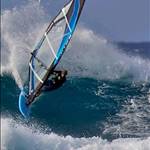
Here is the Frugal 88 with 5.0 and small waves and cold weather (but warm for Sweden in december). This is with 14cm front fins and 11 cm rear fins (all sym) but in the same session also used 2x10cm asyms with both a 17cm single rear as well as with some 13cm twin rear fins (in quad more).


photo Sven Swesley