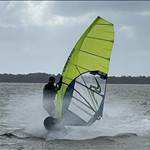
Sailworks are looking at several changes to the popular Flyer foiling sail range for the 2020 season. The existing Flyer range of 3.9m to 8.2m will likely not change geometrically, but they will introduce some lighter weight laminates for all sails in 2020, as well has some batten adjustments to tweak the draft profiles slightly more forward.
Two new sizes 8.5 and 9.5 will be added to the lineup for performance/competition foiling, they will be 6 batten/3 cam layouts like the yellow prototype seen here in testing:
Select to expand quoteWindsurfSystems said..
Sailworks are looking at several changes to the popular Flyer foiling sail range for the 2020 season. The existing Flyer range of 3.9m to 8.2m will likely not change geometrically, but they will introduce some lighter weight laminates for all sails in 2020, as well has some batten adjustments to tweak the draft profiles slightly more forward.
Two new sizes 8.5 and 9.5 will be added to the lineup for performance/competition foiling, they will be 6 batten/3 cam layouts like the yellow prototype seen here in testing:
We'll be stocking in the Flyer range for this season and look forward to seeing the new performance range by Christmas.
A 9.5 Flyer!? Wow! Light wind foiling for bigger guys!
Usually lighter weight, more low end, easier pumping, and softer feel.
Tried my ws Loft 5.8 3 cam the day after a 5.5 Hydra. Same 6-17 breezes.
Select to expand quoteMark _australia said..
So whats the difference with a sail for foiling?
Lot more leech tension, lighter weight.
Lot of race designs are now going for a square foot so the sail/mast is more upright (and the gap to the board is filled).
Select to expand quoteSubsonic said..Mark _australia said..
So whats the difference with a sail for foiling?
Lot more leech tension, lighter weight.
Lot of race designs are now going for a square foot so the sail/mast is more upright (and the gap to the board is filled).
Also worth pointing out that regular wavesails work perfectly for freeride/wave foiling 
Select to expand quoteazymuth said..Subsonic said..Mark _australia said..
So whats the difference with a sail for foiling?
Lot more leech tension, lighter weight.
Lot of race designs are now going for a square foot so the sail/mast is more upright (and the gap to the board is filled).
Also worth pointing out that regular wavesails work perfectly for freeride/wave foiling
That they do 
Select to expand quoteWindsurfSystems said..
Sailworks are looking at several changes to the popular Flyer foiling sail range for the 2020 season. The existing Flyer range of 3.9m to 8.2m will likely not change geometrically, but they will introduce some lighter weight laminates for all sails in 2020, as well has some batten adjustments to tweak the draft profiles slightly more forward.
Two new sizes 8.5 and 9.5 will be added to the lineup for performance/competition foiling, they will be 6 batten/3 cam layouts like the yellow prototype seen here in testing:
We'll be stocking in the Flyer range for this season and look forward to seeing the new performance range by Christmas.
Um, FYI, there is a separate forum for foiling. This one is for windsurfing gear reviews.
It is windsurfing gear though? No reason foiling gear reviews can't be in the gear review section?
Select to expand quoteOrange Whip said..WindsurfSystems said..
Sailworks are looking at several changes to the popular Flyer foiling sail range for the 2020 season. The existing Flyer range of 3.9m to 8.2m will likely not change geometrically, but they will introduce some lighter weight laminates for all sails in 2020, as well has some batten adjustments to tweak the draft profiles slightly more forward.
Two new sizes 8.5 and 9.5 will be added to the lineup for performance/competition foiling, they will be 6 batten/3 cam layouts like the yellow prototype seen here in testing:
We'll be stocking in the Flyer range for this season and look forward to seeing the new performance range by Christmas.
Um, FYI, there is a separate forum for foiling. This one is for windsurfing gear reviews.
Like the sign says - "Gear Review"
Select to expand quoteMark _australia said..
So whats the difference with a sail for foiling?
When sailing in light winds you are in dinghy racing territory, and a typical rig that works well has a higher aspect and a tighter leech at the head.
The higher rig helps catch the better airflow away from the friction of the water, plus the tight leech harnesses that flow to get you going earlier.
Once foiling you move pretty fast for a light wind day, and that means the 'created' wind forms a great part of the 'apparent' wind you sheet in your sail to. So, for example, you may stay sheeted in even when going well downwind.
Thanks to the OP, for promotion of the product you sell.
so in addition to it being on the foil topic, it's here.
Select to expand quoteforceten said..
Thanks to the OP, for promotion of the product you sell.
so in addition to it being on the foil topic, it's here.
That's why site sponsors PAY the site owner.
To promote their wares.
Where da problem at?
Select to expand quoteSubsonic said..Mark _australia said..
So whats the difference with a sail for foiling?
Lot more leech tension, lighter weight.
Lot of race designs are now going for a square foot so the sail/mast is more upright (and the gap to the board is filled).
Seems a bit ridiculous "closing the gap" when there's a massive gap under the board?
Select to expand quoteMark _australia said..forceten said..
Thanks to the OP, for promotion of the product you sell.
so in addition to it being on the foil topic, it's here.
That's why site sponsors PAY the site owner.
To promote their wares.
Where da problem at?
Gear Review, sails boards share your opinion.
so I get a bargain I can promote without paying .
Not closing gap, but COE lower to use the lighter wind closer to the water and NOT deal with as much of the stronger wind up high.
Your boom is down low.
I suspect light wind foiling sails to become LOWER aspect rather than tall to catch stronger wind up high.
Following the lead of slalom sails.
Select to expand quoteStretchy said..Subsonic said..Mark _australia said..
So whats the difference with a sail for foiling?
Lot more leech tension, lighter weight.
Lot of race designs are now going for a square foot so the sail/mast is more upright (and the gap to the board is filled).
Seems a bit ridiculous "closing the gap" when there's a massive gap under the board?
Closing the gap end plates the sail. Since the sail doesn't extend below the board, there's no gap there to worry about.
From what I've read and seen online from those who know about these things: One aspect (no pun intended) of higher aspect sails is reduced backhand pressure when powered up which makes it easier to fly level. Shorter booms are easier to jibe. As well, since the board and sail isn't bouncing all over the place you don't need a longer chord to help the airflow to stay attached as you do with a slalom sail.