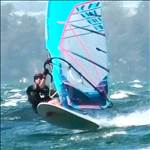
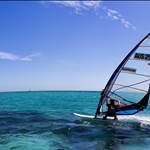
With Janet and I coming back to sailing after 20+ years, there are some adjustments to make regarding the gear used these days. Fins that cost $400, carbon fibre 2-piece masts, and sails which require monstrous amounts of downhaul and have twisted-off square shaped floppy tops didn't exist in 1993. We didn't talk about "centre of effort" and the distance between our footstraps and mast base was measured in metres rather than cm. It's hard to get used to the bigger, far more efficient sails that can be carried today.
But by far the most significant physical change is the predominance of the "short boards" after which this thread is named (or "short fat ugly boards" as I tend to call them).
We tend to expect that technological advancements will inevitably shift our toys towards higher performance with more user-friendliness, and I have approached the short board phenomenon with this in mind. I've ridden several of Jeff and Pete's short boards and having spent millions of hours sailing in my younger years, I expected that I'd quickly adjust to the newer boards, and be blown away by their performance.
Nup.
I’m struggling with these boards. I hop on full of confidence, thinking I can do this in my sleep, and I’m grinding back and forth while other guys plane past. I’m making the sail work, but the board’s not. What’s going on??
Today was a disappointingly light wind day and Jeff kindly offered me a ride on his Go 131. He says it’s a very similar shape to the Starboard Futura, which by all accounts is a superb board. At my 85kg with my 7.8m sail, this 131L board should have got me planing, at least occasionally.
Nup!
My wife Janet was riding the old 140L Bic Metal Rock. A relic from the past, we love this board and have spent huge hours on it and others like it. She was on the plane here and there, and although it was light, she looked sprightly. Now with her being 20+kg lighter (OK Pete, “slimmer”) than me and with the board being 140L, the odds were in her favour. But I kinda wished I was on the old Metal Rock because it’s so familiar.
Back at the beach, I wanted to run an experiment, and swapped the Go 131 for a Mistral Explosion 120L. Let’s see how the old school, narrow design feels compared to the short, wide Go.
The difference was clear! Although I wasn’t really planing, the board was boogying along more smartly than I had been on the Go. I felt more locked in and comfortable when I was hooked in. Theoretically it doesn’t make sense, but something’s going on here. It’s like there are all sorts of sensations, feedback, balance, memories in my head that are matched to the old board format, and the brain keeps doing what it’s sure is going to work, but it doesn’t work.
I don’t have any huge revelations about this, but I can’t help thinking that for old farts like us that come back to the future with these new boards, we have a problem because there are hundreds of hours of kinaesthetic memory imprinting in our brains. It’s not just that we have to learn a new system, we have to fight our brains desperately wanting to keep doing things the same way! I think I’m going to have to spend a lot of time on some short boards until something clicks!
But I may have a fight on my hands convincing Janet to relinquish the Metal Rock!
Not that I'm an expert or anything but where were your feet. The fat boards can really get quite angled if your feet are too far from the centreline. A slim board is probably harder to angle as being narrower your feet are naturally nearer the centreline.
Ive gone down from a big 150 board that even my 95kilos didn't really have and effect on down to a 133 futura this season and have really had to rework my stance to stay more centre....I do that and she planes. I don't do that and it bogs down, my front foot goes under and I catapult.
You really have to keep these boards flat and level as much as possible.
Gooday Andrew and Janet,
Its all about physics, if you apply the principles of your aeronautical expertise to the equation there are just designs that work because all the factors balance to a design that performs to its purpose..
My F2 Course XXL lightwind board was used to win the NSW course champs and was sold to me in the 1990's by the champ as a board that "would be good for you Pete, planes in nothing and handles like a slalom board" (Thanks Steve, i still have it)
No it won't out perform a current course board designed to carry a 12m sail upwind and downwind in bugger all knots.
I guess what i'm trying to say is that the reason as a recreational sailor i'm out there planing when everybody else is onshore is because of a glitch in the space-time continuum 1990's style.
If it works then there is a bloody good reason why it works and if it works for you then what more could you want????????
They all have their faults and short and wide still have to overcome the same power/friction/lift/weight equation.
Fin length vs sail size vs board width, length, volume and rider weight all count, a fin too big won't make a board plane any earlier.
Don't let all the hype get in the way of cold logic.
(and i know that you are too experienced to consider that your sailing skill is to blame)
Short fat Fugly boards is an appropriate description for what they are.
You wont see anyone on one of those trying for their 50 knot barrier pb
The evolution of design does give us better equipment and its a bloody minefield discovering what is best for our particular need.
Rotsa Ruck!!!!!!!
Good analysis there Pete!
It bugs me seeing you guys comfortable on the fugly boards, and I can't work it out, so I'm really keen to keep working on it and will keep pestering you for goes on your fuglies! Janet on the other hand is happy to stick with the Metal Rock, and I can understand why. Women aren't gear freaks like us guys so if it's working, why change? When I get back on the Metal rock I feel comfortable too.
The first time I rode a short wide fugly board was when I demod a 130 isonic in 18-20 knots with a 6.5 race sail.
It was the most uncomfortable and scary ride I can remember.
The nose looked like it was going to bury itself Ito the side of the large chop and I was very much a passenger, not the sailor.
Compared to my 100 lter bump and jump it was a nightmare.
I quickly returned it and opted for a larger, heavier and more controllable 140 lter naish freewide.
Even then I thought I had done the wrong thing.
it wasn't until I tried a few different fins and ended up wth something that met the requirements of an old fat man cruising around and trying to gybe and could carry sails from 5.5 to 8.5
I still use the f2 for 7.5 & 8.5 and the naish for 5.2 to 7.5
I know that this wont solve your dilemma Andrew but you have a bunch of us who will happily let you try out our different boards for comparison.
Hey Avb,
Great analogy!
After getting back into the sport earlier this year I noticed this too. Especially when I first had a go on my friends Formula board after riding my old Wind Action 56cm. The narrow boards can slice through the water easier but require more speed to get on a plane than a wide board. With the modern boards there is a wider surface area dragging through the water and it takes a sharper burst of power to get up on a plane. But once planing it will hold onto it much longer in the lulls than a skinny board.
After a while I realised by bearing off harder(than you ever did with your old skinny board), when you get a gust powerful enough, and a little rig pumping, running with a nice piece of chop, the wider board will release and get up on the plane. Then you can settle into the harness/straps and start pointing(which also seems much easier with the modern boards and large fins).
This is just my opinion but I have also noticed with the new sails that the large size is a little deceiving compared to the old sails. If you put heaps of downhaul on a big modern slalom sail it has so much twist that it doesn't have as much surface area to catch the wind as an old sail that had no twist. Well, it has the same surface area but the top isn't facing the wind squarely. As you pull on more downhaul the mast bends more and allows more twist in the top of the sail. Hence you can have so much range with the modern sail.
I have found the modern stuff a steep learning curve but once you get comfortable with it, it is incredible especially when planing through the lulls and jibing(well for me its more like attempting to jibe).
Ah, OK Eric that helps ... so you need to use more force to break the board free and onto the plane. That kinda matches how it felt ... I'm thinking "I'm leaning into this sail and it should be starting to scamper over the top" but it just sludged along like an old learner board from the '80's. I know exactly what you mean about using a bit of pumping, foot action and bearing away onto the face of a bit of chop to get it to plane (same principle as the wave boards?) so I will be keen to try that next time.
Yeah exactly Andrew. I find in marginal conditions you have to be quite aggressive with your pumping and fight that thing up onto a plane. It is so tiring! After a while you will know exactly how much wind you need to get going and when not to waste your energy pumping.
Watching Nige pump up onto a plane in light conditions is very frustrating as he is so good at it. He'll be blasting by me when I'm just standing there praying for a stronger gust.
I think the Go isn't a performance board more a beginner intermediate ?? so it will be more sluggish than say a similar litre Carve/ tabou rocket etc. If you can try something like that or fanatic hawk etc it should be easier..also a smaller board should have less drag if there is enough wind.
Hi AvB
The bottom shape between a Go and Carve is the same. There's only about a kilo difference in weight between Go and Carve so it'll have an effect on planing, but it shouldn't be dramatic. Easily fixed with a bigger fin.
I'm thinking that like Ezric said, you need to bear off down wind further than you previously thought possible. Probably 110 to 120 degrees off the wind. Once planing, then point up wind.
Also if you're in marginal conditions, use minimal downhaul and not too much twist. Downhaul tension has a big effect. This is what give the eind range.
Also your fin might be too small. I use the tail width as a good guide to fin length. i.e: for a Go, tail width is around 49.2 cm. So in marginal conditions, I would use maybe 52 to 55 cm fin. Also look at the rake. Pointer fins are good in light winds. In ideal winds, maybe 48 and then in high winds I would drop maybe to a 44. But by then I would be down selecting to a smalled B&J board.
Also try staying a little bit forward of the straps until you're planing.
Also try to coincide pumping with a bit of lift from some swell then getting into the straps once you're planing.
Once you get the short boards going, you won't be looking back..... So much easier than the 90's 
Have fun



 ?
?