. But looking for an explanation could it be that as angle of attack increases the low pressure minimum on the low pressure side moves forward while the high pressure peak on the other side moves aft? ie. the pressure peaks move to a better orientation of the fin's surface as far as contributing to induced drag goes.
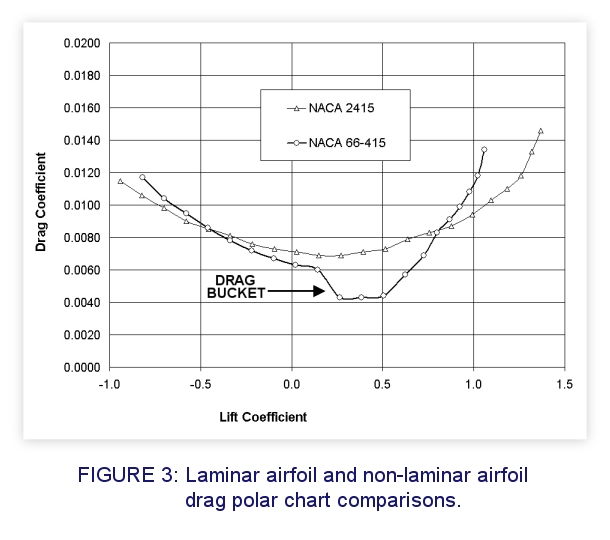
The drag bucket I'm referring to is to do with where on the fin the transition from laminar to turbulent flow occurs. Generally the more of the fin that is covered in laminar flow, the lower the drag. So the bucket shows the operating range where laminar flow is expected to be extensive, and the drag is significantly lower in that range. For a 10% symmetric fin this is usually where the lift coefficient is below around 0.1, which corresponds to about 1 deg AOA.
This region is where the profile, surface finish and water state (and of course a few other things) dictate the actual drag quite strongly, since they determine how much of the fin is copping laminar flow. But below this AOA defining the "wall of the drag bucket" there is a large part of the profile exposed to a favourable pressure gradient which helps to suck the boundary layer along and keep it laminar until the boundary layer "runs out of steam" and slows to a halt, resulting in flow separation- the start of the laminar separation bubble which hopefully reattaches further downstream.
For an interesting overview/tutorial go here...
www.dreesecode.com/primer/airfoil1.html
don't forget to click on the link to the next page at the bottom etc
Great link yoyo. after 3 years of fluid's at uni it is great to find a site that gets to the point.
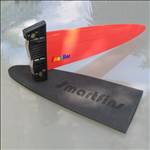
With the design of the smartfin it looks like $380 aussie to me! It looks like a mission to manufacture - getting the stainless pins to bond to the foils, making the front and rear foil sections fit, minimizing warp in the plastic(?) tuttle....
When they say they are assy/cambered - by how much do they rotate relative to each other and how deep is the draft? What stops the over rotation - is it the groove where they fit together?
I like swoosh's idea - to have a material/layup that under load "flexes" into the assy shape. Wheres that unobtainium?
Ian, not having Chris' code writing skills I got myself a ready made program for actual values of lift.
For some sample values with a raked symmetrical speed foil
Profile 64A-010 10%
Lenght 22.875cm
Root Chord 9.15cm
Tip Chord 3.05cm
Area 140cm2
At a Chris like speed of 47.5knots (not sure if a 10% naca 64A would get there).
@ AoA 0.5 degrees Lift = 19.0 kg
Drag = 2.4 kg (of which ~98% is frictional and 1.9% induced)
L/D = 8.0
@ AoA 0.75 degrees lift = 28.7 kg
drag = 2.545 kg (induced 4.5%)
L/D = 11.3
@ AoA 1.0 degrees Lift =38.7 kg
Drag = 2.61 kg ( induced 7%)
L/D = 14.8
If you go 10% slower these numbers will be ~ 21% less and if you are going 20% slower then they will be ~ 44% less
Looking at the above it might seem that a small foil at a higher AoA is the way to go as the L/D increases with increasing AoA but cavitation will punish those that go too small at these speeds.
Not having written the program and not having tank test results for comparison, I have no way of knowing how accurate the results are.
But it better than guessing and I basically use the program for comparing different foils.
Interesting numbers Yoyo. They show that when speed is held constant lift varies linearly with angle of attack. And Slowboat's graph showed that when lift is held constant, the angle of attack is inversely proportional to velocity squared. So each fin must have a K value such that
Lift = K * AoA * Velocity squared.
Which is consistent with the basic understanding of how lift is generated ie. F = d/dt(mv)
But getting the K for a particular fin requires of course a more complicated program like Yoyo's used.
I also checked out how the induced drag varied as a percentage of fin lift as angle of attack is varied. See Yoyo's table for the other settings.
AoA................. Lift................... Induced drag.......................... % induced drag of lift
.5 deg...............19kg.................0.048kg ( 2% of total drag)....................... 0.25%
.75 deg ............28.7kg ..............0.1145kg (4.5% of total drag).................... 0.40%
1deg.................38.7kg...............0.1827kg (7% of total drag.)......................0.47%
(Sorry about the dots, the editor didn't allow spaces to get things in columns )
You can see the lift is precisely linear with AoA at constant velocity, the % induced drag sort of linear. But yes well below the lift*sin AoA ( almost but not quite an order of magnitude)
But it seems induced drag is negligible when you're only trying to generate 19 kg of lift (if that ) at 47 knots.
I'm still curious to fully understand what is meant by induced drag, friction is easy. How do these programs calculate it??
Do they work out the pressure distribution over the whole fin. Then do they integrate the pressure times normal-to-the surface vector over the whole fin. The component of the total vector in the direction transverse to motion to be called lift, and the component along the direction of travel called induced drag?
For those who are interested in trying the SmartFins Red (32cm), give me a call.
Cheers,
Remi
Slow Boats, Yoyo & Ian K software cals are most likely very close!
In my view as a novice designer ~
1/ I can find plenty of;
High quality foil section data taken in "Air" + Aeronautical analyst software!
However;
2/ I can not find;
High quality foil section data taken in "Water" + Hydrodynamic analyst software?
Where is the Source? 
or
Is the adaptation of “Air” properties sufficient?
& how can we 100% certain?
I wish i passed science at school so i could contribute to this forum!
And so many big words too!!!
I just want to go windsurfing!
The main thing is that speed fins only need to be long enough to 1) stay in the water and 2) balance rear foot pressure. Aspect ratio is not important as the AoA is so low that the induced drag is neglible.
Slalom and Formula are a different kettle of fish working at much higher angle of attacks where induced drag (tip vortices) are quite significant.
IanK said "I'm still curious to fully understand what is meant by induced drag"

Think of it as the energy required to get the fluid you are moving through to do this (whilst frictional drag is the energy required to accelerate the stationary air/water molecules near the surface of the foil ).
Basically you are moving the fluid. If you go fast you move a lot of fluid a little bit if you go slow you have to move a little fluid a lot.
Thanks Yoyo - finally a comment capable of making some sense to finance-industry dummies like me!
Yes I wish I had been interested in Science at school too, when I read this stuff, all I see is: *#@*#...=x#@%+*blah blah .......
For Finance the only skill required is "Creative Accounting", steal other peoples/ companies money without going to jail.
This vocation is no longer in demand since the world recession.
Back to Fins,
From the science lessons above;
It is being said that for Speed Fins the AOA is negotiable neglible with induced drag no longer a major factor.
What keeps windsurfers from pushing thru 50+ knots?
 Or rather a lack thereof
More beautiful news: SmartFins rider Radoslaw “Gutek” Kurczewski (POL 75) became World Champion Slalom Juniors on Bonaire last week !
A short report, results list and link to the event website can be found on www.smartfins.nl
Results of Aruba Hi-winds 2009 have also been published (Smartsurfers on 1st place women and 2nd masters). Also a link on Smartfins.nl