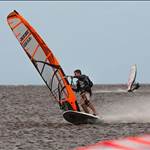
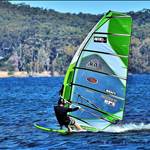
Pretty spectacular photos of it trying to loop!http://www.sailrocket.com/live/?q=blog/3
I've been watching Sailrockets progress for about 18 months now. I must say I'm really happy they have been able to do the speeds they have just done as it has been a labour of love for the owner of the boat and especially so cause he's an Aussie. If you haven't seen their website go check it out. It always makes for a good read and gives a special insight into what goes on in record attempts etc
Just glad that the boat is fairly unscathed from the loop and there is even more potential for it to go faster. For the record, their trimble timing recording showed sustained peaks of above 50 knots. This thing is quick....when it's not looping that is 


Notice in the movie that they are using a GT-11 or 31 for instant feedback on the runs. (Can't tell which from the video).
Interestingly the GT-11/31 only gave a peak of 48 knots on the dial but the Trimble showed they had actually done 52 knots! Do we really know how fast we are going with the GT-11/31, do you want to know your real speed, are you ready?
Here's a fun experiment for you switch on your gps and let it get a fix then watch the SOG doppler speed on the screen. It will bounce around from 0.03 to 0.50 randomly. Now get your mobile phone and pass it over the GPS, the speed will increase. Now dial a number and as it's ringing pass the phone over the GPS. The speed display will double at least and even triple, once you remove the phone it will take at least 10 seconds to go back to normal. If you have the Trimble program find out when the least number of sats will be visible in your area and at the lowest elevations. Try the experiment with the phone again and you will see an even larger effect on the GPS. The effect around airports, cell towers, high voltage powerlines is on an even greater scale......you can never be sure where the interference is coming from or the effect on the accuracy of the units. Until you can, handheld consumer GPS will never be accepted for certifiable record attempts that will hold up if challenged in a court of law.
Sailrocket may be the first time they have compared the GT-11/31 directly with the Trimble system, it was interesting to see the discrepancy in the speeds. I'm sure the WSSRC was watching and have further reason not to approve handheld consumer GPS systems for record attempts. Until you can post process the data from the GT-11/31 and correct it you will never be sure how accurate it is. No amount of mathematics or statistical analysis will improve the accuracy of the units until the RF interference is measured and recorded. The algorithm used to filter interference in the Sirf gps chipset must be reasonably simple since its consistent between units and they all show similar data - but that's where people are getting confused with accuracy. The units are just consistently wrong.
Trackpoint data, once post processed, is a lot more accurate. The trackpoint data from the GT-11/31 may be more accurate than we think. Until we can measure the aliasing effect and RF interference on these units the SOG doppler measurements should be treated with some level of suspicion, just as the trackpoint data currently is. As a fun measurement they are great but as a tool for record attempts I have my doubts, as do others.
Matt I never said ignore the doppler data, I just said treat it with the same level of scepticism that trackpoints are treated. As you well know there are factions demanding the GT-11/31 and the doppler data it produces should be accepted for official GPS records based upon statistical analysis. As the Sailrocket situation shows the level of accuracy of these units in doppler, as well as trackpoint mode, is sadly lacking. Having it compared directly with the Trimble post processed data gives us an idea of how great the disparity can be and this is probably the first time we have concrete proof of the error levels. The RF interference has the greatest detrimental effect on SOG doppler data, as it relies on measurement of frequency change to determine the speed, so I'm not sure how you can call the Trimble trackpoint data into question as it measures the level of error in the calculations used to post process it. The reason I compared the data from the Trimble with the GT-11/31 is because, for the first time, there is a scientific measurement of the error rather than an unfounded hypothesis based on quasi scientific theories that some have tried to prove with statistical analysis rather than measurement.
Much of the core statistical work being done by the GP3S "tech group" was based on getting consistent results for ranking purposes. Somewhere along the line that seems to have been confused with "accuracy". The statistical data being relied on is the differences between units worn at the same time.
Also to consider is the large accelleration involved in sailrocket's run. Aliasing plays a part here. If there was accelleration from 48 to 52 within say 1 second (plausible) the Navi will filter that out if straight afterwards there is decelleration.
Basically the only evidence we have for Navi accuracy (as opposed to consistency) is the comparisons with video gated runs at the ISWC speed events. In Karpathos there was a very large difference. It brings into question the accuracy/validity of the Navi under high accelleration/decelleration. Unlike longer runs with a gradual run-in (500m courses) which had good agreement, Karpathos runs were always under heavy accelleration followed by rapid decelleration (to avoid being minced by the reef). The speeds were consistently lower on the Navi than for video timing. Between Navis worn at the same time there was good agreement.
Some proper tests need to be done to understand the proprietry algs used in the SIRF chipset, and how the adaptive filtering might affect accuracy of measurement under heavy accelleration/decelleration. This isnt trivial, and I've not yet seen anyone attempt this.
The Navi is by far the most consistent consumer GPS on the market, and its a great tool for fun racing and tuning. But I wouldnt run a pacemaker from it...
Hi Ya Roo,i just tried the gps experience and i could,nt get your results. The navi varied from .007 to .01 sitting still with no mobile.Didn,t change when the mobile was near,when ringing etc. Can some one else try this experiement. Yes I accept that these are not good enough for wwssrc but, its the best where,ve got to play with at the moment and its great fun.
Hey Craig, what sort of phone is it? 3G or old-school? I suspect the higher frequency band phones (1800 and 3G) would cause more of a problem compared to the old 900MHz GSM. Its closer to the ~1.5G of the GPS signals. For the tech nerds, the front end of the consumer GPS has pretty crappy passive selectivity before the mixer/amplifier. When you let a strong out of band signal into the front end of the GPS receiver (amplifier/mixer) the in-band noise performance can be significantly degraded. This would directly result in greater error. A more substantial antenna design and input filter (using cavity resonators etc) improves immunity to out-of band interference. This is one of the reasons for survey-grade GPS devices having large antenna/front end systems. Improved SNR=>better accuracy.
Hi Roo. Do you actually HAVE the data from both the Trimble unit (post processing) and the Navi unit the sailrocket pilot wore?
If you do. Share it with us to prove your point. If you don't it is pure speculation.
There are any number of explanations for the so called discrepancy that has been described.
Just did Roo's experiment and I got the same results as Craig. Two GT-31's with the latest firmware. Speed varied between 0.07 and 0.05. Most of the time both GPS were stitting on .05 steady without changing for 15-20 seconds at a time. I saw on gps drop to 0.03 for a few second and the other dropped to 0.01 for about the same period at the same time.
This proves to me that, at least for the duration of that test ( a few minutes) the ACCURACY of the GPS units was within 0.07 at worst and the consistency was within 0.06 of a knot. That is consistent with other more rigorous experimental observations made before.
During my small test I used my (3G) mobile phone, made a call, waved it over the GPS's and held it still close to them while my friend was speaking. I observed absolutely NO influence on the speed displayed. The display speed seemed to my observation to be exactly the same as before and after I made the phone calls.
My experiment PROVES nothing. But it does support the other more rigorous experiments.
Experiments with high acceleration and deceleration are continuing, particularly with regards to finding consistency for the Alpha Racing categories. Significant progress seems to being made so far.
Paul Larsen wears is GT unit on the arm and the Trimble is in the front of the boat as far as i know.
looking at the video flip loop, i wouldn't be surprised about a difference in speed on the two units at all....
boogie
www.c3-fins.com
boogie, when Paul took off the rotational component would have made a difference between the GPSs, but looking at the video, the fastest part appeared to be Paul doing the pendulum swing... so would expect his arm to have been going faster than anything forward. There was also a significant difference on the previous run if I recall correctly. That could be put down to aliasing. Or a problem with the navi handling accelleration/decelleration. Lets hope he had the antenna tied down properly :)
Andrew and Craig, you might want to try it when moving to be sure that there is no zero speed filter being activated. Who knows whats in that SIRF black box in the latest firmware...
Clearly there is an issue with the algorithm when it comes to accelleration/decelleration thanks to Daffy's alpha detective work... Lets hope this can be resolved in firmware.
It's an interesting design. The video shows that at speed there's very little weight on the lee hull. The angle of the wing/sail has been set up so the pressure of the lee hull on the water is minimal. There are stays under tension to the upper tip of the wing. At speed the lower beam is probably mainly under tension - could almost be replaced by a piece of string. The force balances are very kite-like. I'd call it a kite boat.
The hydrodynamic force is a generated a bit more efficiently than a kite surfer, not needing the levered body weight in the system. The hydrodynamic force seems to be generated by a fin canted to leeward ie. the airfoil is operating in almost parallel opposition to the hydrofoil - very efficient. Righting moments and gravity don't play a big deal in the physics of the thing.
Now I remember, ( also discovered you can add a bit to a post later on using the edit button) the forum came up with something a while ago, Seahorse I think it was, where the idea was to get righting moments out of the system by using opposing hydro and aero foils. Someone else AUSXXX? pointed out that this was an old concept and it had a name. Different implementations of the concept look very different because you can put the driver pod just about anywhere.
This one looks like a goer, but if the hydofoil cavitates the whole thing will leap out of the water. What's the latest on cavitation theories?
Maybe not exactly a kite boat, depends on your definition of a kite. How about " A wing or a sail that flies in the air under the control of strings?" If the lower beam is in tension it might as well be string as far as the physics is concerned.
"According to Locosys: There is no position or speed tweaking for zero speed."
Maybe they've inadvertently switched it on. Has been noticed with some GPSs in the past. Besides Locosys dont know whats really happening in the SIRF engine AFAIK.
Biggest concern I have with it is resolving the inconsistencies we are seeing with large accelleration/decelleration. Until thats done the alpha scores will be pretty noisy.
Here is an explanation from Manfred Fu chs on the method of testing and proving speed accuracy using the geostationary method employed so far:
"There are currently 28 operational GPS-satellites orbiting the Earth at a height of 20180 km on 6 different orbital planes. Their orbits are inclined at 55? to the equator, ensuring that at least 4 satellites are in radio communication with any point on the planet. Each satellite orbits the Earth in approximately 12 hours and has four atomic clocks on board.
This means that the satellites travel at a speed of about 13900km/h=7500knots. The Earth rotates once in 24 hours so at the equator the speed is about 1700km/h=900knots. So we are talking about a highly dynamic system. The speed of the GPS unit is determined by the frequency shifts between the different satellites in view (Doppler-effect). These shifts depend on the satellite positions (and thus on the time) and on the latitude (rotation of the Earth). When we are talking about a stationary GPS this unit is of course in no way stationary (only relative to the surface of the Earth, we should better call this quasi-stationary).
When we measure the speed of a quasi-stationary units it moves in reality with really high speeds relative to the satellites. After considering the Earth's rotation we get the relative speed to the rotating Earth. So if we measure at different latitudes or at different times we cover all possible frequency shifts that are much larger than the small additional frequency shifts produced by our rather slow 50knots additional speed relative to the rotating Earth. So measuring 0knots for a quasi-stationary unit over a longer period of time or at different latitudes is a proof of accuracy for all speeds covered up to the bandwidth of the RF-receiver which must be much higher than 50knots in order to determine the large relative speeds to the satellites.
A quasi-stationary unit thus gives us easy access to all constant speeds we are interested in without the need to take care of aliasing effects which are due to inadequate bandwidths or inadequate sampling rates of the units and show up when measuring non-constant speeds with non-synchronized units. The GT-11 for example has a bandwidth of about 2Hz which would required a sampling rate of at least 4Hz (Nyquist theorem) to be able to interpolate between the sampled points and thus integrate of longer periods like 10seconds or 500m. If the bandwidth of the unit is too high the measured speeds represent instantaneous speeds only and the interpolation between them is not possible. If the bandwidth is adequate, the sampled speed over time curve is completely determined and interpolation and integration is possible with high accuracy."
Specific data on the relative accuracy of the three main types of GPS used in recreational speed sailing are on Manfred's website here:http://www.gps-speed.com/gpsaccuracy.html
Note that the GT-31 gives accuracy to 0.05 knots or better with 99.5% confidence and better than 0.07 knots with 99.9% confidence. (20 second runs over 20 knots)
Compare this with Garmin trackpoint devices where the same 99.9% confidence level is at about 1.5 knots!!!!
Note also that the data shows a very significant improvement in the GT-31 Doppler over the GT-11 Doppler.
If we were seeing the sort of errors that Kean claims are possible we would not get figures anywhere near this good.
Edit: Manfred tells me the number of satellites was 28 in 2002, today there may be 31 sats.