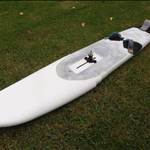
ive been working on light weight footstraps, e,g from high pressure hose , carbon sail cloth and kevlar sail cloth, and the best result so far is kevlar weighing in at 40grms and extremly stiff, with sandy point comeing up maybe some of you guys that's looking at saveing atleast 1/2kg and gaining mabe 1knt on your pb you mite wont to have a go at makeing some


Hi Keef. When I can stand straight upright on my board, look directly down and actually see my feet, I will think about light weight footstraps  . Until then, saving a few grams in the straps is probably a bit of overkill for me.
From what I have seen of the speed sailors, they are trying to carry extra weight to improve their performance, rather than shed it. I don't know if the reduced weight of the footstraps would help the performance of the board, but if they are carrying lead weights, then I think the footstraps wouldn't make any difference.
On the other hand, probably for some of the racers, light straps are a great idea.
Cool straps. They'd be good for freestyle too I guess.
. Until then, saving a few grams in the straps is probably a bit of overkill for me.
I think your footstraps look cutting edge.
Although from what I have found at Sp,footstrap adjustment can be critical - if your front strap is too loose then you can loose board control or if your back strap is too tight you will find your heel dragging in the water(if you are on a skinnyass needle) and if you have to pull out a screw driver and waste 10 minutes while it is going off then it could really hurt!
FBroy the reason why i made these strap's is for one, when i made the board i recessed 30mm from the foot strap area so there fore i needed a foam footstrap to replace the volume i lost , and being eva it's closed cell and doesn't take in any water 
 i dont believe you said that GO SCREW have you had a bad day, maybe the winter blues
i dont believe you said that GO SCREW have you had a bad day, maybe the winter blues
i dont believe you said that GO SCREW have you had a bad day, maybe the winter blues i dont believe you said that GO SCREW have you had a bad day, maybe the winter blues but after saying that i just mite be able to get down your way for the speed week
Fbroy, This is how I look at it. Lots of people are prepared to pay an extra $500 dollars getting the "PRO SUPER SPECIAL FRAGILE CONSTRUCTION" and save 300-400 grams when a set of Keefs straps could save you 500 grams at least dead weight for bugger all( just weigh a set of adjustable neoprene wave straps wet and you will get a shock) Overall board weight must be important to people otherwise they would save their money and get the heavier one.
Sailor weight, wetsuits and weight jackets are totally independant to board (strap) weight which is static "dead" weight.
On a speed board lighter weight does not automatically mean faster top speed but it does help getting going and most certainly is noticable in regards to accelleration. Faster accelleration in gusts is going to impact your 10 second or 500 metre speeds so to me it is important.
If lightweight non water absorbing straps are a comfortable fit to your feet, which is really important for control in knarly conditions, then why not?
I am going to be making one for my back strap for sure as I am using an offset strap at the moment ( super narrow tail and tuttle box ) and it's pissing me off. A wide ,lightweight strap likes Keefs that straddles the fin box is just what I need.
Your 500 grams on your shoulders is leverage over the rig allowing you to sail with more power. 500 grams at you feet is doing FA and if weight is doing FA then get rid of it as it,s slowing you down.
I agree that acceleration is affected by overall weight and in theory you should be reducing your overall weight as much as possible. But rider weight is used to counterbalance rig loads, especially weight outboard (big head and shoulders) and directly affects the ability to use more powerful rigs( assuming you have the strength). Board weight and any other static weight that can't be used to advantage should be eliminated.
In an ideal world you would have the lightest ,stiffest board possible , be 8 foot tall ,have a 10 kilo body and a 100 kilo head.
Now that would be fast.
i agree, any weight that can be shed in any form of sailing (wave to speed) with out compromising strength is a plus. what i like about the kevlar is the lack of stretch and the strength, are they stiff tho???


That's an interesting deck shape keef. Are the recesses there to allow thick cushion inserts or are they just to get your feet closer to the water.
The scoop out at the mast track looks good except that it carries too far back. The hull acts structurally like a beam between the main loads. They are down loads at the mast foot and foot straps and upload on the underside between the mast and footstraps. These plus fin stresses are the condition of loading when the board is most highly loaded ie blasting along at full power in chop.
In essence structurally speaking the most efficient profile for a beam like that is thin at either end and thick in the middle. The skin of the board carries all the significant loads so any deviation in the skin in the fore/aft direction will be a stress riser (ie any local bend going across the deck). This board is super light and looking at the deck shape I would expect you will get a crack across the deck at the back of the front recess. I hope I'm wrong. If it were me I would have tried to keep a fairly pure profile down the middle of the board from the mast track to the back foot straps. Foot recesses would have to be kept to either side of this area. I might even be moved to make the middle bit a little stronger than elsewhere so it does most of the work.
Tell us how it goes.
only time will tell NotWell, the board has 5 carbon stringers about 40mm deep, the two on the bottom connect to the fin box and about 1200 and 3 on the deck, the nose stringer is 8mm carbon tubeing and insert with pressure and connected to the front of the mast track, carbon laminate boxes were made for the mast track, fin box and footstrap plugs, so i'm keeping my fingers crossed , if you notice the bottom of the board has been filled with brown micro balloons ,i give the whole board a coat of balloons and sand before glassing