What's the theory behind wingers? Do they stop water climbing up the rail or something?

I don't know, some people are never happy unless they have something to complain about
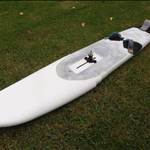
i'm with mineral the only reason i used them is because i don't like wide boards and i dont sail in conditions where i can use a fully blown speed board , so i thought i'd have two bob each way and have 1/2 slalom and 1/2 speed, so at 1100 the board is 520 wide and at 1100 the board is 480 wide, so i assume you need a wider front 1/2 to get you plaining and when your there the front 1/2 is out of the water
Yes but assuming you have a good reason for going from wide to narrow, why would you not do it with a fair curve?
Weeell it could give the rail more bite in a gybe allowing tighter higher G turns.
Could be to reduce the amount of lift behind the rider, allowing greater angle of attack. A fair curve wouldn't give as sharp a difference in lift under the rider, and less behind.

There is a couple of reasons why you may consider using wingers.
First ,if you look at a graph of a flat planing surface which displays where the lift is being created it shows maximum lift occurs at the leading edge, and the amount of lift tapers off quickly to the release point. Drag howeverer stays relative to the wetted surface area.
Depending where you place the wingers they can be a way of reducing the boards wetted surface beyond the point where the majority of the lift is being created and thus reducing drag.
Of course there are other ways of doing this also, pin tails , cutouts ect, wingers are just another tool.
The second reason is that you do get some drag created by water adhesion to the rail as it runs around the curved sections at the rear of the board. How much ? but if the winger has a clean release edge it theoretically can reduce this drag.
Being a car designer and having been in wind tunnels I have seen how these clean release edges dramatically reduce wind drag, so it goes that the same should be relevent to a planning surface on water. Car makers are putting bumps on tail lamp lenses with clean release edges to reduce CD figures.
Do they work???
I stuck them on my two custom fast boards as I felt the science was valid and wanted to see if it worked. I can say that they certainly don't seem to have any negative effect to top speed.
My last session at Sandy point I rode a Carbon Art 44 after riding my board for a few runs. My board is about 5 liters less in volume , nearly 2 cm narrower and pinnier in the tail , but the point in front of the wingers is a touch wider than the CA44 at the same point. Despite my board being lower in volume and narrower it appeared to get on the plane earlier. Obviously not a very scientific test but it seemed to indicate to me that there was at least some indication that it was doing what it was intended.
Why wouldn't you. Well the way I have done it with a very straight outline in front of the wingers certainly impacts the gybing. The boards are directionally very stiff.
It also makes them more complex to build.
It,s all good fun trying these things , if they work great , if not then try something else !!!!
I am having fun , and thats what it's all about.