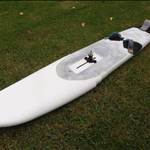
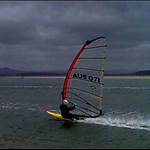
Interesting thread on Starboard forum regarding sanded bottom surfaces and fins versus polished surfaces. http://www.star-board.com/forum/showthread.php?t=5754
Thoughts anyone.
BTW - I'm sanded surface orientated.........not that there's anything wrong with that

Very interesting topic - be great to hear what slowboat and others (practical and theoretical experts) have to say. Reading all the linked forums and articles it would appear the fins should always be sanded with the cleanest (even polished) leading edge. Then the choice appears to depend on planing or displacement mode. If you intend to be sub-planing the majority of the time on a real displacement board then highly polished is the way to go (*board serenity, old Div2 etc). But as we all aim to be planing as fast as possible all of the time then sanded appears to be the best solution as there will always be the water air mix occurring at the surface.
I remember back to my youth sailing days - we spent a lot of time polishing the bottoms of the 420's and other dinghies and Etchells, F15's etc - partly psyche (confidence boats as prepared as possible) as one of the articles refers. But maybe in slower dinghies like the 420's and keel boats (even sports boats like Melges 24) the speed difference would be greater in favour of polished in displacement mode compared to the minor loss of polished surfaces when planing. Wonder what the fast skiffs (18's, 14's, 12's) do nowadays?
From observation, I would say that most guys at Sandy Point sand hulls and polish fins. I pay a lot more attention to my fins that the bottom of the board but I like to give the board a quick wipe over with W&D before a big session just to make sure it is clean.
But hey, after you drag your fin through the sand once, at least the tip is no longer polished! 
My small slalom board was polished to start with. As an experiment I did a few GPS runs polished, then went back to the beach and sanded it down with 600. Did a few more runs...not very scientific but I didn't see a difference.


I like to use 600 grit wet&dry on the board and anything up to 2500 grit or tooth paste(which acts as a fine cutting compound) on my fins.
Last time I put some car wax over my KA assy 20 fin I found my self sliding on the back of my head at 42 knots
Can you elaborate a bit Goo Screw - is tooth paste a non water repelling cutting agent. Are you suggesting the wax in polish makes the fin shed water leading to earlier spin out? I guess it may make sense?
What about expanding on the sanding method - circular - straight? Do you put the fin in a vice?
Best method for filling nicks in the fin - got a big dent in my TM45 to fix!
Just on another thought. About 8 years ago I got told by a guy in a shop that all the pros sand their fins in the direction of water flow with something like 600 grit. The reason he gave was that the little grooves that a formed act as a bit of a barrier to ventilation propagating down the foil. Something like a fence if you remember those tyronsea fins from yesteryear. My experience with the technique was that it did help - I had some fins that I just didn't like - sanded them like this and then found them acceptable. Any comments - others tried this method?
I have polished some of my fins to a mirror finish with a buffing wheel and cutting compound.
There is no real noticeable difference in speeed and no spinout with the polished fins.
but if you have to fix a fin try this.Flair around the dent first,fill it with epoxy and then spray the fin with some paint. You,ll then know when you start sanding into the original fin shape. I clamp a piece of 90x 45 HW into the vice and then clamp the fin to the wood. Its easier to sand across the fin this way.
but if you have to fix a fin try this.Flair around the dent first,fill it with epoxy and then spray the fin with some paint. You,ll then know when you start sanding into the original fin shape. I clamp a piece of 90x 45 HW into the vice and then clamp the fin to the wood. Its easier to sand across the fin this way.
One of the most meticulous fin finishers I have seen is Mal Wright. His basic technique is to use fine wet and dry on a aluminum sanding block and carefully sand in the direction of the water flow across the chord of the fin. He will use panel beaters spray putty paint to build up a light coat on the fin and then carefully sand it with the block until it has virtually all gone. As I understand it, the idea is not to cut into the original shape of the fin except to perhaps fair any slightly high spots. Another light coat and then a light fine sanding and polish usually finishes it off.
I try to follow the same procedure but I admit that I have less patience than Mal. 
When I have a good fine W&D finish I usually use cutting compound car polish to hand buff the fin to a mirror shine. The soft spray putty is brilliant for this and takes a high gloss finish with minimal effort.
One advantage (or disadvantage) is that if there is the slightest scratch or blemish on the fin, the high gloss shows it up like a major flaw.
From my observations I believe Chris Lockwood follows a similar technique to the fine wet and dry point. Not sure if he polishes the fins, but if he doesn't he certainly gets them to close to a gloss with very fine W&D.
When repairing small or large scratches and dings from my fins I follow a slightly different method. I get out my 60 grit and sand down the rest of the fin until the blemish blends in. I then finish it off with some 220 & 600 wet and dry.
As the fin gets a little smaller each time, it becomes noticably faster
Hope this helps