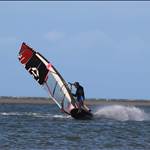
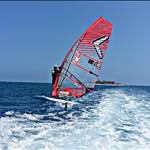
Why and how does Taty Frans' stance, with his legs almost parallel to the water, work?

This is from Barton's video:
He's going to get a good arse smacking in choppy water 
I get hit in the arse sometimes & nearly get launched or even bashed ribs in decent swell 
I think it's aerodynamic lift from the sail, sure enough apparent sail area is reduced, but some of the lift is vertical, reducing wetted area. If you've got a mast top camera, you maybe able to check out this effect.
And also just looking at the pick, it's giving him more leverage over the sail. So it may be wrong to say apparent sail area is decreased, because he can use more sail, with the increased leverage.
Think of that record breaking boat, (I forget it's name) rig was at a huge angle to windward, I think to gain vertical lift.
The soft tip of the Neil Pryde sail is also a contributing factor. Notice how the mast is bending beyond vertical to leeward towards the tip.
Select to expand quotedecrepit said..
I think it's aerodynamic lift from the sail, sure enough apparent sail area is reduced, but some of the lift is vertical, reducing wetted area. If you've got a mast top camera, you maybe able to check out this effect.
And also just looking at the pick, it's giving him more leverage over the sail. So it may be wrong to say apparent sail area is decreased, because he can use more sail, with the increased leverage.
Think of that record breaking boat, (I forget it's name) rig was at a huge angle to windward, I think to gain vertical lift.
That would probably allow him to run a smaller fin which could also give some extra speed.
Select to expand quoteJohn340 said..
The soft tip of the Neil Pryde sail is also a contributing factor. Notice how the mast is bending beyond vertical to leeward towards the tip.
That would make sense if it wasn't for the fact Taty sails Gaastra
Look at skiff moths, lasers, Finns etc all the best sail their boats leaning to windwardSelect to expand quotedecrepit said..
Think of that record breaking boat, (I forget it's name) rig was at a huge angle to windward, I think to gain vertical lift.
Vestas Sail Rocket
Select to expand quoteStuthepirate said..John340 said..
The soft tip of the Neil Pryde sail is also a contributing factor. Notice how the mast is bending beyond vertical to leeward towards the tip.
That would make sense if it wasn't for the fact Taty sails Gaastra
lol, I should wear my glasses
Like a lot of PWA racers he has his unique style that works for him, his is also very light at 70 kg compared to most of the other sailors. His style is very interesting
boards.co.uk/technique/a-guide-to-going-fast-by-taty-frans.html
Actually this article is better
www.windsurf.co.uk/featured/tatys-tips-slalom-speed-for-the-lighter-rider/4/
His sail still looks quite upright to me. The difference is that he is getting his body further from the sail by use of longer harness lines and really extending the arms. This actually should give him better leverage and more efficient power.
Yes, he is going to get some arse slapping in choppy water, but I suspect he can adjust his stance when that is necessary.
As a fellow lightweight, I like his attitude! 
Select to expand quoteHaggar said..
, his is also very light at 70 kg
I would say he's more around 80 ! (and just muscles, no fat !)
He has always been the exception to the rule. He uses quite small sails compared to the slalom giants and is still up there. I love his style and those GA sails look sweet. Efficiency is the go!!
It,s all about getting his weight as far out as possible, using long lines and straight arms, legs. He is smaller than the average PWA rider and needs to be as efficient as he can. Don't know why the big guys don't do the same, they would be even faster.
Agree it would be tough in rough water and he would have to be more upright then, probably shortens his lines or lifts his boom.
Select to expand quoteboardsurfr said..
Why and how does Taty Frans' stance, with his legs almost parallel to the water, work?
This is from Barton's video:
Apparently, Taty uses this stance even in relatively light wind. It seems to conflict with another piece of advice I remember: to keep the sail as upright as possible so that sail area is maximized.
I played around with the stance a bit during my last session, and according to the GPSLogit announcements, it was a couple of knots faster than my usual, more upright stance. The session was a bit to short for any definitive conclusions, though.
Any thoughts?
As one of the lightest on slalom pwa, Tatys stance shows how he has adapted his levers/leverage to maximum effect.
For the past couple of years, since moving to Bonaire, I have had the great privilege of becoming friends with Taty. He is a wonderful ambassador for the windsurfing sport, very friendly, obviously very knowledgeable, and very helpful. He helped me get started in speedsailing by selling me his 'used' 2015 iSonic 107 that he sailed for five days at the New Caledonia PWA race where he placed second overall. Unfortunately for the iSonic, it hasn't been able to go nearly as fast since I got it . For reference, he and I are about the same physical size except that he is all muscle and I am not  .
.
I just finished a very interesting FB message chat with Taty Frans (he is in Costa Brava Spain for the PWA Slalom race). I was amazed he spent the time to immediately answer my questions regarding stance/harness lines. Here are his thoughts...
1) About the chops hitting my body it's a fact that it could happen but i always adjust my body position depending on the conditions
2) And if I am sailing in windy conditions with bigger chops 30 inch or even 32 inch lines
3) For flat water - 28 or 30, depending on sail size. His general rule is : everything from 7.0 and smaller is 30 inch, bigger then 7.0 is 28 inch
4) He said I could use 28
5) Longer lines gives you more space to play with your body position and adjust your body stance while sailing
6) In the past when I was with Maui Sails I was using only 30 inch lines and I like it still do prefer long lines
7) The reason for longer lines is because then you are more far from the sail
8) The shorter the lines the more upright you are on the board, so every chop you encounter you will feel it directly and you will be moving constantly and will be slowing down unless you are committed.
9) 28 inch lines will be good enough for you. Then you can try 26 vs 28, But it depends on the conditions if you need 26 or 28 inch lines. You should use 28 in choppy waters, and 26 in the lake. All pro do use longer lines in choppy.
One quick follow-up to the harness line length discussion - Taty says he does NOT change boom height, it stays the same while he is changing the line lengths.