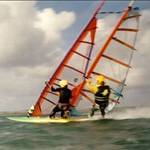
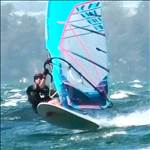
I was at Lake George last week. On several occasions when sailing from choppy water into the flat water, I had the sensation that the board felt draggy, or sticky, as soon as I hit the "ball-bearing" smooth stuff. I initially thought I might have been dragging the fin tip through the mud, but on checking the depth, I certainly had enough water. I'm pretty sure the wind strength and direction and my sailing angle didn't change. A few times it seemed to help if I applied more back foot downward pressure and lifted up with my front foot to try to reduce the wetted surface area of the board. The board was a Fanatic Falcon 89l (60cm wide).
Has anyone else experienced this? Is it "a thing", or was I simply asphyxiating on the fumes from decaying sea-bird poop emanating from the sludge below?
It surely is.
You need different trim for smooth and chop.
mast foot further forward for chop, further back for smooth.
You instinct to move weight back for smooth was correct.
Too far forward in smooth creates greater wetted area.
Too far back in chop. means your slamming into the chop instead of riding over it.
Smooth is only faster, when you trim for it.
I had the opposite feeling: as soon as I entered the smooth water without ripples I felt more power and could fly the fin much more easily. This was in light wind
Yep, that's my experience also. I think over glassy smooth water, the wind is laminar so the whole sail is working.
If there is even the smallest chop, the wind is getting turbulent.
I've had the experience at LG, as long as I was in the glass, I was planning without effort, as soon as I hit the micro chop, dropped off the plane, and couldn't pump back on, hit the smooth and was off again.
Select to expand quotedecrepit said..
It surely is.
You need different trim for smooth and chop.
mast foot further forward for chop, further back for smooth.
You instinct to move weight back for smooth was correct.
Too far forward in smooth creates greater wetted area.
Too far back in chop. means your slamming into the chop instead of riding over it.
Smooth is only faster, when you trim for it.
Good to know. It was an interesting experience to have to have only one variable (water state) change. In all my years of sailing I don't think I've ever consciously adjusted board trim before.
Of course, as soon as I bore away, my weight moved back anyhow, and that plus sailing the deeper angle gave me way better speeds.
Select to expand quotepowersloshin said..
I had the opposite feeling: as soon as I entered the smooth water without ripples I felt more power and could fly the fin much more easily. This was in light wind
I had this feeling a lot just during our recent trip to Albany (although I have yet to figure out how to fly a delta fin). But whenever I looked at the GPS, it did not really show a speed increase. Does not mean it did not happen since those were just random glances, but there definitely seemed to be a disconnect. I really should have brought those headphones for constant real-time feedback...
There are multiple possible reasons for not seeing a speed increase, including increased drag in the "huge" 21 cm delta in the flats (although it did not feel that way, except in the middle of the nauti run). It's also possible that my setup was good for mild chop, and when I entered the flats, the drag increased because too much of the board was in the water, as Mike explained above. A bit more drag would also feel like suddenly having more wind and power.
There is probably no relevance, could be a bit though. Many years ago wakeboarding and kneeboarding , I prefured a slight ripple apposed to glass. Im not sure why. I felt in more control pushing the limits of grip. It didn'tgive me more grip , possibly less , but i could tell more when i was getting close to the limit . Like some fins that let you know before total spin out .It was about getting a nicer carve as apposed to top speed. I'm not sure how this relates but I'm sure there is some kind of connection. Possibly because a slight ripple is easier and more confident inspiring. Glass needs more finesse.
It sounds like you were experiencing this 'stickiness' on a square reach. That make sense and Decrepits analysis and advice is spot on in that case.
Once you bear away on the glass, your board speed will, of course, increase. This naturally make the board plane higher and moves the Centre of resistance (or drive) back a bit. The natural adjustment on your stance is to move your weight, and rake your rig back, and this will naturally allow the nose to rise a little more, decreasing wetted area and helping you to increase speed even more.
I have tried to get an objective read on my speeds over the years at LG, often using the speed talk in GPS-Logit, and I am pretty confident that I consistently see faster speeds off the wind in the 'Glass', compared with small ripple chop. This seems independent of what board I am on, from large slalom to small speed board. I like Decrepits theory about the laminar wind down low as well. I have found this to be a big factor on open flat water venues, and at Sandy Point in it's heyday. The opposite can be a severe disadvantage, as it was on most of my runs in the Luderitz canal in 2013 with the very high, almost square bank, blocking wind in the foot of the sail. (They have corrected this in recent years )
It seems strange that going from 4 cm ripples to 0 cm would have an noticeable effect on the wind flow, considering the center of effort is probably more than a meter above the water. But strange things can be true. I recall a session where the wind had to come over about a small wooded hill, with the tree tops probably about 80 meters over sea level. Even at about 1.5 km distance from the obstruction, the wind was clearly weaker and more gusty - a lot more. The geometry is of course a bit different, but it seems plausible that even small ripples could affect the wind at 20 x the height of the ripples, or 80 cm in this example. With the sail's lower edge close to the water, that would indeed have a big effect on power - both total power (average) and variability.
Interesting. I'm slow as a wet week in small chop, but when I hit the smooth I feel everything come alive.
Select to expand quoteboardsurfr said..
It seems strange that going from 4 cm ripples to 0 cm would have an noticeable effect on the wind flow, considering the center of effort is probably more than a meter above the water. But strange things can be true. I recall a session where the wind had to come over about a small wooded hill, with the tree tops probably about 80 meters over sea level. Even at about 1.5 km distance from the obstruction, the wind was clearly weaker and more gusty - a lot more. The geometry is of course a bit different, but it seems plausible that even small ripples could affect the wind at 20 x the height of the ripples, or 80 cm in this example. With the sail's lower edge close to the water, that would indeed have a big effect on power - both total power (average) and variability.
Back to front Peter. it's the wind that causes the ripples. an interaction between wind and water. I think water ripples and wind turbulence are part of the same process.
If there's no ripples, there's no process, no interaction between wind and water, so no turbulence is created and no ripples formed.
I suspect this is due to oil off the weed, reducing water surface friction.
The wind can then blow over the water without slowing down at water level. Which would precipitate a rotary action in the wind at the surface, in turn creating ruffles.
Well that's my theory anyway. Be good to do a smoke test, to see what the wind is actually doing.
Select to expand quotedecrepit said..
Yep, that's my experience also. I think over glassy smooth water, the wind is laminar so the whole sail is working.
If there is even the smallest chop, the wind is getting turbulent.
I've had the experience at LG, as long as I was in the glass, I was planning without effort, as soon as I hit the micro chop, dropped off the plane, and couldn't pump back on, hit the smooth and was off again.
I Remember that day off Cockys Mike was just us two cruising.
Select to expand quotejimbob SA said..
I Remember that day off Cockys Mike was just us two cruising.
Great memories Jim!
I've just spent a few weeks at Lake George. Other than the ballistic days I was surprised at the speeds. I know when I was super powered I felt I should have been getting better speeds.
Even the good guys were only getting 33 - 34kts..
Maybe something to do with the mud?
Certainly in the last few days I could feel the back of the board affected by the mud.
Select to expand quoteMikeyS said..
I was at Lake George last week. On several occasions when sailing from choppy water into the flat water, I had the sensation that the board felt draggy, or sticky, as soon as I hit the "ball-bearing" smooth stuff. I initially thought I might have been dragging the fin tip through the mud, but on checking the depth, I certainly had enough water. I'm pretty sure the wind strength and direction and my sailing angle didn't change. A few times it seemed to help if I applied more back foot downward pressure and lifted up with my front foot to try to reduce the wetted surface area of the board. The board was a Fanatic Falcon 89l (60cm wide).
Has anyone else experienced this? Is it "a thing", or was I simply asphyxiating on the fumes from decaying sea-bird poop emanating from the sludge below?
If you have ever paddled a SUP or kayak in 30- 50cm of water you will notice it is harder to paddle than in deeper water as the board sucks to the shallow bottom. I find this the same when windsurfing in shallow water.
Select to expand quoteAUS4 said.
If you have ever paddled a SUP or kayak in 30- 50cm of water you will notice it is harder to paddle than in deeper water as the board sucks to the shallow bottom. I find this the same when windsurfing in shallow water.
I disagree. Fangy used to paddle his canoe in the estuary, so he agrres with you that you slow down in shallow water.
This is ground effect, were compressed water by your displacement can't get away and creates a bigger bow wave in front of you. The bow wave limits your speed, unless you have the power to climb over it.
In shallow water the bow wave travels slower than in deep water.
This also makes it harder for a windsurfer sub planning.
BUT!!!! once planing you are going faster than the bow wave and riding it. The increase in pressure is now underneath you not in front, so it adds to board lift and decreases drag. That's why you can actually go faster in shallow flat water.
If you are going slower, as Sue says, it's probably because the fin is partly running in mud.
The slower bow wave should mean in theory that you can plane at a slower speed
Select to expand quotedecrepit said..AUS4 said.
If you have ever paddled a SUP or kayak in 30- 50cm of water you will notice it is harder to paddle than in deeper water as the board sucks to the shallow bottom. I find this the same when windsurfing in shallow water.
I disagree. Fangy used to paddle his canoe in the estuary, so he agrres with you that you slow down in shallow water.
This is ground effect, were compressed water by your displacement can't get away and creates a bigger bow wave in front of you. The bow wave limits your speed, unless you have the power to climb over it.
In shallow water the bow wave travels slower than in deep water.
This also makes it harder for a windsurfer sub planning.
BUT!!!! once planing you are going faster than the bow wave and riding it. The increase in pressure is now underneath you not in front, so it adds to board lift and decreases drag. That's why you can actually go faster in shallow flat water.
If you are going slower, as Sue says, it's probably because the fin is partly running in mud.
The slower bow wave should mean in theory that you can plane at a slower speed
I am planing on a SUP at 10.5-11.6 kph so don't see your point. I can tell the difference in speed between planing (30-40 knots) in glassy flat shallow water and glassy flat water beside a wall or sand spit, if you cannot I can't help you.
Select to expand quoteAUS4 said. I am planing on a SUP at 10.5-11.6 kph so don't see your point. I can tell the difference in speed between planing (30-40 knots) in glassy flat shallow water and glassy flat water beside a wall or sand spit, if you cannot I can't help you.
So are you saying you go faster in deep water behind a chop shield than you do in shallow water without one??????
If that is truly your experience I think there is something else involved, like draggy weed or mud,
Or perhaps different fins.
In deep water you can use more efficient upright fins, in shallow water you have to use less efficient raked fins.