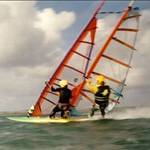
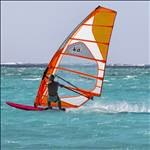
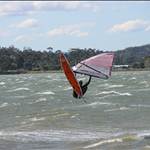
Since I have not been back to Sale this week, I still don't have my trailer with the smaller speed gear in it. And since it looked like it could get to 30Kts today, I decided to have a retro day and sail my old speed boards and older 2009 KA Koncept reference sail. I was actually quite underpowered and the wind was only around 25 knots as it happens.
Both boards are Polyurethane and Polyester, designed and shaped by me.
I have not sailed the 14" speed board since 2004 SpeedWeek as far as I can remember. I think that was the only time I did 40 knots on it. It had a Kai Hopf US box speed fin in it that I got about 13 years ago and had never actually sailed, so I used that. I was tempted to use the Mal Wright Aluminium 20cm assy but it needs some sanding clean up work so I just went with the Kai fin. It is 22cm deep with 9cm chord at the base and I think it is slightly assy, (sbd) but I really could not tell sailing it. It felt really great and hang on exceptionally well in the chop. Very impressed! I was surprised that I could get the mast track far enough back for the 2009 sail (which is not that much different in the position required from a current sail) and that aspect was fine as I didn't even look like dragging the foot of the sail in the water.
I initially rigged the sail with way too much downhaul, but after the first run I eased it by a good cm and it felt much better. Still looked great as well. Also bagged the outhaul quite a bit for some runs as I got into it. The sail was very interesting. I am glad I had not used it in so long (at least 6-7 yrs) as the differences were much more obvious than I remembered. It was surprisingly easy to get going in marginal wind for the board, but the power in the mid and upper was noticeably less than the 2016-17 Koncepts. What was nice was how light it felt. Some thing I need to take another look at regarding construction and materials. I think the difference is all in the luff sleeve, which is now wider and is of different materials. The new sails are noticeably more stable in big gusts going upwind as well, especially with a very loose outhaul as used in speed sailing. But in the mid 20's wind I had it felt excellent on the speed runs. I do remember we changed down to the 4.4m when it got much over 30Kts back in this sails heyday.
I went out first up on my OceanMotion, 48cm wide speed slalom. Constructed around 2001. It was my most used speed board from then up until about 2006 when I got the Isonic 50. It has a PB 2 seconds of over 44 knots so it was no slouch. Polyurethane/Polyester construction with some Kevlar in the deck reinforcing. Originally it had a US box, but later I substituted in a Tuttle box. I used the original Mal Wright TM45 G10 prototype, the same one as I was using in 2005. Assy, 20cm but quite a wide chord and square tip. It was too small for the conditions today and I spun out a lot in the chop. On the last run home at the end of the session, I pushed it too hard and had a hard spinout/trip crash in the chop, snapping the UJ and putting a hole in the foot of the sail.
After a few runs in the 34-35 peaks, I came in a switched to the 14" (36cm) speed board. The max width is a bit deceptive though as the wide point is well forward and the 'working' area from the front straps back, and the 1 foot off tail width is much narrower than modern boards. First run I saw 37 knot peak on the GPS and that was the best run as the wind seemed to ease too much after that. I certainly never felt powered up enough to go any faster, and doubt it would have been much more on my CA40.
The overwhelming feeling I got from this board was how incredibly smooth it rode the chop. I rapidly gained huge confidence in it to push hard right out into areas where I would have bounced and crashed badly on the CA40. I guess thats what these boards were designed for really, as the early speed courses in places like Fuerteventura were mostly very choppy when it was windy.
On top of that, both Polyester boards just feel so much smoother in the chop. I have noticed this a lot over the years, and believe it is a property of the construction (Polyurethane/Polyester) that makes them have more give and dampening. This is one area we have badly lost out on with the todays widespread obsession with super stiff epoxy sandwich construction. In smaller, high wind boards, I am not at all convinced that epoxy sandwich, and certainly not lots of carbon, is better in this respect. Both these boards are glassed heavy (for durability) and both are under 7Kg. Who needs 4.5 to 5Kg boards in really strong winds??
On the other hand, Polyester boards can suffer from rocker creep. By this I mean a change in rocker over time due to shrinkage of the materials. The speed board has been fine, being so thick for it's width, but the wider one, even though it is heavy glassed, has suffered from slight negative tail rocker over the years. I faired it up once in about 2007, but I think it has gained about 1mm of negative rocker in the tail again. That is one thing a properly made sandwich board should not suffer from. There are ways of minimising it in Poly' boards, but one of the the best ways includes heavier stringers which does add a fair bit of weight.
Unfortunately, as I changed boards the wind seemed to drop a bit and I was struggling to get going for a few runs. Then it came back to mid 25's and I had no trouble starting at all. I was still underpowered for any decent speed though.
The trim of the 14" is very flat at speed. Quite a bit of board is touching the water at 35 knots, but the board is so narrow it does not feel like there is much resistance at all. The benefit is in the chop where it slices through it like a hot knife through butter. I do remember that at 40+ knots it does ride higher on the tail. It has quite a bit of fee concave compared to modern speed boards, which must help smoothness as well. The back foot is about half a foot-strap length further forward from the very narrow tail too, but the wake comes off very flat with no big rooster tail, so I think it is still quite low drag.
I did a couple of gybes, just to see if I still had it, and managed a 20Kt Alpha on the best of them. 
Another thing I noticed is that it foot-steers quite easily at high speed. It was still easy to keep it still and straight, but nice to be able to make small adjustments to course with quite subtle movements of the ankles, and less with sail movement.
Now that I know this Kai fin works, and the mast track position is OK, I am looking forward to trying it again with the latest rig in 30+ knots on a good SW speed day to get a direct comparison with the CA40. 


The bottom line is that it was great fun, and it gave a great perspective on how boards and sails have changed. 
Post on GPSTC here: gpsteamchallenge.com.au/sailor_session/show?date=2017-03-18&team=16
Daffy, Thanks for posting
The old speed guns rule  We will have to have a state against state comp
Bring out the old guns baby, good to see you are up for one more run just for fun
I will have to find my old guns and join you.
Retro Style
cheers Russ
You've got me thinking Andrew, with narrow speed boards, you probably could get away with unidirectional carbon across the board, and glass along the board. This would stop the foam compressing but allow some flex. If more flex isn't the ideal answer, maybe hollowing out the foot area so much thicker pads can be used?
I think a lot of the harsh feeling is due to the Sandwich construction, not so much the Carbon, although more carbon makes it a lot worse. I noticed it from the moment I started using PVC sandwich boards.
The first epoxy boards I used were not true sandwich but expanding epoxy foam skin, (Waitata and AHD) and they felt less harsh.
There is still some very nice properties of Polyurethane/Polyester constriction. It's a pity we can't get Polyurethane windsurfing blanks anymore.I rang around the major polyurethane foam Blank suppliers last year and none of them make them anymore.  The old Burford speed board blank mould has been butchered to make Nipper board blanks.
If you are making a PVC sandwich board, I definitely recommend normal glass longitudinally! I would suggest only using Carbon for local reinforcement patches where it is really needed.
And I thought my early nineties stuff was old! Great write up Andrew. I am interested in your thoughts on ease of planing of your vintage boards. I get the feeling, especially from my 310 barge, that although the long skinny outline gets you moving easily, there is a extended period of semi displacement mode as the board climbs over its bow wave at a shallower angle. Is this just the barge, or does it apply more generally to older board shapes?
It's hard to say regarding the two boards I rode. They are not much different in the way they plane up than the modern boards I normally ride. But I was reasonably powered up on a smallish sail.
I did notice when slalom boards suddenly got a lot shorter that they took a lot more of a 'bump' to get them planing. That era also coincided with higher aspect, thinner fins as well so there was a double effect. It became a lot more important to bear off the wind a bit and pump/bump them up on the plane, where the older longer boards would just gradually glide up by themselves. The extreme example for me was the original Starboard Hyper-Sonic, the "potato chip". It was so short and wide compared with my previous boards that it was completely different. The design concept was for really light wind planing, and it would glide though lulls with almost no wind, and go upwind like nothing else, but it always required a bit more effort to bump it up and planing in the first place. The downside of that board was just a lack of top speed. It was like a mini Formula board.
It was a fun board though, making fully planing, flat water gybes possible with a 6m sail in barely 12-13 knots of wind!