After considerable time spent on the board trying to plane in marginal winds or watching a lighter sailor effortlessly blast past I thought there must be some solution. So far I have been accumulating bigger and bigger sails but they get harder and harder to manage. My local area Perth (Melville) has frustratingly constant winds of 8-10 knots that can go on weeks on end. I have recently joined GPSTC so also interested in just going faster in general.
Researching how to sail fast in low winds revealed that Formula Boards or even long thin style boards that don't plane but slice through the water instead were a way to go.but these involved almost complete new kit.giants sails, huge fins and super wide boards. Since a non planing board's max speed is proportional to the square root of the length it quickly makes a board crazy long which then turns like an Oil tanker. Could go foil approach but ultimately you need bigger and bigger foils in lighter winds to get going which limits places you can sail and they also suffer because the drag goes up with the square of speed.. At speed they also appear to be fairly difficult to control. I have already run out of room to store stuff so I want to minimise accumulating more gear.
Surely there is another way? The solution seems completely obvious, so obvious I thought many would have at least tried it. According to Google though, no windsurfer has. However, just because its not on the internet doesn't mean it hasn't been done so maybe someone out there has some examples or info. Its even more odd because the surfers experimented with this around 30 years ago and were discussing it in the early days of the internet..surely one surfer realised the potential application to windsurfing???
This idea involves getting air under the board to reduce wetted area and reduce board drag. Essentially a hovercraft where the entire board rides on a cushion of air and only the fin touches the water.
Large ocean going vessels like tankers and Cruise liners like the Diamond Princess use what they call "air lubrication" to reduce drag and thus fuel consumption. Depending on shape of hull they use either micro bubbles or air channels running the entire length of ship. Air is injected near the bow and travels aft. Depending what you read they are reporting real world improvements between 5-20% savings in fuel consumption.
For Windsurfing would split the solution into two parts:-
1) Active
2) Passive
1) Active approach would be a hover craft style approach where air is injected via some external power source under the board. Could be as simple as an aquarium bubbler or more advanced like a model aeroplane ducted fan unit. Most would agree this is not in the spirt of windsurfing having an external power supply etc and certainly could not compete with conventional craft in competitions. It would have to be classed as a different vessel, maybe Hoversail. It detracts from the simplicity and also adds complexity and cost. I only found one example of anyone suggesting this: US Patent US20040000265A1 (stick that into google and you can get it) It didn't appear anything was ever made as tech at the time wasn't sufficient. It is still appealing though, especially for ultra light winds but the passive approach is the main reason for this post.
2) Passive approach. Very simply using a Venturi to draw air from the top of the board to underneath. (Not to be confused with the Venturi board designs which channel water in different ways under the board and lots of info and experimentation around for that). I've played around with Venturi's in Aquariums and its super simple way to inject air for the fish (or making underwater sand waterfalls). For a windsurfer the basic idea is drill holes through the board where you want get get air under and make minor indentation underneath with a small slit. As the board moves through the water the indentation causes a pressure drop and draws the air under the board...
Surely someone has tried this before? It turns out Mandurah legend Bert Burger (Sunova founder) made 20 or so of these style boards (only for surfing though). He called them 'ventilated' boards. In a post he describes these boards, quote: "..its without a doubt the fastest thing you could possibly ride..", "this board has holes through it ...the holes are covered on the bottom with just a fine slit allowing air onto the bottom of the board ....as the water rushes under the bottom it sucks the air through the holes ,at a certain speed (just a little faster than paddling speed , just before you take off) the whole board rises and rides on a cushion of air ..... unbelievably fast.....................................
only drama was the air introduced onto the bottom of your board , meant the fins just didnt work when you tried to turn to hard ....i was thinking of cav plates at the base of the fins to keep the air trapped against the board ... but the whole process just got to complicated .."
He also mentions the boards made no spray. He included two photos, one a close up of the Venturi system and another him riding it. Unfortunately the internet has lost these photos.
You can read his post from 17 years ago at www.swaylocks.com/groups/question-reducing-skin-friction-drag-surfboards (He starts about 7 comments down and makes a total of 4 posts, ending with... "but at the end of it all introducing air onto the bottom of you board causes some complications..... at the time i didnt know enough about design to deal with it ... i think i would be better equiped to deal with those problems now.... its just a time thing...... id sure be happy to problem solve if you guys wanna have a crack at it..... but ive got to much to deal with to go there again.... " Seems like Bert was pretty busy with company changes etc back then so perhaps he has just forgotten about it..I see he makes windsurf boards now though...
I have been trying to get in touch with Bert to discuss further but so far no luck. According the the Mandurah Sunova outlet he lives in Thailand and is active on Facebook.
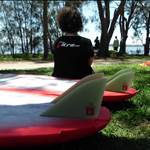
After a lot of searching I found a couple of photos of surfboards with Venturi's which are attached here. One is I think made by Erle Pedersen and the other unknown. Would be really interesting if anyone has other photos of these boards.
Judging by the spray of a windsurfer the water flow directly under the board is roughly 135deg to the direction of travel.i.e. not down the length of the board so you probably need more than one Venturi but really no clue.
I've made a rough sketch of what a Venturi system for a windsurfing board might look like. Taking it a few steps further you could add basic control to the system by placing these air vents near foot positions. i.e. open or close them with your toes in the front foot straps for cruise control, or closing off air flow by placing the inlets where you put your front foot to initiate the gybe, thus stopping air flow and dropping the inside rail into the water.
Another concept is you could enhance this effect by having a ram air intake somewhere (front of board?) and run the air via tubes hidden in the board to the Venturi's. (For testing you could run the tubes above the board to the venturi's) For real speed you could adjust this air intake towards the apparent wind.
No clue how this would make the board handle, how the fin might behave if the board actually fully lifted out of the water etc.Because board drag dominates in pre planing conditions, even a small amount of air lubrication that drops board drag 10% may help get planing earlier or expand lower wind range. In theory at least the concept should increase overall speeds, reduce noise etc.
Anyway, would be really interesting to know if someone has tried this or have ideas. I have a board I picked off the side of the road that the guy was throwing out that will be the sacrificial first test case. I still have to find an American style fin for it and then learn to ride it to see how it feels before I start drilling holes. Its a Warren Thompson Santosa speed board so won't be an ideal test candidate. Before I do that though I plan to do some tests of Venturi designs.maybe this can help explain why I am building a hydro test tank. I can also see the need to start making my own boards in order to play around much further. Talk about opening a can of worms. However, it seems like it could be a way to get close to an Aladdin's magic carpet ride.


I will think you will find it has already been tried. F2 had a speed board out years ago that had what you are suggesting. One of your pics looks like a Jimmy Lewis speed board from the 80's with a BIc logo. I think the idea of shaping the hull with scoops and concaves or channels is the same idea of drawing air under the board to give it lift.
Everything YOU can think of has been tried.
Air to bottom? Horrible idea. Spinout. Hard to plane.
Foil? Better, good in lighter wind.
my 2 cents. air reduces drag but also lift.
To plane early you need lift.
So air may not make it easier to get planing. Depends if it reduces drag more than lift.
Sounds like they've measured improvements in displacement craft. But for planing craft the planing component of lift is equal to your rate of generating momentum in the downward direction. Can't really get around that. The only workaround to that fundamental is to generate that momentum using more mass and less velocity. ie wider boards. (turbo fans vs pure jet engines for the same reason). The other way to move more mass at less velocity is to involve the inertia of mother earth. ie shallower water. We know multi fins are draggy in deep water but what if they allow the use of even shallower water? And if the water is uniformly shallow and the tips are just skimming the bottom the draggy end effects at the fin tips should disappear.
(Or a terrain-following speed foil - even better)
8 to 10 knot seabreeze at melville = 15 at peli point.
Just sayin.
or you could try the ocean, just for sh!ts n giggles.
Select to expand quoteIan K said.. And if the water is uniformly shallow and the tips are just skimming the bottom the draggy end effects at the fin tips should disappear.
I think this is an effect we already experience in weedy water. 
"Could go foil approach but ultimately you need bigger and bigger foils in lighter winds to get going which limits places you can sail and they also suffer because the drag goes up with the square of speed.."
if you have 8-10 for weeks, one sail, one board and one foil is the only thing you need. Yes, you will need a big foil (high aspect 1000 square cm or low aspect 2000 square cm) an 8ish sail, and a wide board. that should be enough to get you foiling all those weeks and I doubt you will get to sail faster than the foil in those conditions. When the wind goes up you can either get a smaller front wing or use your other gear.
Select to expand quoteFlex2 said..
After considerable time spent on the board trying to plane in marginal winds or watching a lighter sailor effortlessly blast past I thought there must be some solution. So far I have been accumulating bigger and bigger sails but they get harder and harder to manage. My local area Perth (Melville) has frustratingly constant winds of 8-10 knots that can go on weeks on end. I have recently joined GPSTC so also interested in just going faster in general.
Researching how to sail fast in low winds revealed that Formula Boards or even long thin style boards that don't plane but slice through the water instead were a way to go.but these involved almost complete new kit.giants sails, huge fins and super wide boards. Since a non planing board's max speed is proportional to the square root of the length it quickly makes a board crazy long which then turns like an Oil tanker. Could go foil approach but ultimately you need bigger and bigger foils in lighter winds to get going which limits places you can sail and they also suffer because the drag goes up with the square of speed.. At speed they also appear to be fairly difficult to control. I have already run out of room to store stuff so I want to minimise accumulating more gear.
Surely there is another way? The solution seems completely obvious, so obvious I thought many would have at least tried it. According to Google though, no windsurfer has. However, just because its not on the internet doesn't mean it hasn't been done so maybe someone out there has some examples or info. Its even more odd because the surfers experimented with this around 30 years ago and were discussing it in the early days of the internet..surely one surfer realised the potential application to windsurfing???
This idea involves getting air under the board to reduce wetted area and reduce board drag. Essentially a hovercraft where the entire board rides on a cushion of air and only the fin touches the water.
Large ocean going vessels like tankers and Cruise liners like the Diamond Princess use what they call "air lubrication" to reduce drag and thus fuel consumption. Depending on shape of hull they use either micro bubbles or air channels running the entire length of ship. Air is injected near the bow and travels aft. Depending what you read they are reporting real world improvements between 5-20% savings in fuel consumption.
For Windsurfing would split the solution into two parts:-
1) Active
2) Passive
1) Active approach would be a hover craft style approach where air is injected via some external power source under the board. Could be as simple as an aquarium bubbler or more advanced like a model aeroplane ducted fan unit. Most would agree this is not in the spirt of windsurfing having an external power supply etc and certainly could not compete with conventional craft in competitions. It would have to be classed as a different vessel, maybe Hoversail. It detracts from the simplicity and also adds complexity and cost. I only found one example of anyone suggesting this: US Patent US20040000265A1 (stick that into google and you can get it) It didn't appear anything was ever made as tech at the time wasn't sufficient. It is still appealing though, especially for ultra light winds but the passive approach is the main reason for this post.
2) Passive approach. Very simply using a Venturi to draw air from the top of the board to underneath. (Not to be confused with the Venturi board designs which channel water in different ways under the board and lots of info and experimentation around for that). I've played around with Venturi's in Aquariums and its super simple way to inject air for the fish (or making underwater sand waterfalls). For a windsurfer the basic idea is drill holes through the board where you want get get air under and make minor indentation underneath with a small slit. As the board moves through the water the indentation causes a pressure drop and draws the air under the board...
Surely someone has tried this before? It turns out Mandurah legend Bert Burger (Sunova founder) made 20 or so of these style boards (only for surfing though). He called them 'ventilated' boards. In a post he describes these boards, quote: "..its without a doubt the fastest thing you could possibly ride..", "this board has holes through it ...the holes are covered on the bottom with just a fine slit allowing air onto the bottom of the board ....as the water rushes under the bottom it sucks the air through the holes ,at a certain speed (just a little faster than paddling speed , just before you take off) the whole board rises and rides on a cushion of air ..... unbelievably fast.....................................
only drama was the air introduced onto the bottom of your board , meant the fins just didnt work when you tried to turn to hard ....i was thinking of cav plates at the base of the fins to keep the air trapped against the board ... but the whole process just got to complicated .."
He also mentions the boards made no spray. He included two photos, one a close up of the Venturi system and another him riding it. Unfortunately the internet has lost these photos.
You can read his post from 17 years ago at www.swaylocks.com/groups/question-reducing-skin-friction-drag-surfboards (He starts about 7 comments down and makes a total of 4 posts, ending with... "but at the end of it all introducing air onto the bottom of you board causes some complications..... at the time i didnt know enough about design to deal with it ... i think i would be better equiped to deal with those problems now.... its just a time thing...... id sure be happy to problem solve if you guys wanna have a crack at it..... but ive got to much to deal with to go there again.... " Seems like Bert was pretty busy with company changes etc back then so perhaps he has just forgotten about it..I see he makes windsurf boards now though...
I have been trying to get in touch with Bert to discuss further but so far no luck. According the the Mandurah Sunova outlet he lives in Thailand and is active on Facebook.
After a lot of searching I found a couple of photos of surfboards with Venturi's which are attached here. One is I think made by Erle Pedersen and the other unknown. Would be really interesting if anyone has other photos of these boards.
Judging by the spray of a windsurfer the water flow directly under the board is roughly 135deg to the direction of travel.i.e. not down the length of the board so you probably need more than one Venturi but really no clue.
I've made a rough sketch of what a Venturi system for a windsurfing board might look like. Taking it a few steps further you could add basic control to the system by placing these air vents near foot positions. i.e. open or close them with your toes in the front foot straps for cruise control, or closing off air flow by placing the inlets where you put your front foot to initiate the gybe, thus stopping air flow and dropping the inside rail into the water.
Another concept is you could enhance this effect by having a ram air intake somewhere (front of board?) and run the air via tubes hidden in the board to the Venturi's. (For testing you could run the tubes above the board to the venturi's) For real speed you could adjust this air intake towards the apparent wind.
No clue how this would make the board handle, how the fin might behave if the board actually fully lifted out of the water etc.Because board drag dominates in pre planing conditions, even a small amount of air lubrication that drops board drag 10% may help get planing earlier or expand lower wind range. In theory at least the concept should increase overall speeds, reduce noise etc.
Anyway, would be really interesting to know if someone has tried this or have ideas. I have a board I picked off the side of the road that the guy was throwing out that will be the sacrificial first test case. I still have to find an American style fin for it and then learn to ride it to see how it feels before I start drilling holes. Its a Warren Thompson Santosa speed board so won't be an ideal test candidate. Before I do that though I plan to do some tests of Venturi designs.maybe this can help explain why I am building a hydro test tank. I can also see the need to start making my own boards in order to play around much further. Talk about opening a can of worms. However, it seems like it could be a way to get close to an Aladdin's magic carpet ride.
Very interesting - but we have an answer to get more TOW and (as others have said) it's foiling.
Such an amazing innovation - I can't understand why all windsurfers (who have the coin) haven't tried it.
Just had 16 sessions in April which has been a particularly crappy month - monthly average (winter and summer) over the last couple of years is 22 
The intention of this thread was not what is the best 'current' sailing tech for light winds which is obviously foiling but rather looking for examples of sailing on a cushion of air. Consider the extreme example of a fully active system. i.e. a Hover sail. You can walk into Bunnings and purchase a Ryobi 200CFM cordless leaf blower including battery and charger for $149. If you watch King of Random youtube video he made a hovercraft using 2 of these which was just enough to hover for a flat surface. On water, maybe 4 of these units should be able to lift yourself and mast/boom/sail clear of the water. Total outlay would be far less than the cost of a new sail and far cheaper than a foil setup. Could go crazy and have 10 of these units and be still cheaper than a new board of any sort. Bolt a mast base and a fin on and try it out. What would happen? Has anyone done done it?
Whilst run time would be short and certainly not peaceful, for any wind conditions on flat water would this craft would go faster than anything else?
You forget.
Lift good, but you need a fin to control direction.
Add a fin, you add drag equal to windsurf or windfoil.
In the spirit of the OP and brainstorming outside the box and not whether its feasible etc etc. How about a short duration active boost system: One piece SDM mast to contain a pressurised bladder (no idea whether the mast would need reinforcing), small rechargeable battery pack and micro air compressor. In use: a 'turbo' switch on the boom releases the air down into the hull venting system via some funky plumbing into the board base when you need a 10 second boost of magic carpet.
So to get the air under the board. Why not use a venturi? At a certain speed it'll start sucking air to underside.
How about shark skin like surface on the bottom of the board? Has that been tried? Sharkskin swimsuits made a big difference for swimmers.
Select to expand quoteLeeD said..
Do you know what "cavitation" is?
I think so. Cavitation results from the creation of an area of very low pressure within the water. This pressure is lower than the vapour pressure of water, which in turn causes the water to vaporise. None of these suggestions seem that likely to cause cavitation. Ventilation, on the other hand, seems to be a very likely outcome.
Select to expand quoteLeeD said..
Do you know what "cavitation" is?
Do you? If the air gets sucked down from under the board it's ventilation, not cavitation
What ever happened to JP's channel design ? (and Starboard adopted this idea in their Carve boards). This disappeared from JP boards after 2011. What was the principle of this design ?
Flex2: Keep up the good work. Good on you for asking the question.
Select to expand quoteLeeD said..
Do you know what "cavitation" is?
Very similar effect to "ventilation", which is what you would get by pumping air around your fin for sure. 
Call it what you want, the effect is like cutting off 90% of your fin.
Try windsurfing more, try less useless theorizing.
Introducing air only makes winddriven planing craft go sideways.
It works in boats because a MOTOR is the power source.
Just like you cannot apply modern JET design to windsurfing.
Select to expand quoteLeeD said
Just like you cannot apply modern JET design to windsurfing.
And yet they have......
Mathew has posted a few.
Not environmental sound but oil on water.
Or for the greens in us bio detergent . I've sailed on hail floating in the water and it felt smooth and fast
Select to expand quotekato said..
I've sailed on hail floating in the water and it felt smooth and fast
Typical Victorian sailing conditions eh Kato