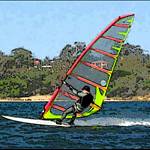
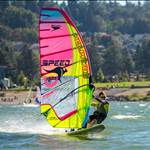
I didn't know that the WSSRC had a category for this but I saw this on the Luderitz site.
Open water windsurf record: Bjorn Dunkerbeck (SUI) – 44.74 knots (83kph)
Sponsors: Red Bull, VW, North Sails, Basf, Ecotel, Proof boards, Oakley, Mystic
Does anyone know if Sandy Point is regarded as "open water" or would it need to be ocean side?
Looking at the Luderitz site via photos and on google maps it seems it is almost a lagoon. Not exactly an ocean side site like Fuerte or Tarifa.
My impression is that pretty much anything other than the canal that is a 'natural' venue is considered 'open water'. It is not an official category anyhow AFAIK and I would consider Sandy Point, Southend and The Brace to be 'open water'.
Now, this brings up an interesting scenario, because Bjorn's 'unofficial' open water record is lower than Chris Lockwood's 'unofficial' open water record. In fact the top 6 500m speeds on GPS-SS are faster than 44.74 knots!
They are: Chris Lockwood: 47.2, Mal Wright:46.23, Dave White: 46.18, Martin Van Meurs: 45.15, Dirk Doppenberg and Tony Wynhoven: both on 44.98.
Opps, Have I just opened another can of worms...........
Andrew remember those speeds you quote are GPS timed speeds and not officially verified trimble speeds as used at Luderitz as required by the World Speed Sailing Council. That could be the reason why they are UNofficial and Bjorns is official.
Not sure if they are Doppler or Track point apart from Dirk, which is listed as Doppler. Not that it matters much as they are clearly faster.... and their Doppler speeds would be in their data anyhow if anyone wanted to nit-pick.
My point was that 'open water' is an 'unofficial' category, not a recognised record AFAIK. Just like GPS records. :-)
BTW, 'rex, they didn't use Trimble GPS at Luderitz. They had video timing gear.

I guess "open water" is any large expanse of water, a dam, big lake, wide river or estuary etc. So I wouldn't think sailing close to a sand bar etc could be called open water. In my mind "open water" would be as Yoyo asked, ocean side. And yes sailing in the flat between waves with the right wind direction can be a lot easier and faster than mongrel chop on an enclosed water system, but to me it's "open water"
I read last year, one of the Maui competitors said he thought he could go 9 knots faster if on a dedicated speed course in the same wind speed. (I hope I got that right)
Chris L would be near on the best speed sailer in the world, be interesting to hear his thoughts.
Just my 2c 
Well clearly sailing meters from a bank (and an artificial wall) at Luderitz is what they call open water. Remember that 'open water' does not have an 'official' definition as it is not an 'official' category. It is whatever you want it to be!
Open water as defined by
US army
OPEN WATER: An area that, during a year with normal patterns of precipitation, has standing or flowing water for sufficient duration to establish an ordinary high water mark. Aquatic vegetation within the area of standing or flowing water is either non-emergent, sparse, or absent. Vegetated shallows are considered to be open waters. The term 'open water' includes rivers, streams, lakes, and ponds.
Wiktionary
open water (plural open waters)
1. An expanse of an ocean, sea, or large lake which is distant from shore and devoid of nearby islands or other obstructions.
* 1851, Herman Melville, Moby Dick, ch. 13,
Gaining the more open water, the bracing breeze waxed fresh; the little Moss tossed the quick foam from her bows, as a young colt his snortings.
2. In a river, pond, or other small body of water, an area of surface unobstructed by aquatic vegetation, boulders, and the like, adequate for navigation or swimming.
* 1916, Joseph A. Altsheler, The Hunters of the Hills, ch. 1,
Willet sent the canoe through the open water between the tall reeds.
3. (mainly Canada) An area of an ocean, sea, lake, or river which is not covered by ice.
* 2005, "Seasonal Summary for the Canadian Arctic, Summer 2005," Canadian Ice Service, Government of Canada, 6 Dec, p. 1 (retrieved 14 Mar. 2008),
At the end of June, James Bay was generally open water except for loose ice persisting over its northwestern section.
"open water" is what used to be in my toilet bowl before I made a deposit
the "open water" term in speedsailing is an attempt to distinguish records set in perfect conditions, versus those set in natural, swell/wave-prone venues. It honestly has no value since some extensively open-to-sea venues (like Namibia and Fuerteventura) can be insanely good for speedsailing in the absence of swell- which does happen. Even Maui can be insanely flat for a few hundred metres over the reefs.
At the end of the day, some venues are ridiculously flat and windy compared to others. What we are trying to qualify is the level of difficulty/chop involved when the record was set. Unfortunately "open water" is a bit of a hit and miss term.
A more useful distinction might be man-made/altered, versus natural. Luderitz and the canal would not be considered natural venues. ie by altering the landscape to assist in breaking records the venue is no longer a "natural" venue. There is significant advantage in modifying the landscape to fine tune the conditions for breaking records. Just my 2c...
Actually, not sure how they can claim Luderitz as open water with sandbags and a wooden fence chop breaker.
For anyone interested, this is how measurements are taken and times verified at luderitz.
It is important to be aware that the speeds live from the strip are provisional -- they have to be verified against the video records with possible correction, and can also be modified again by WSSRC to correct for water currents.
The times for each run are measured by Markus Schwendtner from HighSpeed-Timing.com, veterans of the meticulous art of measuring the speeds of racing craft of all descriptions. A video camera monitors the start line, connected to the timing system by radio link. This is synchronised with a second video camera that monitors the finish line, and with the timer. The video camera method is not only extremely accurate, but it provides a way to go back and review events to be sure that everything is correct - both timing and the identity of the competitor.
When we publish results live, they are the measurements taken live by HighSpeed-Timing under observation by the WSSRC official, Michael Ellison, and are published immediately to “Live” as provisional times. We then update these posts with the reviewed times a few hours later, when the video records are rechecked frame by frame to give exact timings. The WSSRC official also may apply an adjustment correcting for currents, according to accurate measurements taken during the day's competition, particularly when someone does a record speed run. The verified speeds are still subject to final ratification by a sitting of the World Speed Sailing Records Council, but this is normally just to ensure correct procedures were followed in the records claim.
Because there is some confusion around which times are which, posts will indicate clearly what the status is of a result. The results on the Luderitz-speed.com “Live” are "provisional” speeds, these are then updated later with "confirmed times, unratified", and after final WSSRC sign-off, as "ratified times". This final step can take some time after the event.

This is straight from someone who should know what a record is, Christophe Simian, taken from the Windsurf Journal website. a part of his comments about the recently broken records at Luderitz:http://www.windsurfjournal.com/frontblocks/news/news.asp
...............But you'd also have to say that there's still no record for open water sailing and that therefore Bjorn Dunkerbeck has never set any kind of record. If such a thing existed it would be held by Yellow Pages with its 46.52 knots, leaving Bjorn Dunkerbeck a long way off the mark !................
interesting.....
Our newfound spot de Brace is on de waddenzee (sea). We're sailing behind the usual sandbank, nothing artificial to it, open sea, but the best spot I've ever sailed. Better than the canal when everything comes together. The only advantage of the canal I can think of is the fact there is no tide so one can sail anytime the wind is there. I agree with the people who think the open water title is worth nothing. It would only mean a thing if one would have to sail a given distance from a shore and not supported by an artificial wave breaker.