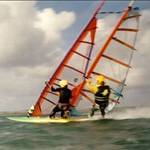
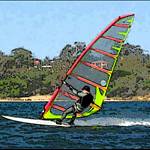
The topic may be somehow related to an inflatable enlarger for the board, but I think this another invention of mine deserves separate input.Same problem or similar. How to get to the starting point on a small speed board? In a comfortable and easy maner.Sailing up the wind to the highest point, on a small board with the smallest fin possible may not be easy, or even possible at all.There comes a very simple invention.
Let's do fiberglass or carbon fiber sleave extension to our small speed fin. Something easy for slide in- like our typical cover for fin, but stiff.
Extending typical twenty-something fin into massive thirty-something.Without the need to change, replace fins something easy, just to slide on, secure safely to existing fin, and sail up the wind.
On arrived release sleave and get into camel backpack.


Sleave could be made as a mold on our typical fin , from fiberglass matt.
Some community brainstorming is required to come with ideas on how to secure our leave to fin, to prevent falling off. Something quick and easy.Our fin extension is designed to increase our comfort as a temporary one-way gadget, not for racing and speeding. In some cases may serve also as a protector of our fin from damage while sailing unknown risky terrain.
Better.
But if you are fully powered going deep downwind, you would have plenty of power to go high upwind!
Same sail, same board, maybe change the fin.
Select to expand quoteLeeD said..
Better.
But if you are fully powered going deep downwind, you would have plenty of power to go high upwind!
Same sail, same board, maybe change the fin.
Right, what I am proposing here is avoiding to change the fin.
JUst a simple sleeve that pops on top of your existing fin, That is it. Takes 5 seconds and can be made on the bank or in the water.
Just as your ordinary fin cover. Just a stiffer and a bit longer.Something that you could easy can and want to do several times a day.
LIke at Burrum that you need to climb 2 -3 km upwind, up the chop.
There is plenty of wind, your small board is not sinking, but on the very small fin going up is a hassle and takes more time than with a simple insert extender.
Select to expand quoteelmo said..
Inflatable fin with a foot pump on the board
we have been talking about fin that could retract, but that is another option, to get into the highest possible speed.
Retracting incrementally fin length when already at high speed to get into even higher. This one is for taxing onto place to start your speed run, slowly maybe but with least efforrt , to save energy on the more important run.
Just skill up. 

In all my many years of speedsailing, mostly on really narrow boards (40cm and 50-60L) and really small fins (typically 16-20cm and very often assy fins), I have never felt it was a blocker to just sail upwind as best I could. In some of the best places it is actually better in many ways to walk upwind for part, or all of the way anyhow. (Not much slower, use a lot less energy and a lot safer) and in one decadent notable anomaly, you hitch I ride on a trailer back to the start. 
Remember that many of us actually deliberatly compromise our upwind effeciency now buy choosing to use assymetrical fins! And we feel that is a compromise that is easily worth it. 
Before I even considered compromising the fin design for easier upwind sailing, (and a shape shifting fin would have to be HUGELY compromised!  ), I would explore 'quick changing' the fin. That would seem to be far easier and far more efficient. Perhaps you could turn your mind to a super quick change, tool-less, Tuttle base fin change system?
See, I just 'invented'. it, but I would have no problems with you claiming it if you develop it Macro. 
Select to expand quotesailquik said..
Just skill up.
In all my many years of speedsailing, mostly on really narrow boards (40cm and 50-60L) and really small fins (typically 16-20cm and very often assy fins), I have never felt it was a blocker to just sail upwind as best I could.
Before I even considered compromising the fin design for easier upwind sailing, ( and a shape shifting fin would have to be HUGELY compromised! ), I would explore 'quick changing' the fin. That would seem to be far easier and far more efficient. Perhaps you could turn your mind to a quick change, tool-less, Tuttle base fin change system?
Again, retractable fin could be the answer. One fin that do all.
Skilling up is the main problem.
I hardly could use small sail and small boards, without the risk of sinking in Queensland where the good wind is rare as hen tooth.So I do sail on what is easy - ninety-something liters. Compromised speed vs comfort.A good board like this FF 51 is sitting on the shelve for years, but once I have a chance to ride is nothing better in the whole world that could compare with the pleasure But I agree that the system of boxes and mounting is not very practical and need to complete new rethinking. The best example is foil attachment now on deep tuthle. What the absurd - as that box is not engineered to transfer forces required by hydrofoil.Again mounting foil on the board is a hassle and takes time. It should be as easy at getting your ski boot into ski binding. Just a click.Foil mast is the worst- require you to buy a truck to carry everything like good old times 4-meter boards used to be.
It must be a better way and will be found one day.
I think talk of a 'foil attachment' is going in completely the wrong direction. Stick with what is easily available (Tuttle base speed fins) and invent a really quick change system.
Extending fins have been tried a number of times, and development abandoned many years ago, but the idea is still relevant of you can perfect the engineering and avoid compromising the speed downwind. One issue to remember is that modern boards and stance have at least part of the back foot directly over the fin, is bringing it up through the beck is problematic.
I don't think your local wind conditions are as much of an issue as you may think Macro. I have comfortably used my 40cm speed board at Burrum heads when you were there on a 20-25 knots day at the end of the week. But I probably would have used a slight larger (47-48cm wide) board that day if I had the choice. The big change I have noticed in the last 5 or so years has been the development of larger 'speed/slalom boards in the 50-60cm wide range that are very capable of 40+ speeds, even for the smaller sailors, not just the big guys. That certainly opens up a lot more less than ideal spots and less than ideal wind conditions. But the fact remains, if you are trying to achieve your absolute personal best, no compromises are desirable when conditions are epic and it's not going to be easy. Some element of calculated risk has to accepted.
Select to expand quotesailquik said..
Just skill up.
In all my many years of speedsailing, mostly on really narrow boards (40cm and 50-60L) and really small fins (typically 16-20cm and very often assy fins), I have never felt it was a blocker to just sail upwind as best I could. In some of the best places it is actually better in many ways to walk upwind for part, or all of the way anyhow. (Not much slower, use a lot less energy and a lot safer) and in one decadent notable anomaly, you hitch I ride on a trailer back to the start.
Remember that many of us actually deliberatly compromise our upwind effeciency now buy choosing to use assymetrical fins! And we feel that is a compromise that is easily worth it.
Before I even considered compromising the fin design for easier upwind sailing, (and a shape shifting fin would have to be HUGELY compromised! ), I would explore 'quick changing' the fin. That would seem to be far easier and far more efficient. Perhaps you could turn your mind to a super quick change, tool-less, Tuttle base fin change system?
See, I just 'invented'. it, but I would have no problems with you claiming it if you develop it Macro.
one of the most annoying things about Tuttle is the inability to set high of box insert precisely. Without filling, adding stuff, that requires time, is not transferable from one board to another. You may want to have the base of the fin precisely even with the surface of the board.Each imperfection creates drag and turbulence. Maybe the proper speed board should have even that fin base, but fin should extend from the fissure in the board, exactly? I am already thinking that the best racers use some hard compound to glue , cover fin box fissure and then file and polish for optimal shape and smoothness.I did try one day candle but stuff pop our instantly.
Select to expand quoteMacroscien said..sailquik said..
Just skill up.
In all my many years of speedsailing, mostly on really narrow boards (40cm and 50-60L) and really small fins (typically 16-20cm and very often assy fins), I have never felt it was a blocker to just sail upwind as best I could. In some of the best places it is actually better in many ways to walk upwind for part, or all of the way anyhow. (Not much slower, use a lot less energy and a lot safer) and in one decadent notable anomaly, you hitch I ride on a trailer back to the start.
Remember that many of us actually deliberatly compromise our upwind effeciency now buy choosing to use assymetrical fins! And we feel that is a compromise that is easily worth it.
Before I even considered compromising the fin design for easier upwind sailing, (and a shape shifting fin would have to be HUGELY compromised! ), I would explore 'quick changing' the fin. That would seem to be far easier and far more efficient. Perhaps you could turn your mind to a super quick change, tool-less, Tuttle base fin change system?
See, I just 'invented'. it, but I would have no problems with you claiming it if you develop it Macro.
one of the most annoying things about Tuttle is the inability to set high of box insert precisely. Without filling, adding stuff, that requires time, is not transferable from one board to another. You may want to have the base of the fin precisely even with the surface of the board.Each imperfection creates drag and turbulence. Maybe the proper speed board should have even that fin base, but fin should extend from the fissure in the board, exactly? I am already thinking that the best racers use some hard compound to glue , cover fin box fissure and then file and polish for optimal shape and smoothness.I did try one day candle but stuff pop our instantly.
Tuttle box bases are very easy to 'adjust' for perfect depth. Add thin shims (tape or plastic) or a coat of resin to the front and/or rear taper, or sand the base taper slightly. Simples. Lots of sailors have done this very successfully for 20 years!
The other thing that kind of nullifies the need for this is that we usually have certain fins for certain board and sail combo's. So I don't ever try to fit my small speed fins into my other boards anyhow.
And as someone who spent many years playing with speed boards in the 80's and 90's with US base fins, I can tell you that Tuttle box fins fair into the board infinitely better, I can remember all sorts of experiments with plasticine and adhesive tape etc, to try to fill and fair the US box cavity around the fins and fixing screw, and the jury is still out on whether that really made any noticable difference, perhaps just because we were going significantly slower back then. (30Kt was then what 40Kt is today! )
Select to expand quotesailquik said..Macroscien said..sailquik said..
Just skill up.
In all my many years of speedsailing, mostly on really narrow boards (40cm and 50-60L) and really small fins (typically 16-20cm and very often assy fins), I have never felt it was a blocker to just sail upwind as best I could. In some of the best places it is actually better in many ways to walk upwind for part, or all of the way anyhow. (Not much slower, use a lot less energy and a lot safer) and in one decadent notable anomaly, you hitch I ride on a trailer back to the start.
Remember that many of us actually deliberatly compromise our upwind effeciency now buy choosing to use assymetrical fins! And we feel that is a compromise that is easily worth it.
Before I even considered compromising the fin design for easier upwind sailing, (and a shape shifting fin would have to be HUGELY compromised! ), I would explore 'quick changing' the fin. That would seem to be far easier and far more efficient. Perhaps you could turn your mind to a super quick change, tool-less, Tuttle base fin change system?
See, I just 'invented'. it, but I would have no problems with you claiming it if you develop it Macro.
one of the most annoying things about Tuttle is the inability to set high of box insert precisely. Without filling, adding stuff, that requires time, is not transferable from one board to another. You may want to have the base of the fin precisely even with the surface of the board.Each imperfection creates drag and turbulence. Maybe the proper speed board should have even that fin base, but fin should extend from the fissure in the board, exactly? I am already thinking that the best racers use some hard compound to glue , cover fin box fissure and then file and polish for optimal shape and smoothness.I did try one day candle but stuff pop our instantly.
Tuttle box bases are very easy to 'adjust' for perfect depth. Add thin shims to the front and/or rear taper, or sand the base taper slightly. Simples. Lots of sailors have done very successfully this for 20 years!
The other thing that kind of nullifies the need for this is that we usually have certain fins for certain board and sail combo's. So I don't ever try to fit my small speed fins into my other boards anyhow.
yes, that a problem. Your fin fits perfectly your particular board because you spend hours to make it fit. Doesn't work on another board of yours, say nothing to borrow/ lend fin to friend/stranger.By nowadays technical standards that is not good enough and we should do better. What you buy a bolt from Bunning 10mmm or 3/8inch you don;'t need to run file to improve groves change thread your nut.
Select to expand quoteMacroscien said..
yes, that a problem. You fin fit perfectly your particular board because you spend hours to maki it fit. Doesn't work on another board of yours, say nothing to borrow/ lend fin to friend/stranger.By nowadays technical standards that is not good enough and we should do better. What you buy a bolt from Bunning 10mmm or 3/8inch you don;'t need to run file to improve groves change thread your your nut.
It normally take me only minutes to 'fit' fins to my boards. I don't normally use fins in more than one particular board. Each different board usually has a preference for a particular set of fins that i rarely even consider using in other boards.
I regularly borrow and test fins from others and have lent fins to many people and rarely have a significant issue with fit, especially of the fin is slightly deep in the box, when it really does not make a significant difference. You are better of spending the time tuning your sail.
Select to expand quotesailquik said..Macroscien said..
yes, that a problem. You fin fit perfectly your particular board because you spend hours to maki it fit. Doesn't work on another board of yours, say nothing to borrow/ lend fin to friend/stranger.By nowadays technical standards that is not good enough and we should do better. What you buy a bolt from Bunning 10mmm or 3/8inch you don;'t need to run file to improve groves change thread your your nut.
It normally take me only minutes to 'fit' fins to my boards. I don't normally use fins in more than one particular board. Each different board usually has a preference for a particular set of fins that i rarely even consider using in other boards.
I regularly borrow and test fins from others and have lent fins to many people and rarely have a significant issue with fit, especially of the fin is slightly deep in the box, when it really does not make a significant difference. You are better of spending the time tuning your sail.
I am a simple bloke farm man, I spent my time on tuning my tractor!

then thousand other things that need rethinking at our farms and homes.
Select to expand quoteMacroscien said..
How to get to the starting point on a small speed board? In a comfortable and easy maner.
Sleave could be made as a mold on our typical fin , from fiberglass matt.
Some community brainstorming is required to come with ideas on how to secure our leave to fin, to prevent falling off. Something quick and easy.Our fin extension is designed to increase our comfort as a temporary one-way gadget, not for racing and speeding. In some cases may serve also as a protector of our fin from damage while sailing unknown risky terrain.
You want to come back upwind in an easy comfortable manner? Why stop at sleeving a larger fin over a shorter fin? Sleeve a foil over it. We know tuttle boxes are up to the job. You should be able to design a fold away foil that packs on the front deck. Nobody has tried deliberately adding a little weight to the nose of the board, but it should aid directional stability. That might be handy in 30 knots of wind. Win/win.
There's a board already made for the job.

What would win a there and back LOC. A foil board, a slapper, or a slapper stowing a foil that could be fitted on the beach in 3 minutes?
Select to expand quotemr love said..
A flap would be the best way, have a high lift setting and a low drag setting
Is the low drag setting to give you an extra knot of top speed or to gain 10 degrees of pointing angle?
Select to expand quoteIan K said..mr love said..
A flap would be the best way, have a high lift setting and a low drag setting
Is the low drag setting to give you an extra knot of top speed or to gain 10 degrees of pointing angle?
Depending on your fin size ( and skills obviously as Sailquick mentioned  ) ,
) ,
To get to the top of Burrum run could take from just a few to even more tacks and gybes.Wasting precious energy in the chop.How convenient it could be to go sharp to the wind, so we could use almost the same path near the bank, at ultra flat water? Maybe there is some other invention to allow us to get ultra sharp up wind on speed board ?
 We know that central board could be very effective in improving our angle. What about small additional fin in the front of the board?
Something like small shoe on the top of the board with 10 cm fin? what difference it may do ?
removable shoe of course
Select to expand quoteLeeD said..
Sounds like you are looking for a dagger board and forward sets of footstraps.
yep , maybe.
but maybe to extreame?
what about additional fin in the front of the board ?
If works then even small fissure could be made in the front of speed boards to put the fin ON and OFF easy.
eventually that doesn't make any difference whe board is flying high speed the nose is up above water.
Or small plug for cover the fissure will do .Additionally our additional fin could be asymmetrical, tilted already like a rudder to help us get optimal angle up the wind sharply?
I've had thought of this idea years ago don't know if I had seen or read about it but the fin pulls through the tail, wouldn't be any good on current designs because out feet are over the fin.

They figured a gasket and constant parallel fin shape by around '87.
Durability and slight wobble was still a problem.
Something you can reach down to adjust while holding position under changing lateral loads was a killing point.
Select to expand quotemr love said..
It would need to be sealed so it didn't suck air down the fin box.
Thought about the dagger board fin years/decades ago but after loosing a rear fin bolt and struggling to get back upwind with the rear of the board sounding like a vacuum cleaner with all the air being sucked down and ventilating the fin I realised it would be more trouble that it was worth. All the good sailors (not me) seem to get back ok. Light rear foot pressure.
Select to expand quoteyoyo said..mr love said..
It would need to be sealed so it didn't suck air down the fin box.
Thought about the dagger board fin years/decades ago but after loosing a rear fin bolt and struggling to get back upwind with the rear of the board sounding like a vacuum cleaner with all the air being sucked down and ventilating the fin I realised it would be more trouble that it was worth. All the good sailors (not me) seem to get back ok. Light rear foot pressure.
After loosing fin completely ( single bolt type) , years ago I did try few times sailing back without any. Can be done with some practice, although not fun at all.