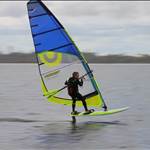
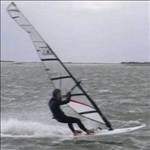
Check it: http://gpsteamchallenge.com.au/showsession.php?date=2008-01-04&team=16
Must be all the coaching I gave him while I was over there
Thanks guys 
It was almost perfect conditions today to have a good go. 18-22 knots and low tide. The wind eased a bit at times and I actually felt slightly underpowered and under finned, even on my best runs so I recon there is still a bit of headroom left for me yet.
I was surprised and impressed at how quick the TM speed 26 was on a beam reach on the run in and run out.

Congratulations Andrew, a truely world class result. Its great to acknowledge the gear but in Alpha Racing its more about the rider than any other category of speed sailing. Brilliant work.
What is that saying you like best, "The older I get the better I was"? Well what really applies is... "The older you get the better you are"!
Mal
Funny that such a high scoring gybe could be only 450 metres or so... look at the other ones as well, one of them is only 400 metres!
Very nice though, I'm jealous 
great -awesome gybe Andrew the bar has been set high now!!!
would be interested to get a comment from Mal re the distance measurement as it looks unusual for a 500meter reading?
One of the key elements of Alpha Racing is the maximum distance value. It restricts the total distance to a set maximum that ensures the gybe is a big part of the result. The longer the distance in the Alpha division the higher the speeds will be, on average.
But it is it entirely possible and allowable to use a shorter distance than the max distance for any given division. If you can do a 30 knot Alpha over 200m, and it is your best result, then that will count for the 500m division! The problem is that it is exponentially more difficult the shorter the distance gets. Andrew's result over 400m shows he has even more gas in the tank yet, and can go even faster when he optimises the 500m available.
I expect to be updating his results again on the next big easterly...
The whole idea of alpha-racing is excellent, however one of the problems with the current recommended settings is that it doesn't represent a real-world sailing scenario - not that the current settings are "wrong" but just that I think some refinement is possible, ie:
- the 500m distance is too long such that it doesn't measure your actual gybe speed, where as the 250m gives a better representation; combined withthe 50m radius, we could even shorten the distance further.
- the tighter the gybe, the less downwind loss -> with an allowance of a 50m downwind radius, it doesn't show how tight your gybes are.
- in figure-8 racing you must cross over your previous leg at some point before the next marker -> it would be great to see Realspeed have this as an option which could be enforced.
Thoughts?
My thoughts were that's a mighty fine alpha, and looking at the track it would still qualify as a top 250m one. Mat's suggesting the return 50 m radius might encourage a wider gybe. To simulate figure 8 racing I suppose the computer could calculate the radius of your gybe and require that you cross tracks upwind and get to that diameter ( 2*radius) upwind of your start position to qualify. That way by gybing tightly you'd not have to go so far upwind to be in position for a similar gybe at the virtual starting buoy. Tight gybes might push gps resolution though.
Calculated Daffy's centrifugal acceleration in that gybe, at about 10 m/sec on a 25 m radius , a = v*v/r , that's 0.4 Gs. So quite a bit of G force in that gybe, can you even pull any more on a sailboard on flat water? So I think a tighter gybe would have to be slower, maybe a ~25 m arc is optimum anyway, and the current format is already simplest and best?
The other real world gybing scenario a computer could calculate is max VMG downwind for 250m point to point with one gybe - but that might not be a good thing to encourage.
I don't see the need to simulate anything. If you want to do real world racing, do real world racing.
I'm very happy with this as a unique computer aided gps division in it's own right, with a whole new set of strategies to work out, to get best results.
 .
.