Catapults at 30 knots+ are not fun anymore.
Does anyone have any techniques or equipment that lessen the risk of having the catapult?
Has anyone tried inverting the hook, using sacrificial harness lines or some other technical aid?
It seems to me that being able to un-hook somehow is the key.
But everything happens too fast to allow rider input.
Interested to hear what people think.
The only way to avoid them when speeding is to stay on the beach.
Generally I find I get splattered more when I go conservative and tense up rather than letting the gear run, at the moment my mind set is not right for speeding, I need to do some work to get it back in the right place.
As generally by the time you realize you are in trouble it's already to late I do like my harness lines to break rather than stay hooked in and get slammed when catapulted which has a tendency to either break me or some more expensive part of the rig.
sailing the river yesterday was catapult/injury waiting to happen.
conditions,steep chop,around 15/30 knots,much higher in gusts.
you could push speed hard in lulls reasonably safely,in gusts could do 26/27 knots,any higher then catapult became inevitable.
to kill speed and avoid catapult i sailed upwind when i reached around 25 knots of speed.
a lower boom in these conditions can reduce lift of board.
sheeting out in gusts can help too.
weed fins can reduce catapults,they reduce lift of board significantly, so you can push it harder.
or try a very flexible pointer fin, this has similiar control effect to weed fin.
Maybe some Erik's tips help you:
www.speedsurfingblog.com/2010/06/how-to-prevent-damage.html
Catapaulting is possibly the best way to crash. I've been most rattled in crashes where I've been unhooked. You can hit your gear. If you don't tuck into a ball and a loose leg catches you get slapped down really hard. Can get a bit of whiplash.
Staying hooked in and sheeted in avoids these possibilites. You also get a bit of forward rotation to lessen the relative speed of hitting the water.
Waist harnesses are most comfortable to catapault in. They support you closest to your C of G making it easier to hang onto the boom and stay sheeted in.
I've bent 2 spreader bars. Doesn't hurt a bit.

Fair enough Elmo - but how can we be sure the harness lines will break at the right time?
I wonder if anyone has had a go at calculating the moments of force involved to compare the forces of a catapult with normal sailing.
PM33 - I take your points about lowering the boom and using a weed fin to lessen lift. It seems though sometimes lift can get you out of the chop and a smoother ride?
IanK - your idea that staying hooked up can keep you out of harms way - I'm usually hooked up at the beginning of the catapult but by the end I am unhooked and free to get crashed by the board and boom.
I'd be happier if I could somehow eject (or break) the harness lines as the catapult starts and perhaps avoid the crash completely.
Re Harness lines, sorry it's trial and error finding out what works best for you.
I sail quite a bit and go through about 3-4 sets per year, Some through general wear and tear others by catapulting and staying hooked in (catapulting and unhooking in flight is the ideal scenario if you get catapulted).
I've tried I think around 4 of the major brands and found my ideal set.
Some wear out the webbing to quick, others had other problems.
The ones I've settled on give as good er life as any but will break at the stitching when I cop a b1tch whipping.
Always keep a spare set in car/trailer then you are good to go again when back on shore after 1/2 hour of maintenance and conversation.
it hapens to fast to chose how ya dunna land but idealy id say ud wanna be hooked in and holding onto the boom .. a couple of times ive let go of boom while hooked in and slamed into the mast .. if ya hang on ya might slow ya body down a bit
When it happens I get into the fetal position and hope i wake up after the landing, seems to have worked so far.
I'm pretty sure I was unhooked when I came off badly recently and bust my nose on the edge of the board. If you are unhooked you have to jump clear and tuck pretty quickly or else the gear can really belt you - as I found out. I was unhooked but hung onto the gear a tad too long as I was concerned that if I let if go it would have blown across the inlet at Sandy Point. It was quite windy that day.
I can recommend the NP adjustable lines for letting go at the webbing in a hard catapault. They have done this for me now in two out of two recent heavy falls - but never broken during ordinary sailing. But I am fairly light and it would be different if I was 100kg or so.
Dare I say it, is there any kite technology strain breakers that could be incorporated into harness lines?? Some sort of load limit which is set as a function of user weight??? So I buy 100 kg rated line and Peter purchases 80kg?
Something for the inventors out there
Russ
As Fred Haywood used to say, "Never Sheet Out". This is especially true when sailing at finer angles. Also try your mast base a little further forward to keep the nose down. Also make sure your back foot is really plugged into the strap because you're unlikely to loose it in a true catapult if you're also strong.
If you're weak, asta la vista.
I went over the handlebars at 35 the other weekend in dead flat water, it is just a normal part of speedsailing which only practice will help avoid, I have never broken a harness line but the other weekends one did cost me a boom and a harness hook

My last sail the fin hit the bottom just as I was about to bear off down the speed run at Henty while doing around 35 knots. Totally out of the blue and just got swung around the front of the rig and snapped the harness line on impact. Definitely think it saved my boom and mast (and me). Top batten broke as the mast hit the water during forward loop mode. I've broken a few lines like that now and harness hooks too. Definitely agree that you just go for it and stay sheeted in. When things go wrong there is no time to react.
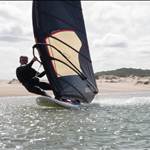
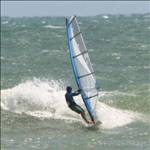
This is the end of a catapult on the weekend, not sure what happened just happened so fast

If you look hard enough you can make out the top of the RS slalom sail, was at 29 kts


Tom Chalko went to a lot of effort a last year to perfect his 'breakaway' harness lines. He experimented with various controlled amounts of strong, thin line that would allow his harness lines to break before his harness, boom or body. After a few teething problems with premature ejection he reckoned he had it about sussed last summer, at least for his weight. 
Its very easy,I work over 20 years fins without spin outs. A cut out at the base,
doubleconcaves( diagonal).Thomas Döblin made 50knots topspeed here in Germany.
2 weeks ago, made 3 speeder good topspeed with the rake 30° fin in22cm.the same fin that Döblin used. www.designlessacher.eu Wolfgang