Asymmetrical fins are designed to work best in one direction and trade drag in the speed direction for lift in the upwind direction. I wonder if a very fine fin with a means to rotate it a bit around the vertical axis would achieve the same thing. Then you could run the same "asy" fin in both directions.
A fin foil is optimized for a certain angle of attack. It is independent of the angle of the board. Having the fin rotate in the board will achieve very little except to slightly reduce the 'crabbing' of the board upwind.
In my experience, the trade off upwind is less lift for the same size/area fin, but with the KA/Lockwood fins this is very minor as they are not as exaggerated 'assy' as some others.
For the Time Machine fins ( a bit more 'assy' than the KA) the upwind performance is very good within a 'sweet spot' at around 18-22 knots. If you can stay in this range they truck upwind very well indeed, although you do have to put up with some minor 'crabbing' of the board. Really rough conditions upwind is really where they lose out a bit because it is hard to keep the speed up to get into that sweet spot.
if you are looking at a assy fin i highly recommend ka assy's and symmetrical fins
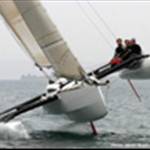
What some one needs to sit down and design a Gybing fin /fin box set up ,Used for years in high performance sailing dinghys.and cats such as 505's 14 ft skiffs and F18 cats such as Nacra Infusions' .this set up produces ****loads of lift,helps upwind performance
Here's an example.http://www.usa505.org/wiki/index.php5?title=How_Gybing_Centreboards_Work
The fin on a sailboard produces lateral resistance and lift the same as a dinghy centerboard ,if you could somehow rotate the leading edge of the fin around 3 degrees to windward this would give the same result as an asymetrical fin.The gybing centerbords actually gybe automatically from side to side (rotates in centerboard case) when you change directions (tack or gybe).

I think they missed a trick in that one. The fin flops from a starboard to port asy but it seems to me that if you are going to go to the trouble of making an articulated fin you may as well take the extra step of articulating the angle of attack. Maybe it was too complicated to bother with. The gybing centre board looks doable in principle.
If the bottom of the board is flat and featureless then the fin may as well be centred because changing its aoa in relation to the hull would make no difference as sailquick said. However if it has any feature like v or concaves or channels then the fin heading should be reasonably expected to make a difference.
By far the most common feature is v. For the fin to work at a favourable aoa the hull must be pointed upwind of its true path (crabbing). This results in an upwind bias in the direction of water flow under the board. In this case you will get water flow crossing the chine along the centre of the v. This will create a small pressure drop on the upwind side of the hull and tend to suck the board into the water with an overall marginal increase in drag. (I believe its this effect that makes v better for gybing) With concaves you just get differential lift but the local aoa of the hull at the edges of the concave is increased. That should tend to hold the nose down but I think it would also be a little draggy. Not sure. I can't help thinking that for outright speed a flat featureless planing flat is best. If you must have v for control in the bumps then a fin with a variable aoa would probably be a tad faster.
the depth of the concaves has a very big impact on all of the above.
there are also other factors involved when using concaves. the main one being that a concave introduces a flat area to the rocker which can improve speed and early planing. you also get more control with the extra v so all of these things i would think make the board potentially faster.
taking notwals example there are lots of areas to locate the v along the length of the board.
putting it up front increases control in chop. (spiral v)
putting a flat v in the tail makes the board ride higher in the water and change lateral stability
so there is a lot going on and it's a system that needs to be ballanced.
a flat featureless tail is easier to design and get right so that may out weigh everything also.