Not sure if this has been mentioned before. I'm totally intrigued by this nano technology that can keep the bottom of a board totally dry by not allowing water to adhere, surely it would make our boards faster on the water.
Im thinking it couls be a solution to prevent stuck zippers on board bags and general corrosion.
The demo's in the site are pretty cool, have a look at the link.
How does Ultra-Ever Dry work?
Answer: The bottom coat bonds to most materials and acts as a primer. It also offers corrosion protection and provides a consistent material for the top coat to bond to while interacting with the top coat to self-assemble the surface into a nano-textured surface. This surface creates patterns of geometric shapes and billions of interstitial spaces that trap and hold air creating an ?umbrella of air? on the surface of the coating. There are high points in the texture that only allow the water droplets to touch approximately 2-3% of the coating itself. The rest of the water droplet rides along the layer of trapped air. The coating also has low surface energy. It is the combination of these elements that allow Ultra-Ever Dry to be superhydrophobic and oleophobic for refined oils.
www.spillcontainment.com/products/ever-dry
still not sure about this issue, the guys in the pwa sand their boards down to the max.
But surely you need a minimum surface contact.... Not long ago a mate of mine sanded and polished/waxed the bottom of his firerace, I tried it and the blessed thing was a nightmare to control...
too technical for me.....
This is what shark skin looks like.

Someone will come along to this thread soon and explain it better than I ever could.
^^ laminar flow and friction. Smooth surfaces will have more friction than a sanded surface as water will stick to the smooth surface. A sanded surface wont have the same laminar flow as the smooth surface as the laminar flow is broken up so the water dosnt stick to the sanded surface.
I think thats right 
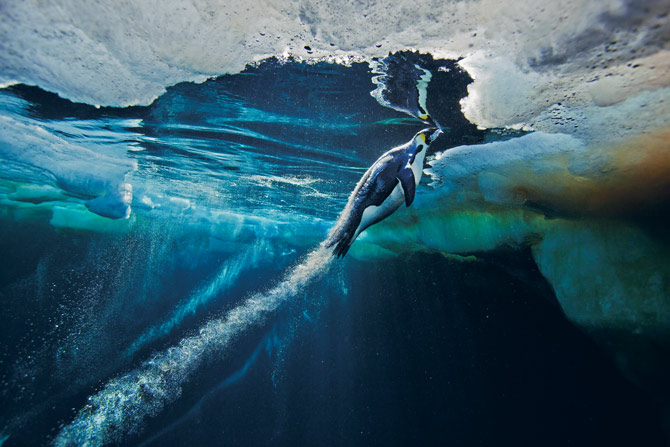 ?w=670&h=447
^^^So I need to glue feathers on the underside of my boards in order to go faster - OK!
Select to expand quoteWA71 said..
^^ laminar flow and friction. Smooth surfaces will have more friction than a sanded surface as water will stick to the smooth surface. A sanded surface wont have the same laminar flow as the smooth surface as the laminar flow is broken up so the water dosnt stick to the sanded surface.
I think thats right
If you look at the demo on the product the water does not stick to the surface whatsoever. According to them the nano product creates a layer of nano air bubbles on the surface. Even paint didn't stick to the surface of the applied product.
If you covered the whole board it would come out of the water dry!
Select to expand quoteSailhack said..
^^^So I need to glue feathers on the underside of my boards in order to go faster - OK!
No just the penguin 
Select to expand quoteMark _australia said..
We have been here before, a little rough is faster.
Why fish so slimy? Slime fast?
Select to expand quotebarn said..Mark _australia said..
We have been here before, a little rough is faster.
Why fish so slimy? Slime fast?
Same reason all your membranes exposed to the outside world have mucous too.
Not to be fast 
Select to expand quoteMark _australia said..
We have been here before, a little rough is faster.
So why is the worlds fastest production board super smooth and glossy?????
Select to expand quotewantmorewind said..Mark _australia said..
We have been here before, a little rough is faster.
So why is the worlds fastest production board super smooth and glossy?????
He won't answer unless you use at least 6 question marks..
Select to expand quoteWA71 said..
^^ laminar flow and friction. Smooth surfaces will have more friction than a sanded surface as water will stick to the smooth surface. A sanded surface wont have the same laminar flow as the smooth surface as the laminar flow is broken up so the water dosnt stick to the sanded surface.
I think thats right
Sounds good to me. A rough surface induces a turbulent boundary flow. Golf balls use the dimples to increase lift and reduce drag. I remember reading somewhere about aeronautical companies looking into making wings with dimples but suspected the dimples might be more effective with spin like golf balls have in flight, as opposed to linear motion.
It would be interesting to see how this layer of air effected the surface friction.
Cool videos on the site anyway
Laminar flow (what shark skin causes)is supposedly the best compromise, if the surface isn't hydrophobic, or emitting some sort of polymer, like they experimented with back in the good old days. They'd stick anything on the bottom of a yacht if it'd make it go faster back then.
If the coating is truly hydrophobic, a board should be faster with it on the bottom. Good luck trying to go in a straight line with it though
Only $160 for a few litres. Better try it out. BUT "no meaningful results yet as a boat coating".
Different to a penguin which releases a stream of minibubbles.
Something still has to support the Weight of The Rider. With 3% water contact the point loading would be several TONNES.
Which would tear off the coating?
No free lunch... maybe a 1000 cm wide board would sort of work,
Select to expand quoteoldie said..
Something still has to support the Weight of The Rider. With 3% water contact the point loading would be several TONNES.
Which would tear off the coating?
No free lunch... maybe a 1000 cm wide board would sort of work,
Are you saying that the board will sink, because the 97% of the water will refuse to displace it?
Select to expand quoted1 said..
oldie said..
Something still has to support the Weight of The Rider. With 3% water contact the point loading would be several TONNES.
Which would tear off the coating?
No free lunch... maybe a 1000 cm wide board would sort of work,
Are you saying that the board will sink, because the 97% of the water will refuse to displace it?
Well, considering 99.9999999998% of an atom is empty space, and the water is made of atoms, and so is your board!So then nothing is touching!!!
We should just past straight through the water..
Select to expand quoteMark _australia said..
We have been here before, a little rough is faster.
In the demo they actually mentioned that the nano layer is a bunch of dimples / bumps, but i guess being nano size bumps it will still be smoother than a baby's bottom.
I think I might throw some on my westsuit, I like the idea of coming out of the water bone dry, like the gloves in the demo !
Select to expand quoteWaiting4wind said..
I think I might throw some on my westsuit, I like the idea of coming out of the water bone dry, like the gloves in the demo !
Since your wetsuit is porous, you may want to try some silane or siloxane instead. The repelling effect on water is exactly the same, but the cost is an order of magnitude lower.


Select to expand quoteWA71 said..
^^ laminar flow and friction. Smooth surfaces will have more friction than a sanded surface as water will stick to the smooth surface. A sanded surface wont have the same laminar flow as the smooth surface as the laminar flow is broken up so the water dosnt stick to the sanded surface.
I think thats right
Doggie, I have a vague recollection that the sanded surface traps a thin layer of water and then this layer 'slides' over the surrounding water.
The theory being that the 'water to water' friction is less than the the 'water to board' friction (on a super smooth board).
I've read somewhere (but am too lazy to google now) that 800 grit wet and dry paper produces a surface that is about the optimum 'roughness'
Select to expand quoteSkid said..WA71 said..
^^ laminar flow and friction. Smooth surfaces will have more friction than a sanded surface as water will stick to the smooth surface. A sanded surface wont have the same laminar flow as the smooth surface as the laminar flow is broken up so the water dosnt stick to the sanded surface.
I think thats right
Doggie, I have a vague recollection that the sanded surface traps a thin layer of water and then this layer 'slides' over the surrounding water.
The theory being that the 'water to water' friction is less than the the 'water to board' friction (on a super smooth board).
I've read somewhere (but am too lazy to google now) that 800 grit wet and dry paper produces a surface that is about the optimum 'roughness'
I used some 600 w&d on my shortboard (quad) and its even quicker down the line, I do the same to my fins as well
I think your explination is a bit better than mine
Very nice discussion here - ranging from quantum chemistry to mechanical friction.
Not sure if there is much to be gained by using a hydrophobic coating to reduce the friction of a board. Superhydrophobic surfaces usually rely on Cassie's Law, which requires the presence of air to form a water bubble at a high contact angle. So, a hydrophobic board that is immersed in water would only experience a minimal reduction of wetted area around the waterline - probably a fraction of a percent. When looking at it at a more microscopic level - a hydrophobe (usually a non-polar molecule) will try not to stick to water (a polar molecule), so there may be a tiny gain from reduced intermolecular forces (particularly dipole-dipole), but I doubt this is measurable, so this gain is only theoretical. It seems that the answer lies at a more macroscopic level - entrapment of air bubbles (penguin), grit 800 sandpaper (empirically proven in racing yachts), or artificially induced cavitation (Shkval)?
I've been using Harken McLube, largely used for racing yachts like the Farr 40's, Melges 32's. No idea if it's making any difference on my Falcon 99, but it makes me THINK I'm faster
Select to expand quotewantmorewind said..Mark _australia said..
We have been here before, a little rough is faster.
So why is the worlds fastest production board super smooth and glossy?????
Shape
Fin
conditions
and the other thousand things
a slightly rough surface has been shown to be faster in so much testing it's not funny. Maybe only 0.1kn in our sport? dunno. But I could guarantee that board you speak of would not get slower if it was evenly rubbed back with about 800grade wet.