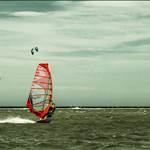
So I'm hoping I've finally got getting into the straps sorted out :)...I've had trouble in the past trying to get planing after hooking in fearing too much to unweight the back foot and load up the mast foot for fear of getting catapulted and also kept smacking one of my toes into the footstraps all the time :/
The solution?
I don't hook in(or hook out when I'm ready to get into straps), bare downwind, get on the plane(pumping if required), get in the straps(or the back one if already in the front) and Bob's your uncle; let the beast mode begin :)
Is this good technique or could I be learning bad habits which might be problematic in the future?
Is this how you get slalom boards onto the plane?(I've heard they can be hard to release)...and I've heard different boards need different pumping techniques for getting onto the plane in light winds and not sure why...
Only having used freeride or fsw, what is the difference between using a slalom board?...when they say they are more technical to use what does that actually mean? I usually feel pretty secure once in the straps(but hear of people getting thrown off their boards and crashing, seemingly once already in the straps)
And would a 150L slalom board work ok with an 8.2m no cam freerace?
...lots of questions I know 


I found moving your back hand down the boom stabilizes the rig while you get your foot in the strap.
Also use the underhand grip whilst learning as the motion of pulling down and in to your body acts as a brake and prevents catapults. (Some, not all  )
)
Some relevant footstrap discussion here
www.iwindsurf.com/forums/viewtopic.php?t=30924&postdays=0&postorder=asc&start=0&sid=57dc9a5e26942efd4badfae3b0e596d4
150 l slalom 8m no cam. It will work. What board? what sail? What weight are you?
I have a 76kg mate (intermediate) who uses isonic137 with 7.5 no cam Anh he is the king of early planing on the lake - he is loving it. Made us reasses what a slalom board can be used as
Cheers Jeff
Starboard isonic and ka koyote...got the sail already...Wondering what board I should get as I want good upwind, want to learn to jibe, early planing, fast, fun, not too technical(whatever that means?), second hand and not too big and heavy (thought about getting an old longboard but don't really have room for it and don't really want to lug one around)...I have a naish freeride which is good when the wind picks up a bit more and should be better for learning to jibe but I just want to get out on the water more often because the stronger days hardly seem to be coinciding with my days off
Select to expand quoteLindz1510 said..
So I'm hoping I've finally got getting into the straps sorted out :)...I've had trouble in the past trying to get planing after hooking in fearing too much to unweight the back foot and load up the mast foot for fear of getting catapulted and also kept smacking one of my toes into the footstraps all the time :/
The solution?
I don't hook in(or hook out when I'm ready to get into straps), bare downwind, get on the plane(pumping if required), get in the straps(or the back one if already in the front) and Bob's your uncle; let the beast mode begin :)
Is this good technique or could I be learning bad habits which might be problematic in the future?
Is this how you get slalom boards onto the plane?(I've heard they can be hard to release)...and I've heard different boards need different pumping techniques for getting onto the plane in light winds and not sure why...
Only having used freeride or fsw, what is the difference between using a slalom board?...when they say they are more technical to use what does that actually mean? I usually feel pretty secure once in the straps(but hear of people getting thrown off their boards and crashing, seemingly once already in the straps)
And would a 150L slalom board work ok with an 8.2m no cam freerace?
...lots of questions I know
Hi lindz...sounds like you need to just practise ...it will come ..why we catapult .? We have. All this forward thrust and you can't unload it because the board s nose get buried in a wave or chop ..or you pull on the power to quick .being your back hand and the board can't move fast enough ..
we all still do it ..yeah it hurt s .and scares the crap out of you ..I have a 130 litre board and 83 wide free ride .. I use a 8.0 on ..and a 150 should be even better with your weight .stick with the no-cam sails.slalom board or free ride .with that sail and your weight you will need a fin in the range of 40-48 .. Or the stock fin is usually spot on with the starboard s.
Sometimes it's better to go out a little under power to nail your jibes ...and just play around moving you board around and find out what your sail can do and can't do ...it's all angles .and leaning the sail forward and raking it back ....important ....keep your mast straight up and down ..(Jibing.) helps.
foot steering ..is another important part ..
well done on getting into the straps ..your windsurfing will get better and better as you go along now ..
It took me 12 months of windsurfing before I could do jibes ..fluently..so be patient .. I was a little slow..at learning ..I preferred to tack .
it was the long board days ..I loved my mistral 11.3 escape..
If you wish to learn to gybe than the FSW would be a better option or free ride .
A slalom board has a flat rocker and generally sharp rails which enables speed however the trade off is maneuverability.
the softer more rounded rails on the FSW makes the board more forgiving in waves and chop . The sharp rails on the slalom can bite and dig in throwing you with it .
if you wish to get out on those lighter days just get something wider than you already have with an additional 10 to twenty litres .
If you are only just getting the hang of footstraps do not get an iSonic. The straps are really outboard and tricky to get used to unless you are good at it.
A freeride board rather than a slalom is just more manageable, less scary and a smoother ride.
Select to expand quotejirvin4505 said...
Some relevant footstrap discussion here
www.iwindsurf.com/forums/viewtopic.php?t=30924&postdays=0&postorder=asc&start=0&sid=57dc9a5e26942efd4badfae3b0e596d4
150 l slalom 8m no cam. It will work. What board? what sail? What weight are you?
I have a 76kg mate (intermediate) who uses isonic137 with 7.5 no cam Anh he is the king of early planing on the lake - he is loving it. Made us reasses what a slalom board can be used as
Cheers Jeff
113kg still working on intermediate skills-
In the link I provided you will see Morgs mastering footstraps on a 180l naish typically on 7.8-8.5m sails in lake winds ~14knts. He is a fellow member of the large size sailing community
Check out the full story in the QLD forum.,,,
www.seabreeze.com.au/forums/Windsurfing/Queensland/Windsurfing-Learning-Curve/?page=1
Lots of usefull hard won experience for us larger sailers
I'm having success on lightwind boards large JP SLW and now Starboard Ultrasonic with 8.5-9.5 sails I'm 95kg
Cheers Jeff
Hey Jeff how does your ultra sonic go? I've heard they are a bit of a funny breed...people either loved them or hated them but really good upwind apparently which is something I would really like(always seem to be struggling to make it back to my launch area)

Going into the harness first and then into the footsteps is the right way. Here are some tips:
How long are your harness lines? Shorter harness lines may make it easier to get catapulted. Longer (32 inch) ones are the way to go for correct technique (I just switched from 28 after the guy cribb camp and it's so much better, despite the fact that I thought my technique was correct). You can use now your whole body weight and "ARSE" to sail.
Move your backfoot right next to the back strap so that just the beginning of the toes touch it. That allows you to be aware of the footstrap position. You may also "wiggle" the backfoot in there once you are in the front footstrap.
Look down for moving your front foot into the footstrap. Then quickly move in the backfoot. Don't look down though for the back strap, the correct position as detailed above will make sure you find your way in there without banginf them.
Going downwind for front foot and upwind for backfoot also makes it easier but really focus on your backfoot position next to the strap, it will make all the difference.
Select to expand quoteMrSpinout said..
Going into the harness first and then into the footsteps is the right way. Here are some tips:
How long are your harness lines? Shorter harness lines may make it easier to get catapulted. Longer (32 inch) ones are the way to go for correct technique (I just switched from 28 after the guy cribb camp and it's so much better, despite the fact that I thought my technique was correct). You can use now your whole body weight and "ARSE" to sail.
Move your backfoot right next to the back strap so that just the beginning of the toes touch it. That allows you to be aware of the footstrap position. You may also "wiggle" the backfoot in there once you are in the front footstrap.
Look down for moving your front foot into the footstrap. Then quickly move in the backfoot. Don't look down though for the back strap, the correct position as detailed above will make sure you find your way in there without banginf them.
Going downwind for front foot and upwind for backfoot also makes it easier but really focus on your backfoot position next to the strap, it will make all the difference.
Guy also emphasizes getting into the straps just before you're about to plane i.e. look upwind for gusts. I can't see them, only feel them, so I always get the front foot in first when I'm already planing (hooked in before that), then a few a terrifying seconds later feeling for the back strap. If I see chop and swell in front of me, I hold off going for the back strap to prevent catapulting. If I could only see gusts.
Regarding prevention of catapults, Guy teaches to pull on the brake (front hand) and releasing the back hand to depower the sail and make the hook drop out of the line. I had been taught to never let go of the boom, and in fact sheet in hard to do a "half-forward loop" to make sure the mast misses the nose as you go over (suggested by another famous UK guru, whose name I will not mention). Guy said this was a really bad idea. I don't know how I will condition myself to not do this from now on (even as catapults hardly ever happen to me now), even as I instinctively often pull on the brake, probably killing my early planing in the progress.
Speaking of doing things instinctively... I've been using very long harness lines and a high boom from the beginning (based on Guy's articles) and found that they force bent arms and arsing out anyway. I felt bad about the latter, thinking "straight arms, rig away" is the right way (based on the advice of the same unnamed UK guru). Turns out, I've been doing it right. Trying to bring my hips in and straightening my arms just caused hook-outs (maybe less of an issue with shorter lines).
I am probably a very different breed to many of the contributors here on SeaBreeze. I don't believe equipment can solve most of your problems. You need to adjust to what you have, and make the most of it.
In the case of getting into foot-straps and being confident and comfortable in them, while hooked in and planing, I believe in the following...
(1). Practice and more of it.
(2). Be confident and be brave. You will fall and possibly catapulted, but that is what #1 is about, practice.
(3). Improve your reaction time. Wind is a funny beast as it fluctuates quite a bit, in directions and strength. So if you can't quickly adjust your stance, you will either fall backward for the lack of wind, or pulled forward in a gust. For me, when the wind dies a bit, I pull my front foot out of the strap and place it just behind the mast, where it has the most buoyancy. I still keep my back foot in the strap as it is my insurance if a gust hits.
(4). In gusty winds, I always keep my back foot in strap as per #3, it prevents me from being pulled into the water. You can hook in to conserve your energy. By having your back foot in strap will mitigate a lot of the involuntary forward splash.
(5). To get onto a plane, head downwind a bit.
As I said, the best and latest equipment doesn't solve your problem for you. You want to invest time and efforts to learn to use what you already have.
Select to expand quoteMrCranky said..
Regarding prevention of catapults, Guy teaches to pull on the brake (front hand) and releasing the back hand to depower the sail and make the hook drop out of the line. I had been taught to never let go of the boom, and in fact sheet in hard to do a "half-forward loop" to make sure the mast misses the nose as you go over (suggested by another famous UK guru, whose name I will not mention). Guy said this was a really bad idea. I don't know how I will condition myself to not do this from now on (even as catapults hardly ever happen to me now), even as I instinctively often pull on the brake, probably killing my early planing in the progress.
Sheeting out as Guy describes it will prevent a catapult; sheeting in for the half-loop will prevent damage to the board when you catapult. Both can work, and you can find arguments for each of them. But if you think you might ever want to learn a front loop, stick to the sheeting in! If you retrain yourself to sheet out whenever the power comes on, your body may do that automatically when you try to loop, and you'll go nowhere. I'm very good at that (sheeting out to avoid catapults, and going nowhere when trying to loop).
Select to expand quoteboardsurfr said..MrCranky said..
Regarding prevention of catapults, Guy teaches to pull on the brake (front hand) and releasing the back hand to depower the sail and make the hook drop out of the line. I had been taught to never let go of the boom, and in fact sheet in hard to do a "half-forward loop" to make sure the mast misses the nose as you go over (suggested by another famous UK guru, whose name I will not mention). Guy said this was a really bad idea. I don't know how I will condition myself to not do this from now on (even as catapults hardly ever happen to me now), even as I instinctively often pull on the brake, probably killing my early planing in the progress.
Sheeting out as Guy describes it will prevent a catapult; sheeting in for the half-loop will prevent damage to the board when you catapult. Both can work, and you can find arguments for each of them. But if you think you might ever want to learn a front loop, stick to the sheeting in! If you retrain yourself to sheet out whenever the power comes on, your body may do that automatically when you try to loop, and you'll go nowhere. I'm very good at that (sheeting out to avoid catapults, and going nowhere when trying to loop).
Yeah, I'm aware of "you can learn to forward loop before gybing if you're still catapulting on the regular"... But I'm kind of scared of braking ribs (never broken any bones, don't want to start now).
Hey LINDZ,
Grab a 150t Freeride board. They are so easy to ride and learn on.
The next thing is to COMMIT. More crashes happen when not fully committed. But they will be more spectacular when fully committed. You will have to learn the other skills other people are talking about.
So harness up, get in the straps, drop your arse in the gusts and hang on for the ride.