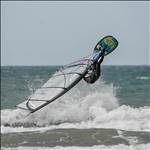
I am considering making a floaty wave board for smaller waves and light winds, and have decided that xps and relatively simple glassing will be the way i should do it. I have made about 200 surfboards, so this way seems more natural to me than composite sandwich structure. I can get carbon, kevlar and timber veneers, but for the positioning of these on the board i am in need of advice. My understanding so far, is that carbon provides stiffness, but not much in the way of impact strength, kevlar, high impact strength, and veneers something similar. I would intend to use carbon lengthways in the front 3/4 of the board, and possibly not the tail (to allow some flex) and possibly a kevlar patch between the rear strap and just in front of the mast track, (and possibly veneer footstrap patches). I think what confuses me is that i see carbon being used in nose patches, and rails (which i understand will give the board stiffness). Cost will be an issue, so I want to reduce the amount of expensive cloths and if i can keep it cheap enough, i will feel i can try a weirder design, along the lines of the sea lion, and maybe as a bonzer? Has anyone tried one? I appreciate any advice, mainly about the materials, as so far, i have mainly used polyurethane/polyester, and 4/6oz standard cloth.
Certainly possible to do it cheap. For carbon, the 100mm wide unidirectional from China, about $2 per meter makes it really nice n cheap for rails and a strip up the middle. I'd still use a plain or twill 200gsm underfoot - yes its brittle but the stiffness means the foam does not deflect leading to cracks and delam. So whilst kevlar is better for impact, its not necessarily the case with our stuff that has a soft core.
But - I ditch that XPS idea. Its much harder to shape, some people get delam with it from offgassing and it offers very little strength advantage to EPS.
With your huge experience, I reckon get a $100 eBay vac pump and give sandwich a go.
If not, 28kg EPS, glass and uni carbon.
With stringerless boards carbon rail bands are doing the job of a stringer while carbon patches in other areas are trying to spread the impact load across a bigger area. same with timber veneers. kevlar cloth will leave heel marks behind because it has good impact but isn't stiff.
Carbon kevlar cloth is available it just won't act as a stringer.
if you are using 24+ kg/m3 eps foam with a stringer i don't think you need any exotic materials at all. maybe some carbon kevlar around the nose and feet area and do the rest in fibreglass. sure you will get some compression marks over time around the mast track but that's what used to happen.
Thanks for the advice, i think a plan is now forming. A change to EPS, salvaged plugs and boxes, if possible, and ditch ideas of kevlar. I don't think 200 surfboards is huge experience, Mark, but thanks, i still very much regard myself as a back-yarder! Now to find some EPS!
Having seen some YouTube videos, on carbon, I've only used minimal, as a mock stringer and length wise support, it soaks up more epoxy, or whatever you use on that material. Carbon will be as strong as the layers above it, it does add stiffness.
kevlar, pita, don't use it.
S- Glass is stronger , if I started over on mine I would use it mostly. Best of luck, guys on here are great.
Thanks for the ongoing responses! I have managed to find either 25kg/m3 or 30kgm/3 EPS for ?80-100 per 2400x1200x200 block with a minimum order of 2 blocks.... pity it will be a 200 mile round trip, but which weight do the gurus think will be best?
For what you're doing I say 30
I use 28 on kiteboards that get jumped hard so with carbon and wood underfoot it will be cool
Ok, managed to get some EPS200, and designed a floaty wave board on shape3d, then realised i couldn't export the file to CAD from the free version. As the UK is just about to embark on 'lockdown, the sequel' , thought hand shaping might be a project to keep me amused. So, 1st question, What diameter wire for making a hotwire, and 2, what DC voltage? (i can put in a dimmer switch to vary it). Thanks
You can saw for rough shaping and sand for final, skipping the hot wire.
Old bud built over 100 ws boards that lasted better than mid 90's custom productions using saw, sandpaper, spackle sealing, hand laminating.
He built jumpable 8'6, boards that weighed 11 lbs. and had almost no breakage or delams.
Rounded decks and v bottoms.
Select to expand quotejontyh said..
So, 1st question, What diameter wire for making a hotwire, and 2, what DC voltage? (i can put in a dimmer switch to vary it). Thanks
I used a 12 V car charger and 24 to 26 gauge nichrome wire when I built a wing board recently. I just ordered a sample pack from Amazon that had 25 ft each of 22-36 g wire in 2 g steps for $15 or so. That's more wire than I'll ever need, enough for a wide cutter (for the profile; boardsurfr.blogspot.com/2020/09/making-foam-wire-cutter.html) and for a table cutter (for the outline; boardsurfr.blogspot.com/2020/09/cutting-and-shaping.html). Easy enough to test wires on some scrap pieces of EPS, and to switch to a different thickness if it get too hot, or not hot enough.
I'd definitely use a hot wire instead of a saw - a lot less messy.
definitely going to hotwire, have planed and sanded eps boards before, and not fun! Thanks for the info.
If you are getting the board cut by a surf company they should be able to read the Shape 3D file you dont need to export it. It depends on what software they use to drive their machine.
Select to expand quotemr love said..
If you are getting the board cut by a surf company they should be able to read the Shape 3D file you dont need to export it. It depends on what software they use to drive their machine.
Europe is locking down again, so no pickups, and a good chance that surf companies will be closed (I'd guess there are relatively few compared to Oz, anyway). If you need to get a blank via truck here in the US, that triples the cost of a cut blank (which already is about 2x the cost of just foam).
Just as important is that shaping and making templates and tools for shaping can keep you amused for a few days in a lockdown.
Thanks. Good news about the surf companies being able to read the files. I think i can find out on Monday, so if yes, then I'll wait 'till lockdown is over, and perhaps make a longboard (surfboard not windsurfer) for my wife as practise with eps. I will obviously document the process.
Select to expand quotejontyh said..
Ok, managed to get some EPS200, and designed a floaty wave board on shape3d, then realised i couldn't export the file to CAD from the free version. As the UK is just about to embark on 'lockdown, the sequel' , thought hand shaping might be a project to keep me amused. So, 1st question, What diameter wire for making a hotwire, and 2, what DC voltage? (i can put in a dimmer switch to vary it). Thanks
"steel" guitar strings and a downlight ballast and dimmer combo make a perfectly usable hot-wire, the sculptors in the film industry use these very affordable set ups all the time.