Hey fellas,
ok... so im still pretty new to windsurfing. (started a couple of years ago but only recently getting back into it)
I learnt / have been learning on an f2 spice (bit optimistic probably but ive enjoyed the challenge + the board was pretty cheap and in great nick). 86 liters. im about 79kgs sails 5.4 / 5, (tried both)
So, I cant get into the straps without loosing power / the tail sinking in. I can fly along with my back foot behind the mast and the other between the two straps, ive even hooked in but that normally results in a stack as I get ripped of the board first gust of wind.
What am I doing wrong? to some degree I can get the front foot into its strap. tho normally I just start to slow down. Am I keeping the board too flat? / should the edge be dug in, and make myself hang off the sail over the water more?
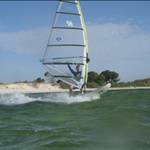
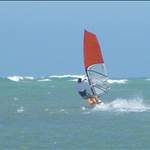
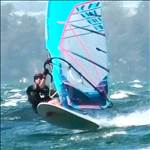
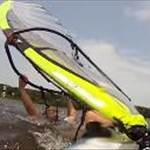
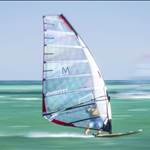
the pics on my profile are a pretty good indication of how far i get.
Any suggestions would be nice : )
( I suspect that it may be the board.... being a "freestyle" / difficult for someone of my level. just wondering b4 i go get a new one)
cheers,
you need to get more of your weight onto the rig, are you hooked in?
It's not so easy getting in the straps unless you're in the harness and hooked in. That way you can just sit on the harness and put much more weight on the rig.
That stops the tail sinking.
You could also try moving the rig and footstraps further forward.
Yeah the board is a tad small but you're over the worst of the learning curve now, (apart from learning to gybe).
In those shots your boom looks a bit too high, but it's hard to be sure.
Boom looks a little high but could also be from pics that you have too much extension as the gap between foot of sail and board is huge.
Hook into harness,take a deep breath, and put your back foot into the straps,come what may.
Get the sail as low on the mast as possible. Set the boom at about shoulder height. It looks in one photo like you have too much outhaul (wrinkles pointing toward the clew eye).
You want the sail to be stable and pulling from its most forward centre of effort.
Then when you get planing fast, you will have little resistance from the water. You need to keep the board planing fast because if the board slows, your body goes off-balance and forward.
So you must keep the same power in the sail and dont disturb the board as you get your front foot in. That means you have to keep the power in the sail while also leaning down onto the mastfoot so you can take your weight off your front foot. Practice doing that where you just lift your front foot up and put it back in the same place.
Once you can do that for a couple of seconds, then you're ready to put your front foot in the strap.
Having got the front foot in, keep the back foot close to it and get used to sailing with them close together. Try to steer over the smoothest water.If you get hit by a gust, turn upwind. If the wind drops, bear off and try to get a downslope.
To get into the back strap, pick some smooth water, preferably going downhill. Wiggle your foot back until it touches the back strap. Then you will have to lean forward slightly to put more weight on your front foot and put the back foot in. If you are overpowered when you want to put the back foot in, oversheet the sail (ie. pull the back hand in too much) and it will reduce the power and allow you to get the back foot in.
As its a freestyle board, put the front and back straps all the way forward and centre, if you have not already.
It would be worth mentioning if you have a freestyle fin (<20cm) or regular freeride fin in it. That will make a big difference in how the board handles, you will not be able to ride the fin on small freestyle fin, but that wont stop you riding the board properly.
Its a small board for your weight and skill level put together, but on the flip side it should plane very easily and at lower speed than a similar size board, if you keep it flat. By Flat I mean don't try and 'dig the edge in' as you mentioned, and don't try an d lift the nose, just let it sit in it natural planning position, which will reasonably low, at it does not have much rocker, you can still tilt board to side to control your direction and keep you speed under control.
My suggestion is to not use the harness while getting into the footstraps, get the board onto the plane, relax, put your front foot in, relax and put you back foot in, then hook in.
While 'relaxing' try and control your speed so you don't go too fast, just fast enough to stay on the plane, and keep the board flat. To help getting you front foot in, it can help to weight you back foot, so the rig slightly forward can help (i.e. bear away slightly), and for the back strap weight your front foot, heading upwind can help there.
You will probably end a a fair bit downwind after a few goes at this... but your probably used to that already.
Once your got a feel for it, use the harness more, until you can do it all remaining hooked in.
Best tip is to find some flat water, safety bay?
Another trick with a freestyle board (with straps setup correctly, i.e. forward and centre) is put both feet in before you get planning and then hook in, you need a lot of wind, and a bit of skill to do that, but it might help to get over this hurdle.
all tips above are great, but i think you are perfectly right: an 86lt board for an 80 kg beginner is too hard. You should get at least 120 ltrs and you will progress in no time. It took me over a year to get into the straps, and I had a 135 lt board. Too many things to learn in the beginning, you need to make it easy for yourself somehow.
It looks like the sail is a cammed race sail too. I noticed in one of your profile pics the foil is popped the wrong way probably because there is not enough wind to pop the cams.
That will make things difficult because the sail will not be properly powered up which will make planing etc harder. You may have to give it a big jerk after you've changed direction to make sure it rotates or even kick the bottom batten. It's certainly not a beginners rig - board & sail.
You'd find it a whole lot easier to progress if you get a larger board with a freeride ( non cammed sail) - say + 40 of your weight ( & that will still be tippy but I suppose after what you are using it would feel like a tank!
Hey dring44...
If there's one thing in life that I have learnt - is that what works for me might not work for you, but here's my 2c anyway...
I recently got into both straps, so I hear what you are saying... All the below is based on me at 84kg, JP Super Sport Pro 118 and (usually) a 7.4 KA Koyote.
I'm certainly no expert on the fine tuning of your settings, but what they guys have said so far is spot on... In regard to boom height, you need to get the boom height up to a point that you are able to transfer the weight when you are hooked in. I had my boom sitting in the lower half, and when I was told to raise it an inch - which basically took it to the middle of the cutout, the effect was immediate. I was able to get much better weight transfer which (at that stage) helped me to get settled and plane upwind.
I usually get hooked in, slide the front foot in virtually straight away and after a second or two providing I think there is enough wind to keep me planing, get the back foot in. This was only two sessions ago, we had a 15-20kn day and I took one look down at my back foot and just popped it in... 
You said you have your back foot behind the mast ? I take it you mean your front foot, with your back foot between the two straps... so is that your back foot between the back straps ? I found I needed to slowly work on getting my weight back as I got powered up. Put your weight back too early and crapola you sink the tail and round up into the wind. (I'm sure you may already know), you need to counter the rig... so when you want to put weight back, take the sail forward, helping you also bear away as you do  .
.
Are your lines long enough... I found nice long lines 28-30's are helping me get hooked in, sink my weight down and keep my arms straight to hike out. Get your front foot in... point your toes to accelerate (ala Cribbie advice) and get your back foot backwards... when your back foot is basically sitting right next to, touching or even better - on the back strap - you know you are ready to lock yourself in !
Hope this helps as the difference in getting both feet locked in has been amazing... sailed 64km in a session last weekend and didn't want to get off the water ! I also found I got better efficiency too, as in I was able to post better speeds from lower winds than I have in the past.
Hope this helps mate.
Haha! , yeah front foot behind the mast* other one between the straps :P
thanks guys!
"Put your weight back too early and crapola you sink the tail and round up into the wind. (I'm sure you may already know), you need to counter the rig... so when you want to put weight back, take the sail forward, helping you also bear away as you do "
-exactly whats happening.
Those pics are pretty old, since then I did get a new mast / the right size and have lowered the boom. I have found that the smaller board wasnt actually to bad for learning, it was a hell of a lot easyer to water start than anything over 100liters. (gave me the confidence to go way out and know i didnt need to paddle back at the time)
I shal give these tips a go :)
Cheers,
I'm just now getting into the straps reliably, it's important to understand what is happening.
Put simply, when you lift your front foot to put it in the strap your front foot is no longer pushing the board downwind and you round up, slow down, sink the tail, head upwind etc..
To counter the front foot not pushing the board downwind you can do two things, first just before you try to get in the straps head downwind a bit on a broad reach and secondly and most importantly you need to be going really fast then hang from the booms in the harness really committing all your weight, this creates mast foot pressure which is the same as pushing the board downwind with your front foot.
Is no one going to question the fact that dring44's back foot is behind the mast and his other is between the foot straps?
Unless you are about to do a spiny flicky flaka thingy that doesn't sound right to me
Dring I also agree about weight too far bakc too early.
You don't move to the straps to go fast - you move to the straps because you are moving fast and you have to.
It is a slow creeping back thing as the board accelerates and you kinda wriggle feet back and then bump into the straps. Later on you get a feel for when the board is ready and going to plane hard n fast in 0.01sec so you hoom in and hang weight off the boom and step in all at same time.
Your first two pics (at least) on your profile show waaay too much wieght on the back leg
I am going through the same problem as you atm. Although i have a much bigger board for my weight (60kg/125l board) i think the technique would be similar. I have found that i can get my front foot in but the back foot i always lost my speed and turned into the wind.
The advice i got was to hook in put ur weight on the boom and then shuffle ur back foot into the straps. Putting ur weight on the boom helps heaps but the wiggling things didnt work for me.
The last couple of time ive gone out ive been getting in the straps no prob. All i do is get up speed shuffle feet back so touching the straps (slowly), then get comfortable. Put ur weight on the boom get where you feel comfortable and then slip ur front foot in. Once again get comfortable and keep ur speed then quickly lift ur back foot and place it in.
Rushing was my biggest mistake.... just take ur time and and prepare for each step
I am only a beginner and only talking from my experience and what works for me..... so listen to the guys above 
A bigger board helps heaps though
sometimes tell my windsurf buddy to not worry about the straps and enjoy the session
he actually got the same advise from a semi-pro while on a w/s trip :-)
myself, i have a footstrap phobia
i hook in early with 28 inch lines spaced closely and SLOWLY move back - unless wind is kickax
my feet end up just beside the footstraps - placed outside - and i push against the rail for pressure on the fin
this basically gives me close to the same effect as using straps, but not in terms of foot control and maneuverability
my goal is FUN and TOW {time on water}
in 6 months i have gone out 54 times :-)
light wind area - and now using a FreeFormula with 10-oh
this gets me out and smaller sails feel like nothing afterwards
also means feet need to go back and way out
however, still have that phobia
it NEVER helps when someone tells me , my foot got stuck and i got dragged across the bay #$%^&*(
so, my moto is patience and i am considering even longer lines to move the boom up higher
i hook early cuz i am lazy - why work hard :-)
so, patience my friend - even if it is a virtue seldom found in women and never found in man :-)
Something I do to grab the back strap is to rock a little onto the front foot and just briefly put more weight onto the board. If you do this quickly it doesn't upset the trim of the board much and by unweighting the back foot it gives you just a little more time to get it in. I do stress a LITTLE onto the front foot because you are putting yourself into catapult territory and you have to be careful.
I'd also check how you've rigged the sail. Based on your photos it looks like you've got too much mast extension and not enough down haul. That will make the sail twitchy and more likely to pull you over.
To all - what do you think is the best way to LEARN to get in the straps? Most experienced sailors will get into the harness before getting into the straps most if the time, but I'm not sure this the best way to learn.
I'm thinking learning to hang off the boom and get your weight low, then shifting weight back and pointing your back toes as the board starts to plane, teaches you confidence in handling a powered up sail. I remember when I learned that I'd hook into the harness too quickly especially on windier days, which then led to either the board rounding up or a catapult. Being hooked in as a beginner does teach you to weight up the mast foot, but the downside is that it doesn't teach to keep the rig away.
Getting into the straps first forced me to get comfortable planing out of the harness, which is a necessary skills for your next challenge - gybing.
A good thing about the new begginer boards (Funster, Viper) is that they have footstrap positions way up near the mast track. So as you progress with heavier winds and/or bigger sails you can move the footstraps accordingly.
I found when i was learning that it was easier to hook in first and apply weight to the harness. Next was to comfortably get in the front strap.
I was having issues with the back strap to but moving my back hand furthe down/out the boom stabilizes your body and you don't fall forward. The trick is though you have to be planing if you have your footstraps down the tail of the board. There's no getting around it.
It may be that you are not powered up enough. For your weight, the board and sails are small. You'll need it to be really windy for those sails to get you going fast enough to get back in the straps without sinking the tail, and strong wind isn't good for learning basic technique. You would do better to go out in lighter wind with a bigger board and sail. (I know that's not really helpful but it may explain your frustration)
Select to expand quoteTristanF said...
To all - what do you think is the best way to LEARN to get in the straps? Most experienced sailors will get into the harness before getting into the straps most if the time, but I'm not sure this the best way to learn.
I'm not the most experienced guy here but I don't remember getting in the foot straps to be that hard, and I'm not the most coordinated guy around. I think the ease of it was due to using an appropriate beginners board. Plenty off width for stability,adjustable strap positions, the right size sail so your not getting over powered and being pulled in and it didn't seem like a big learning curve. If I'd gone with the board I liked instead off listening to the guys at the shop then I would have found it a huge challenge. Talk to the local shops they will tell you exactly what you need for your skill level so you can learn to walk before you learn to run. I'm not trying to have a dig at anyone as the best way to learn is to be on the water and we can't always afford the right board, but I do believe the right kit is the way to go.
Haha ive already corrected my typo :P maybe i was doing something specy in my mind while i typed that.
I actually found this... kat.ph/beginner-to-winner-dvdrip-xvid-windsurfing-for-beginners-t483123.html
its pretty clear where im going wrong. putting 2 much weight back and not enough through the boom to the mast foot.
buy/.... obtain.. this if you want nice clear explinations!
i assume that is the Jem Hall instructional video
the explanations are great
however, the one area that did NOT help me was the footstraps
this is due to the fact that i am a heavyweight
i cannot practice in lighter winds without a bigger sail
AND as i stated earlier - i have a phobia of being locked in
for myself:
i will practice sliding foot in and out on land
this should remove the fear
personally i hook in before i move back on the board
Matt Pritchard suggests the same
some others suggest footstraps first - was it Peter Hart or Guy Cribb ??
so far we have discussed front first foot :-)
{suggestion: leave that one be }