Select to expand quoteOrange Whip said..
Anyone made a simulator for teaching beginners or improving technique?
I know you mean well ,and it is a worthy question , but have you any idea what you have done ?
You have opened the Pandora's box that is Sandman.
Im just hoping your also on his silenced list .
I have seen pics of a windsurfer on a swivel base on the sand . I don't think a simulator could be as good as the real thing for beginners in a foot of flat water in 5 kts .
Are you thinking like a windsurfing version of one of those swiveling karate poles with the wooden arms 
I could do with one that trains me to swing my hand under the other one when flipping the sail gibing instead of over .
You can make a really good simulator with a few pieces of wood glued into a board shape and mount it on a trailer hub and stub axle so it rotates easily. Glue it all up with Six10, just don't get it wet for 14 days or it goes milky.
Back stretching first is really advisable. Seated pike and no advice from a professional is certainly the way to go.
Select to expand quotekato said..
Yes, but never seen them work well. Easier to teach on water
Disagree, taught quite a few course's to a dozen people at a time. The are a great tool you can use to teach technique on the beach and then let the students go and apply the technique on the water.
Being able to demonstrate the technique on the beach, then getting students to attempt the technique where you can give immediate correction is great because when they do get on the water they understand what your asking them to do when you are providing instruction in what is often a noisy and fluid environment.
When happy hour and $5 roast night coincide at the bowls club.
ooops, sorry, miss read the title, thought it said windsurfer stimulator.
Select to expand quotecammd said..kato said..
Yes, but never seen them work well. Easier to teach on water
Disagree, taught quite a few course's to a dozen people at a time. The are a great tool you can use to teach technique on the beach and then let the students go and apply the technique on the water.
Being able to demonstrate the technique on the beach, then getting students to attempt the technique where you can give immediate correction is great because when they do get on the water they understand what your asking them to do when you are providing instruction in what is often a noisy and fluid environment.
Yep, you're right. You just don't need all the swively stuff because it never behaves the way a board on water does.
I taught 2 beginners, neither of whom had any sailing background whatsoever (or any idea what upwind/downwind was, nor what a mast was) before then. Both times I set my windsup on the beach with the smallest sail I had for them. Second time the shop here lent me an even smaller sail because she really needed a 4.5 instead of my 5 (which was the smallest I had at the time). They also helped teach so I can't claim full credit. They're definitely better teachers than me.
It would be good to have a sand bag or something to keep the board off the sand but it was lowish tide so I was able to keep it out of the rocks.
Hands-on helps a ton. The lesson I was given with sail chi on the beach also made a huge difference.
In my oppinion you really cannot beat a tandem board for teaching. They are having success right from the beginning and you are right there with them. Just make sure the sail size matches the person. Little kids need tiny sails and big blokes need a bit of size to balance against and Take out the wobbles
Select to expand quotekato said..cammd said..kato said..
Yes, but never seen them work well. Easier to teach on water
Disagree, taught quite a few course's to a dozen people at a time. The are a great tool you can use to teach technique on the beach and then let the students go and apply the technique on the water.
Being able to demonstrate the technique on the beach, then getting students to attempt the technique where you can give immediate correction is great because when they do get on the water they understand what your asking them to do when you are providing instruction in what is often a noisy and fluid environment.
Yep, you're right. You just don't need all the swively stuff because it never behaves the way a board on water does.
The swiveling is crucial to teach a static turn using the rig combined with foot pressure so the student can face the board in the direction they want to go prior to beginning to sail, its one of the first techniques to teach students, helps them turn around and sail back.
Also is vital in helping to teach students how to up haul the rig from any position including clew first upwind, saves them hours of trying to swim a rig into position.
Also its great in explaining to them how a board actually steers using a rig and helps them to understand the relationship between centre of effort and centre of resistance.
I agree the board reacts better than a simulator to adjustments on the water but the simulator does respond the same all be it a little clunkier but the technique and understanding can be taught on land and then applied on water.
One final thing the swivel is great for is teaching technique on both tacks which is a must do, every time a student learns a technique it gets practiced on both tacks, the swivel makes that real easy and every time a student is swiveling the simulator from one tack to another muscle memory is being developed.
Select to expand quotecammd said..kato said..cammd said..kato said..
Yes, but never seen them work well. Easier to teach on water
Disagree, taught quite a few course's to a dozen people at a time. The are a great tool you can use to teach technique on the beach and then let the students go and apply the technique on the water.
Being able to demonstrate the technique on the beach, then getting students to attempt the technique where you can give immediate correction is great because when they do get on the water they understand what your asking them to do when you are providing instruction in what is often a noisy and fluid environment.
Yep, you're right. You just don't need all the swively stuff because it never behaves the way a board on water does.
The swiveling is crucial to teach a static turn using the rig combined with foot pressure so the student can face the board in the direction they want to go prior to beginning to sail, its one of the first techniques to teach students, helps them turn around and sail back.
Also is vital in helping to teach students how to up haul the rig from any position including clew first upwind, saves them hours of trying to swim a rig into position.
Also its great in explaining to them how a board actually steers using a rig and helps them to understand the relationship between centre of effort and centre of resistance.
I agree the board reacts better than a simulator to adjustments on the water but the simulator does respond the same all be it a little clunkier but the technique and understanding can be taught on land and then applied on water.
One final thing the swivel is great for is teaching technique on both tacks which is a must do, every time a student learns a technique it gets practiced on both tacks, the swivel makes that real easy and every time a student is swiveling the simulator from one tack to another muscle memory is being developed.
That is how I learned, on a simulator, old board bolted to a swiveling base, worked great! Then right after simulator went on the water and was able to tack and gybe easily while instructor taught someone else on the simulator.
Remove the fin from a board, place it on the grass or sand, tie a rope to the nose, rig a sail, and teach. As you teach tacks and jibes, simply pull the board around while talking to the student. Direct interaction.
Dirt or land windsurfing, can practice in ANY wind on ANY terrain!
Select to expand quoteHeavy1 said..
In my oppinion you really cannot beat a tandem board for teaching. They are having success right from the beginning and you are right there with them. Just make sure the sail size matches the person. Little kids need tiny sails and big blokes need a bit of size to balance against and Take out the wobbles
Next I'm going to experiment with a serenity cat as a learning platform,
Something like this.
Got the boards. Just need to build the bridge.
I think the simulator is a good idea, but then you need to store it away, and it really has limited value for each learner. . So I've steered away
The arrows irig inflatable sail is a great introduction as well , but you need pretty light wind.
That double is a lot of fun for learning on.
I tried the serenity cat at a starboard demo day. So very hard to tack, it would go backwards and then eventually get around. Also it was not as stable as I thought it would be. But it could handle two adults.
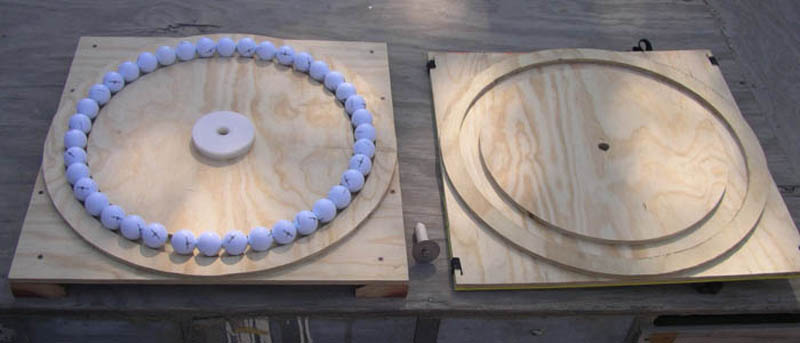
This version of simulator has almost no swivel resistance - pivots on a short metal pole, plywood board, 6 skateboard trucks mounted perpendicular to the pivot point, etc.
Created for a kids learn to sail program.
www.facebook.com/photo?fbid=3172063723066222&set=pcb.5203427609694740
back in the olden days of the 90's in NZ there were simulators called the 'kiwisi' (obviously) which functioned as per a beginner board with small sail on flat water perfectly. the school where I sailed regularly had complete beginners learn on them after 30 mins on land could go straight on the water sail out, tack, and come back without dropping the rig or falling in.
So they can be useful for sure, I can't find much info online about this particular one though as it was just pre-mainstream internet!
Select to expand quotecammd said..kato said..
Yes, but never seen them work well. Easier to teach on water
Disagree, taught quite a few course's to a dozen people at a time. The are a great tool you can use to teach technique on the beach and then let the students go and apply the technique on the water.
Being able to demonstrate the technique on the beach, then getting students to attempt the technique where you can give immediate correction is great because when they do get on the water they understand what your asking them to do when you are providing instruction in what is often a noisy and fluid environment.
Agree. At least for newbies and beginners their can be too many things going on in their head, around them, difficult environment to communicate....
Initial lessons on a simulator. Mistral School back in the '90s . Decades later still benefit of the "monkey listen, see, monkey do" on the simulator. Then going out on the water. At least from my perspective accelerates the progression.
Friend who just started windsurfing built the "golf ball simulator". I keep telling him to use the sim. He doesn't. His rig handling is crap. His stance is poor. Just spending time on his simulator with a few tips would improve his skill and allow for progression, but some people are set in how they plan to "learn" (bad habits & form).