combination, fin lifts windward rail, wind gets under board.
Smaller fin, or more weight forward would help control this.
We've all felt that lift , if only for a second .
It would be so great if we had that super flat windy water to play in.
Select to expand quoteImax1 said.. It would be so great if we had that super flat windy water to play in.
Where I come from that's only flatish, a long way from super flat.
Select to expand quotedecrepit said..
combination, fin lifts windward rail, wind gets under board.
Smaller fin, or more weight forward would help control this.
So for lift nose in the air ,first everything starts with lifting windward rail up or it can happend even if windward rail dont goes up?
Is it same cause for lifting nose in this video at 1:44 as it my first video?
A lot of that was also lift from chop, the last bit was self initiated as a braking manoeuvre
Are you having this specific problem, or just interested in the physics of the situation? All good either way, just asking because you'll get different answers if youre having problems...
Powered up sail forces you to weight backfoot.
Raked back sail produces lift.
Now add a touch of board speed.
Fin lifts windward rail, air starts a bit of life under front of board.
Select to expand quoteLeeD said..
>>>> Raked back sail produces lift.
>>>
Lift from sail, is pushing nose down! That's why less downhaul helps reduce tailwalking, and more downhaul helps unstick the board. Sheeting out in a gust will also initiate tail walking
Have you noticed you can't save those TWS vids because they are "content made for children"? You can't comment on them either.
I wonder if they know they've done that.
In the video I notice a blurry white shape,
could it be Casper the friendly ghost ?
Select to expand quotedecrepit said..LeeD said..
>>>> Raked back sail produces lift.
>>>
Lift from sail, is pushing nose down! That's why less downhaul helps reduce tailwalking, and more downhaul helps unstick the board. Sheeting out in a gust will also initiate tail walking
Does more downhaul make sail more raked to the back,if does that will also bring your body more to the back?
Select to expand quoteSubsonic said..
Are you having this specific problem, or just interested in the physics of the situation? All good either way, just asking because you'll get different answers if youre having problems...
No body can explain physics in windsurifing.
Fin cant lift nose,just opposite ,flexibile fin can lift tail and put nose down, but fin can lift windward rail up.
Sail dont produce downforce at all,just opposite sail ALLWAYS produce "upforce" becuse it is lean to windward,sailor body mass is what produce "downforce" or so called mast foot pressure,but if your harness lines stay 100% horizontal there is no downforce at all..etc etc
www.guycribb.com/userfiles/documents/downforce.pdf


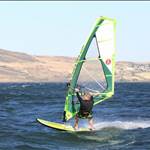
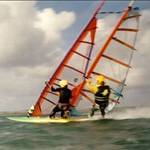
Guess who has more mast foot pressure of these two?
Not applicable.
Both sailors are in control.
Tailwalking occured as control is lost.
Select to expand quoteLeeD said..
Not applicable.
Both sailors are in control.
Tailwalking occured as control is lost.
Are you mad......both sailors are totally out of control and just about hanging onto their rigs. Its a speed course and they are using way too much sail area but are also going ridiculously fast.
Select to expand quotefpw9082 said..decrepit said..LeeD said..
>>>> Raked back sail produces lift.
>>>
Lift from sail, is pushing nose down! That's why less downhaul helps reduce tailwalking, and more downhaul helps unstick the board. Sheeting out in a gust will also initiate tail walking
Does more downhaul make sail more raked to the back,if does that will also bring your body more to the back?
No & No.
Select to expand quotefpw9082 said..Subsonic said..
Are you having this specific problem, or just interested in the physics of the situation? All good either way, just asking because you'll get different answers if youre having problems...
No body can explain physics in windsurifing.
Fin cant lift nose,just opposite ,flexibile fin can lift tail and put nose down, but fin can lift windward rail up.
Sail dont produce downforce at all,just opposite sail ALLWAYS produce "upforce" becuse it is lean to windward,sailor body mass is what produce "downforce" or so called mast foot pressure,but if your harness lines stay 100% horizontal there is no downforce at all..etc etc
www.guycribb.com/userfiles/documents/downforce.pdf
Guess who has more mast foot pressure of these two?
Mast foot pressure is relative. You can tell by the trim of the board that the first sailor likely has more mast foot pressure. If you transfer some weight from your feet - especially back foot into the rig then you can level the board out & we call this mast foot pressure.
Madge, both sailors are sailing NORMAL speed trial power applications.
Nobody rigs small and sails around doing vulcans when on a course and competitive event.
That is normal powered on a speed course during an event.
Select to expand quotefpw9082 said..Subsonic said..
Are you having this specific problem, or just interested in the physics of the situation? All good either way, just asking because you'll get different answers if youre having problems...
No body can explain physics in windsurifing.
Fin cant lift nose,just opposite ,flexibile fin can lift tail and put nose down, but fin can lift windward rail up.
Sail dont produce downforce at all,just opposite sail ALLWAYS produce "upforce" becuse it is lean to windward,sailor body mass is what produce "downforce" or so called mast foot pressure,but if your harness lines stay 100% horizontal there is no downforce at all..etc etc
www.guycribb.com/userfiles/documents/downforce.pdf
Guess who has more mast foot pressure of these two?
Every bit of physics in windsurfing is explainable, but theres just that much of it going on that it can sometimes be hard to determine what exactly is causing something specific. Especially when targeting a single picture, which is not even a split second of what is going on.
what if i told you the sail can and does produce down force?
Select to expand quotegorgesailor said..fpw9082 said..
Does more downhaul make sail more raked to the back,if does that will also bring your body more to the back?
No & No.
Well, IMHO = Yes and No. 

Yes that more downhaul will usually lower and move forward the CoE in the sail, so it will inevitably need to be raked back more to maintain balance
but No, you body weight will not nessasarily more back further as the balance between the CoE and C of Resistance may remain the same.
However, Raking the sail back more may also increase the vertical lift component of the sail, which may allow the nose of the board to ride higher.
Select to expand quoteMadge said..
Are you mad......both sailors are totally out of control and just about hanging onto their rigs. Its a speed course and they are using way too much sail area but are also going ridiculously fast.
I have to point out that both sailors ARE in control. 'Out of control' means they would be crashing or about to crash.
They woud be cretainly feel very well powered up. Perhaps feeling that they could not hold much more power without crashing, but that is not being 'out of control'.
  They would probably be feeling that they better get everything exactly right, as one small error could put them 'out of control' and into a big crash.
There seems to be a common misconception that to go as fast as possible on a speed run, one has to use the biggest sail possible. This is not actually the case. One has to use the most effecient sail size possible, and there is a difference. You are looking for the best lift to drag ratio. There is no gain on using a sail 2 sq meters larger and then having to rig it extremely flat and twisted to reduce its lift so as to remain in control. That very large sail will have far more drag when a smaller one will likely have the same amount of lift and far less drag.
Now of course the situation in a course or slalom race is a bit different. The overriding factor there is often the need to maintain as much power as possible during the inevitable lulls, and to be able to have maximum acceleration from starts and gybes. That is often worth carrying more sail and more drag at top speed. Just dropping off the plane for a few seconds in a race can take you from first to last in a very short time and is worth trying to avoid at all costs (carrying more sail and drag at top speed and having to be really fit, strong and skilled to control it for the, often, relitively short duration of the race is the 'cost')
Select to expand quotefpw9082 said..
No body can explain physics in windsurifing.
Fin cant lift nose,just opposite ,flexibile fin can lift tail and put nose down, but fin can lift windward rail up.
Sail dont produce downforce at all,just opposite sail ALLWAYS produce "upforce" becuse it is lean to windward,sailor body mass is what produce "downforce" or so called mast foot pressure,but if your harness lines stay 100% horizontal there is no downforce at all..etc etc
Ok so relative to the sailboard. sail produces lift mainly forwards, and depending how much the sail is raked to windward, a small amount of vertical lift as well. But look at the geometry, and draw some vectors.
The COE of sail forward lift is high, the drag from board and fin is low. This produces a turning moment, pushing the nose down. So more downhaul, shifts sail COE downwards, reducing the turning moment.
Lift at the nose is aerodynamic, try picking a board up by the footstraps in 30kts and point into wind at an angle of 45deg, then play with raising and lowering the windward rail. You'll then get an appreciation of the forces involved. But make sure you're standing on something soft, or you could ding the board. And those guys on the speed coarse have an apparent wind way above 30kts.
Select to expand quotedecrepit said..
But look at the geometry, and draw some vectors.
The COE of sail forward lift is high, the drag from board and fin is low. This produces a turning moment, pushing the nose down. So more downhaul, shifts sail COE downwards, reducing the turning moment.
But you forgot one thing,wsurf have universal joint and sailboat has fixed connection.
Universal joint can not transfer moment on board ,it can transfer only forces.
So if COE is higher/less downhaul than "mast foot pressure" will also increase,because sailor must transfer more his body weight on boom to compensate increase in sail lever arm(COE moves up).
So you are right,but your explanation is not technically correct.
Do you agree with my observation?
(If windsurf have fixed connection-like sailboat,every even small change in sail pressure or change in COE position,will move board in roll or pitch direction.So board will be imposible to ride..)

Select to expand quoteSubsonic said..
what if i told you the sail can and does produce down force?
You would be wrong, although you may be just confusing forces versus moments
Select to expand quote
Are the forces with 2006 kit the same with modern kit and is the sailing 'style' still the same?
If not, pointless talking about 2006 unless you still use old kit.
Maciek Rutzowski has said they tend not to use seat harnesses so much in slalom sailing because the boards are wider.
Select to expand quotePacey said..Subsonic said..
what if i told you the sail can and does produce down force?
You would be wrong, although you may be just confusing forces versus moments
When i say down force, im speaking of the leverage coming from wind hitting the top part of the sail, which pins the nose of the board down (higher COE) More downhaul = more twist/less down force, and vice versa. Of course theres also the weight of the rig too, but thats not whats being talked about.
Call it what you will, but i'd say thats a force since the pressure remains constant. From what i've read so far, im not sure fpw understands that it occurs.
Doesn't boom hight significantly change the MFP therefore affect the way the board rides as well? Lower boom > higher MFP.
Select to expand quotefpw9082 said..decrepit said..
But look at the geometry, and draw some vectors.
The COE of sail forward lift is high, the drag from board and fin is low. This produces a turning moment, pushing the nose down. So more downhaul, shifts sail COE downwards, reducing the turning moment.
But you forgot one thing,wsurf have universal joint and sailboat has fixed connection.
Universal joint can not transfer moment on board ,it can transfer only forces.
So if COE is higher/less downhaul than "mast foot pressure" will also increase,because sailor must transfer more his body weight on boom to compensate increase in sail lever arm(COE moves up).
So you are right,but your explanation is not technically correct.
Do you agree with my observation?
(If windsurf have fixed connection-like sailboat,every even small change in sail pressure or change in COE position,will move board in roll or pitch direction.So board will be imposible to ride..)
Nice sketch. The board, rig and sailor can be considered a fixed system. The flexible UJ doesn't matter. All that is necessary is that all the bits maintain the same general relationship to each other. So you have a system that is driven at the centre of lift of the sail ( somewhat above the boom) and resisted at the bottom of the hull. This generates a pitching moment.