Hey we all tend to sail in areas with weed for fast sailing.
I am back into sailing after 20 yrs or so after family et al.
There is lots of fantastic gear available now compaired to when I started.
Fins are a big discussion. Im hearing that fin bend and subsequenting lift is very important to high end speed, as well as windward rail lift over chop.
Do long weed fins ( non delta style) create lift with the long rake !!?? Docos on You Tube fin reviews say there is next to none
Do small Deltas ETC that are proven fast at Lake George ETC create any lift at all!!
ANDY H GEELONG
Is LIFT only for straight slalom fins that i have NEVER used??
Weed fins certainly generate lift, and the very big ones (I have a 50cm Curtis that looks like a keel) can be sailed like slalom fins - board heeled to leeward and riding mostly on the fin - although it's a little awkward because the CoE is so far back. The Delta fins vary, and my experience is that it's mostly to do with the thickness of the wing. The fairly thin Maui Ultra Fins Delta wings are insanely fast but don't really point all that well until seriously powered up. The much thicker Black Project deltas are much liftier at lower speeds, point extremely well, and generate a ton of lift. I have a 24cm which is perfect under a 7.5, handles an 8.6 ok, and is way overpowered once you go below 6.5. None of the deltas handle chop all that well because once they're out of the water at all they take a while to reestablish laminar flow.
Big pointers are more fun if conditions allow, and although the very soft ones are easiest to drive upwind, even the very stout fins will lift and lift hard once railed over. They need to be jibed very aggressively.
If you can get away with using normal weed fins you will get more lift
but if its very shallow like George a delta will be good ,and finding the right size for your sail
your weight and tail width is important .
When its choppy with say a 19 delta they will let go if you get lift in between chop swell so go easy on foot
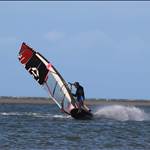
tail pressure .but they are fast for sure ,heres a picture of me in chop with a 31 fin ,if I was on a delta i would be spinning out ,but the 31 held well ,its a carbon weed and the lift is very good ,so if its shallow and flat ,Delta ,as for chop normal weeds are better .

Select to expand quoteAndrew / Geelong said.
Do small Deltas ETC that are proven fast at Lake George ETC create any lift at all!!
ANDY H GEELONG
I think I can answer one part of your question: Short weed fins by nature tend to be very stiff. Tip flex is not sufficient to be a meaningful source of spanwise or, in this case, 'vertical' lift. Spanwise flows down a raked leading edge do produce vertical lift. However, it takes a chunk of energy to change the direction of the water flow from straight across the fin, to angle it down the leading edge. This energy requirement is manifested as drag.
A delta like fin at very high angles of attack can develop a leading edge vortex running down the fin. When sailing, it feels like the fin is almost spun out, but hasn't quite let go. In this state, the fin does produce some 'vertical' lift, but it is intensely draggy. Leading edge vortex flow is unsteady, so unless you are sailing in smooth water the vortex is likely to join with the trailing edge low pressure area and ventilate the entire surface, that is, spin out.
A large radius leading raked edge does have a speedboat hull like effect and does want to ride up over the water, again, vertical lift. The effect of this is double-edged. Increasing the fin drag, but decreasing the board drag can be very effective (e.g. foiling) but only up to a point. Increased frontal area on a fin increases the drag exponentially, so at higher speed the relative board drag becomes low, and the fin feels like it has hit a speed wall.
Just on a small tangent, flow across a windsurfing fin needs to be mostly attached to provide lateral lift. It is usually turbulent, but it can, under a special set of circumstances, be laminar. At windsurfing speeds, the inertia effects of the water's mass dictate the flow around the fin. Viscous effects such as creating laminar flow are overwhelmed. A perfectly smooth fin, in perfectly smooth water conditions, will achieve laminar flow for about 2 cm from the leading edge, even less as the speed increases or there is a ripple on the water. Or a butterfly takes off in the Amazon forest. The transition from laminar flow to turbulent flow is more unstable and violent the longer the flow resists tripping to turbulent flow. The severity of the transition to turbulent flow when windsurfing can induce small cavitation bubbles that migrate downstream and provide a pathway for leading and trailing edge low pressure areas and/or surface ventilation to join. Sudden sheet cavitation is the result. (e.g. spin out). In reality, a perfectly smooth fin is almost impossible to achieve, whereas chord length, chord width, and leading edge radius are potent influences on flow and pressure. Similarly, given fins are surface piercing, the effect of wingspan and ventilation is also important. But that is all another story, and methinks I have hijacked this thread too much already.
Select to expand quoteAndrew / Geelong said..
Do long weed fins ( non delta style) create lift
Do small Deltas ETC that are proven fast at Lake George ETC create any lift at all!!
Weed speed (40 deg) fins and super weed speed (50 deg) do create lift if they are stiff enough. Super weed fins are also used successfully at Lake George by a number of very good sailors.
Delta fins also create lift if the water is flat, shallow enough and or the weed is close to the surface. There is some sort of ground effect in these conditions that creates lift.
Select to expand quoteJohn340 said..Andrew / Geelong said..
Do long weed fins ( non delta style) create lift
Do small Deltas ETC that are proven fast at Lake George see ETC create any lift at all!!
Does a fin need to flex/bend windward with Blackfoot pressure to lift?
How does a small triangular delta do this??
Weed speed (40 deg) fins and super weed speed (50 deg) do create lift if they are stiff enough. Super weed fins are also used successfully at Lake George by a number of very good sailors.
Delta fins also create lift if the water is flat, shallow enough and or the weed is close to the surface. There is some sort of ground effect in these conditions that creates lift.