I've been sailing a long time and never had issues water starting before.
Lately sometimes when I try to start if I flip the clew over, the tip of the mast goes down to the bottom of the lake , then the board flips over . I have to flip the board over and wait for the sail to start to come up then use my feet to get it up closer to the top of the water so I can grab it. By now the whole kit has rotated around so it's not at a good angle to start.
I try to swim it around a bit but when trying to manoeuvre the rig or flip it I have the same problem with the rig sinking.
It happens with cammed and un cammed sails and with different booms. ???
Lake chop...
I've been off the water for 3 weeks so my recollection is a bit hazy. I know there are other times I have the issue but can't remember.
Anyone had similar problems ?
Sue that's the very reason I stay in shallow water as much as possible now, flying the sail in deep water is just getting to be too much of a pain.
Select to expand quotedecrepit said..
Sue that's the very reason I stay in shallow water as much as possible now, flying the sail in deep water is just getting to be too much of a pain.
I just can't understand why I only seem to be having issues lately? Maybe I'm falling off at a different stage so the gear is orientated differently?
Sure, had the same issue a few times. It can happen if either the wind or a wave is pushing onto the mast when it is slightly under water. Weight of the water keeps the mast angled downwards and the push moves it further in. Was surprised how fast the mast pointed straight to the bottom. Take your time to orient the material properly. Sometimes it is easier to swim the mast around than to flip it.
Select to expand quotePeer78 said..
Sure, had the same issue a few times. It can happen if either the wind or a wave is pushing onto the mast when it is slightly under water. Weight of the water keeps the mast angled downwards and the push moves it further in. Was surprised how fast the mast pointed straight to the bottom. Take your time to orient the material properly. Sometimes it is easier to swim the mast around than to flip it.
That makes sense. Also , maybe I'm taking a little bit longer to get to the gear and start, and that gives more time for things to go wrong..
I used to be able to waterstart clew first if I had to, I reckon the cammed sails have messed me up.
(I'm sure it has nothing to do with me being 20kg heavier)
I saw a kid earlier with bits of a pool noodle attached to the clew, maybe that works for you too to keep it floating.
Select to expand quotesboardcrazy said..
Lately sometimes when I try to start if I flip the clew over,
That's the first mistake, I think. You cannot simply lift and flip the clew over, as it will do exactly what you describe...
Grab the mast above the boom, and swim it towards the wind, without lifting it above the water surface. Then to get the rig out of the water you drag the mast (above the boom) just above the water surface towards the wind and let the wind get underneath the mast and lift the sail out of the water, still keeping it just above the water surface. In rough conditions you can grab the mast even higher up and only feed down to the boom area once the sail is free from the water.
On small boards I feel the tendon-style is much to stiff and it will flip the board in the water, the regular Boge-join works much better as it is more flexible.
Select to expand quoteSurferKris said..
of the water you drag the mast (above the boom) just above the water surface towards the wind and let the wind get underneath the mast and lift the sail out of the water, still keeping it just above the water surface.
Doesn't work easily with cambered sails rotated in the wrong direction. First you have to persuade the sail to flip.
For me the process is the same with or without cambers. If the cambers are on the wrong side you still need to drag the mast above and parallel to the water, you just have to lift it a little higher. Just avoid lifting it straight up, as than will make the clew sink into the water. Once there is air under the sail I use my head to pop at least a few of the cambers over, and waterstart.
If you can't get the sail to fly that way, you can purposely lift straight up on the mast in order to sink the clew and "flip" the sail in the water. The mast will still be at the water surface, and by dragging it along the surface the clew will come up too. This works better than flipping the sail by the clew, that is the worst option as the mast is pushed down (as noted in the first post).
There was a dedicated "noodle" to place on the clew of the boom, I think it was made by the "Easy-uphaul" company. This would stop the clew from sinking, but I think it might give you bad habits. Better to learn it properly from the start.
Found a link to the "noodle" or "waterstarter" as they prefer to call it: www.easyuphaul.com/waterstarter
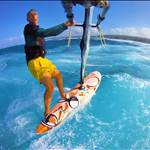
Select to expand quoteCookie did a video about waterstarting that was a total game changer for me. You only need to think about getting the mast 45 deg - 90 deg from the wind angle. You then lift the (mast tip) out of the water, and waterstart. Saved me so much floundering- once I watched this:
How to get ready to waterstart! #insta360 #windsurf
yt3.ggpht.com/VAp2iDMD44cmn126CHEPxEg7j0t_1eJYCZ6wSq-_-e6QO_8WYtGw-hKTn4vlG-ZMqhrDlsEuNw=s48-c-k-c0x00ffffff-no-rj
Ride-Along Sessions with Cookie!
Select to expand quoteremery said..
I used to be able to waterstart clew first if I had to, I reckon the cammed sails have messed me up.
(I'm sure it has nothing to do with me being 20kg heavier)
Yep back in my younger days so could I..
I was using smaller wavesails then.
Have you considered foiling instead? You can get away with much smaller and lighter sails without cambers. It's also more gentle on the body when sailing in choppy waters and a great sensation.
Either wind foiling if you want to stay closer to windsurfing or wing foiling if you want to go small and light. It's not that hard to learn and worth the effort.
Select to expand quoteptsf1111 said..
Have you considered foiling instead? You can get away with much smaller and lighter sails without cambers. It's also more gentle on the body when sailing in choppy waters and a great sensation.
Either wind foiling if you want to stay closer to windsurfing or wing foiling if you want to go small and light. It's not that hard to learn and worth the effort.
I'm learning winging for those crappy gusty days when the gust only last 10m. I wouldn't say it's easy to learn...
I love the physical effort / fitness involved with fin and the contact with the water. My boards are lively , fun, pretty fast and have suspension so they are comfortable and very safe..
I have an absolute ball doing bearaways over the back of chop. 
Select to expand quoteSurferKris said..sboardcrazy said..
Lately sometimes when I try to start if I flip the clew over,
That's the first mistake, I think. You cannot simply lift and flip the clew over, as it will do exactly what you describe...
Grab the mast above the boom, and swim it towards the wind, without lifting it above the water surface. Then to get the rig out of the water you drag the mast (above the boom) just above the water surface towards the wind and let the wind get underneath the mast and lift the sail out of the water, still keeping it just above the water surface. In rough conditions you can grab the mast even higher up and only feed down to the boom area once the sail is free from the water.
On small boards I feel the tendon-style is much to stiff and it will flip the board in the water, the regular Boge-join works much better as it is more flexible.
I read this and thought " I've been flipping the clew for years without issues.." I then realised that it was once the sail is in the air. 
I've thought about it a bit more. Often the rig ends up with the mast pointing into the wind or even through the wind. I have to swim the rig towards the tail to get it into waterstarting position. I know I could turn the other way, but it's usually after I've gybed and want to head back into the shore.
What SurferChris said - dont flip, if the rig is on the wrong tack get it in the air first then flip to the direction of travel tack
Also instead of swimming the sail around to be in a good position to lift it out, move the board around instead
Having an uphaul is a good idea if you have a cambered rig thats gone under you can yank it out to a good waterstart position (or sail away) much quicker than swimming that thing around
Also you can use the nose of the board under the boom to lift the rig a bit
Select to expand quoteausbinny said..
What SurferChris said - dont flip, if the rig is on the wrong tack get it in the air first then flip to the direction of travel tack
Also instead of swimming the sail around to be in a good position to lift it out, move the board around instead
Having an uphaul is a good idea if you have a cambered rig thats gone under you can yank it out to a good waterstart position (or sail away) much quicker than swimming that thing around
Also you can use the nose of the board under the boom to lift the rig a bit
I hadn't thought of using the uphaul.. I'm not sure if I'd have the strength but I'll check it out next time.
Select to expand quoteSurferKris said..
For me the process is the same with or without cambers. If the cambers are on the wrong side you still need to drag the mast above and parallel to the water, you just have to lift it a little higher. Just avoid lifting it straight up, as than will make the clew sink into the water. Once there is air under the sail I use my head to pop at least a few of the cambers over, and waterstart.
If you can't get the sail to fly that way, you can purposely lift straight up on the mast in order to sink the clew and "flip" the sail in the water. The mast will still be at the water surface, and by dragging it along the surface the clew will come up too. This works better than flipping the sail by the clew, that is the worst option as the mast is pushed down (as noted in the first post).
There was a dedicated "noodle" to place on the clew of the boom, I think it was made by the "Easy-uphaul" company. This would stop the clew from sinking, but I think it might give you bad habits. Better to learn it properly from the start.
I'll keep this in mind. I use twin cams in chop so I get my body under the sail and pop the cams the right way by using my knees.
Select to expand quotesboardcrazy said..ausbinny said..
What SurferChris said - dont flip, if the rig is on the wrong tack get it in the air first then flip to the direction of travel tack
Also instead of swimming the sail around to be in a good position to lift it out, move the board around instead
Having an uphaul is a good idea if you have a cambered rig thats gone under you can yank it out to a good waterstart position (or sail away) much quicker than swimming that thing around
Also you can use the nose of the board under the boom to lift the rig a bit
I hadn't thought of using the uphaul.. I'm not sure if I'd have the strength but I'll check it out next time.
technique - bend the knees, straight arms and back straighten your knees = easy peasy if you try to pull it out with your arms and back = difficult
Select to expand quoteausbinny said..sboardcrazy said..ausbinny said..
What SurferChris said - dont flip, if the rig is on the wrong tack get it in the air first then flip to the direction of travel tack
Also instead of swimming the sail around to be in a good position to lift it out, move the board around instead
Having an uphaul is a good idea if you have a cambered rig thats gone under you can yank it out to a good waterstart position (or sail away) much quicker than swimming that thing around
Also you can use the nose of the board under the boom to lift the rig a bit
I hadn't thought of using the uphaul.. I'm not sure if I'd have the strength but I'll check it out next time.
technique - bend the knees, straight arms and back straighten your knees = easy peasy if you try to pull it out with your arms and back = difficult
Uphauling? Not going to happen with the kit I'm using..too old..
Instead of a regular up-haul line you can use the "easyuphaul" or make one yourself from a regular strap. The idea is to have a loop at the end that you can hook onto the harness hook. Then for the heavy part of up-hauling, i.e. getting the sail out of the water, you just lean back and let the body weight do all of the work. The sail will come out of the water (without even using your arms or back) and once the force is small you just grab the strap and do the last bit as usual. This works great on larger sail, and was almost a must on larger Formula sails for me. I'm about 65kg and used to sail with an 11.7 sail as my largest sail (now I only use up to 10.8 m^2), works great. :)
Select to expand quoteSurferKris said..
Instead of a regular up-haul line you can use the "easyuphaul" or make one yourself from a regular strap. The idea is to have a loop at the end that you can hook onto the harness hook. Then for the heavy part of up-hauling, i.e. getting the sail out of the water, you just lean back and let the body weight do all of the work. The sail will come out of the water (without even using your arms or back) and once the force is small you just grab the strap and do the last bit as usual. This works great on larger sail, and was almost a must on larger Formula sails for me. I'm about 65kg and used to sail with an 11.7 sail as my largest sail (now I only use up to 10.8 m^2), works great. :)
I've got one.
Although I haven't adjusted it properly and I don't use it much.
How does that help waterstarting?
Select to expand quotedecrepit said..
Sue that's the very reason I stay in shallow water as much as possible now, flying the sail in deep water is just getting to be too much of a pain.
I'm the same, but then I think: having a shallow water quiver and a deep water quiver might solve one problem, but creates another. So now I'm thinking I have to use my cammed sails as much as I can for experience and tuning. I rarely drop a sail, but when I do, it's a session ender  . I was thinking of getting an 100 life jacket, so I'm able to leverage the cammed sail out of the water. My current 50S vest is useless.
Select to expand quotesboardcrazy said..SurferKris said..
Instead of a regular up-haul line you can use the "easyuphaul" or make one yourself from a regular strap. The idea is to have a loop at the end that you can hook onto the harness hook. Then for the heavy part of up-hauling, i.e. getting the sail out of the water, you just lean back and let the body weight do all of the work. The sail will come out of the water (without even using your arms or back) and once the force is small you just grab the strap and do the last bit as usual. This works great on larger sail, and was almost a must on larger Formula sails for me. I'm about 65kg and used to sail with an 11.7 sail as my largest sail (now I only use up to 10.8 m^2), works great. :)
I've got one.
Although I haven't adjusted it properly and I don't use it much.
How does that help waterstarting?
My comment was in respons to the fact that you said that uphauling is not going to happen. With a DYI "easyuphaul" there are no sails that one cannot uphaul. ;)
Select to expand quoteSurferKris said..sboardcrazy said..SurferKris said..
Instead of a regular up-haul line you can use the "easyuphaul" or make one yourself from a regular strap. The idea is to have a loop at the end that you can hook onto the harness hook. Then for the heavy part of up-hauling, i.e. getting the sail out of the water, you just lean back and let the body weight do all of the work. The sail will come out of the water (without even using your arms or back) and once the force is small you just grab the strap and do the last bit as usual. This works great on larger sail, and was almost a must on larger Formula sails for me. I'm about 65kg and used to sail with an 11.7 sail as my largest sail (now I only use up to 10.8 m^2), works great. :)
I've got one.
Although I haven't adjusted it properly and I don't use it much.
How does that help waterstarting?
My comment was in respons to the fact that you said that uphauling is not going to happen. With a DYI "easyuphaul" there are no sails that one cannot uphaul. ;)
I meant the board is too much effort to uphaul in chop.I know it's gigantic by most young fit blokes perspective but I'm 64 and struggle to clamber on a big board in chop.
It's + 20ltres over my kitted out weight) @ 90ltres but longer and narrower.
Hi Sue ,I really think its a luff pocket and cam issue ,not you I dread dropping my race sails in the water so quick water starts it is .
Next sail up grade look at the NCX or Neilpryde Speedsters ,really fast sails
and easier to waterstart ,we tested these sails against race in WA 2 years back again each other had 4 of us
and 1-2 knots slower ,with our watches
stability was pretty good .with 100 % carbon mast .a lot nicer in chop and easier to hang on
in hard chop some times the no cam was as quick as no sheeting off was required .
the Pryde speedster is a awesome sail .
64 your still youngish ,
I just hum the "Jaws ", theme music to myself.
Years ago in deep water something big and solid brushed against my leg . Apart from crapping myself I believe I water started on the leeward side of the board, clew first in about three seconds.
Select to expand quoteTardy said..
Hi Sue ,I really think its a luff pocket and cam issue ,not you I dread dropping my race sails in the water so quick water starts it is .
Next sail up grade look at the NCX or Neilpryde Speedsters ,really fast sails
and easier to waterstart ,we tested these sails against race in WA 2 years back again each other had 4 of us
and 1-2 knots slower ,with our watches
stability was pretty good .with 100 % carbon mast .a lot nicer in chop and easier to hang on
in hard chop some times the no cam was as quick as no sheeting off was required .
the Pryde speedster is a awesome sail .
64 your still youngish ,
It's happened with my twin cams plus my non cammed gators and wave sails. 
It doesn't happen all the time just often enough to be a pain.
It takes 5 mins to start...Imax I try not to think of sharks..
You got it! If I understand you correctly, the sail sinks sometimes when you're flipping it over while being behind the clew.
On skinny masts and narrow boards, I never do this. Reason is the wind will catch and drive the mast towards the bottom.
Instead I do 2 whole body strokes to reorient the gear and have the mast on the wind side.
Other important thing, never try to lift the sail while the boom clips are under water, it'll bury the clew unless you pull really hard the mast into the wind and get lucky.
If the clew is buried, flip the board up (if needed) grab the mast and pull it hard upwind/up wave, it'll speed up the sail flattening and rising up to the surface.
More tips and tricks: windsurfing.lepicture.com/