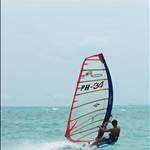
I sail mostly in light winds ( 10-15 knts) because these are the prevailing winds around here in summer. I have a Bic 290 OD and I weigh 85 kg. Planing is of course out of question, also given my abilities. I would be more than happy to leisurely cruise around sub-planing, but with these winds I can't even get moving with any sail less than an 8.5. and with some difficulty at that. How do I maximize the power of my Severne Focus 8.5 with, say 10-12 Knts winds? I wouldn't go for a larger sail, because it might become too heavy for manoeuvering and especially uphauling.
Sometimes I wonder whether under my conditions one shouldn't perhaps go against the conventional wisdom and keep both the downhaul and the outhaul to a minimum, in order to allow the sail to take a deeper shape and thus maximize the power of an already low wind. The only problem I see is that reducing both the downhaul and the outhaul would hamper the rotation of the sail because the batten will stick around the mast. How to get out of the thicket, short of staying home. Any comments/suggestions?
Thanks
Ittiandro
Hi Sounds like a common problem You should go and buy a second hand One design wind surfer or old race board and happily be fully hooked up in 12 knots and if the wind dies you can still get back to the beach. Second hand should be about the same price as a sail for your BIC. you can even use your existing rig on an old race board 8.5 is plenty big enough.
Just my opinion I got sick of being caught out and having to swim back to the beach or winding up a mile down wind.
Cheers
Hey Franco:
Joe from Montreal here again.
What i would like to do is have you try some of my boards.
Ideally this would be OKA Parc - even if far (one hour) from you - water stays shallow
You need to try my longboard(s) and perhaps even my FreeFormula
That 8.5 should get you going with your weight !!!
You WILL plane in 12 to 13 knots on either board !!!
(and no pumping required)
Conventional wisdom is actually to keep downhaul and outhaul to a minimum, in those conditions.
You want maximum power, especially up top of the sail where there's a bit more wind!
I'm just under 80kgs and was able to plane in ~13 knots on a 110 litre freeride board, a 7.2 freerace sail with no cambers, and a 40cm fin. Just. 12 knots and I could keep planing, but net get planing. Obviously these numbers are a guess but around there - If a kiteboard could plane so could I.
In these conditions I'd have minimum downhaul and outhaul. I'd also move the rig as far back as possible.
From there it's technique; you want to be almost catapulting to get max power to get onto the plane. I found pumping didn't really help that much as you'd only fall off the plane once you stopped anyway. I used to instead lightly flutter the sail which does... something. Seems to loosen up the flow. You also want all your weight in the harness - mast foot pressure.
Good luck.
Select to expand quoteevlPanda said..
Conventional wisdom is actually to keep downhaul and outhaul to a minimum, in those conditions.
You want maximum power, especially up top of the sail where there's a bit more wind!
I'm just under 80kgs and was able to plane in ~13 knots on a 110 litre freeride board, a 7.2 freerace sail with no cambers, and a 40cm fin. Just. 12 knots and I could keep planing, but net get planing. Obviously these numbers are a guess but around there - If a kiteboard could plane so could I.
In these conditions I'd have minimum downhaul and outhaul. I'd also move the rig as far back as possible.
From there it's technique; you want to be almost catapulting to get max power to get onto the plane. I found pumping didn't really help that much as you'd only fall off the plane once you stopped anyway. I used to instead lightly flutter the sail which does... something. Seems to loosen up the flow. You also want all your weight in the harness - mast foot pressure.
Good luck.
I thank you for your advice and I am glad to see that I am not the only one to think that, in those conditions, keeping downhaul and outhaul to a minimum is the only sensible way.
I was thinking to go against conventional wisdom, though, because the most common piece of advice you hear in windsurfing circles is to downhaul as much as possible, as a general rule and only adjust the outhaul, depending on the strength of the wind. . Some even advocate using manual winches to bend the mast to the "optimal" (!?) position, beyond the degree attainable by sheer arms' strength.. No doubt this common ( but not always right) wisdom assumes that high winds and planing are the only dimension of windsurfing. Your explanation makes perfect sense . In its simplicity it is like Columbus' egg: indeed, reducing downhaul allows to power up the top part of the sail by minimizing or eliminating the twist which allows the wind to spill out.. Of course this is a perfect recipe for getting catapulted in stronger winds or sudden gusts, but it is a risk I am willing to take, if it makes the difference between sitting on the beach forever waiting for planing conditions or having fun..
The only thing which may be a problem is that the sail may not rotate properly, if at all, by keeping downhaul to a minimum.I hope this can be compensated by playing with the outhaul. I'll see next spring,( once the ice is melted on the lake...)
Ittiandro
actually this happened yesterday .. I was about to launch in high winds nearing the water's edge I thought I need to downhaul the sail to it's maximum but was in a hurry(who isn't?)..luckily the wind lowered a bit by 3-5 kts and with a fuller sail helped me quite a bit and ended well .. sail couldn't rotate fast enough but instant power with lesser speed but still happy bout it 
Select to expand quotejp747 said..
actually this happened yesterday .. I was about to launch in high winds nearing the water's edge I thought I need to downhaul the sail to it's maximum but was in a hurry(who isn't?)..luckily the wind lowered a bit by 3-5 kts and with a fuller sail helped me quite a bit and ended well .. sail couldn't rotate fast enough but instant power with lesser speed but still happy bout it
This is my next question: how much should one be concerned about sluggish rotation of the sail, especially in light winds and subplaning conditions? Does it affect the power of the sail, hence the speed? What are the disadvantages,if any? Intuitively, I tend to think that a sail that is not fully rotated and stuck half-way around the mast may be depowered a bit, because it cannot deploy the full, deeper shape required to maximize the power in light winds, but sometimes intuition is wrong. Any comments on this?
Thanks
Francone
Francone I think what you are missing is - the difference between normal downhaul and a setting for light winds is about 1-2cm. I feel you are talking about using a lot less than that and it won't work.
You still need to downhaul in such a way that it may be difficult (takes some strength), the mast still bends, you may still need a winch. The same effort is required, just that it is downhauled about 1-2cm less
On most sails I find if downhaul is insufficient it will give you more power for sure, but won't go upwind well and feels funny in the gusts as it is just not set right. Often it is better to use recommended downhaul and then have to bear away a bit or pump to get on the plane. Then when planing you at least have a sail that is working properly.
^+1
modern sails do have a SMALL range for downhaul
as someone said - adjust using the outhaul
tight leech only works on sails designed for it - otherwise other issues come up
also, i just looked up the Severne Focus since it is a sail I am not accustomed to hearing about
for an 8.5 sail, 5 battens are not many
my free-race had 7 and my race sail has 9
with cambers these sails locked in the wind through luffs no problem
not saying to change the sail - just that it may not plane as early as mine
you can try my boards and my TR-6 8.4 - perhaps this summer
standard rules apply - you break it - you pay to have it fixed :)
joe windsurfer
montreal


Select to expand quoteFrancone said..jp747 said..
actually this happened yesterday .. I was about to launch in high winds nearing the water's edge I thought I need to downhaul the sail to it's maximum but was in a hurry(who isn't?)..luckily the wind lowered a bit by 3-5 kts and with a fuller sail helped me quite a bit and ended well .. sail couldn't rotate fast enough but instant power with lesser speed but still happy bout it
This is my next question: how much should one be concerned about sluggish rotation of the sail, especially in light winds and subplaning conditions? Does it affect the power of the sail, hence the speed? What are the disadvantages,if any? Intuitively, I tend to think that a sail that is not fully rotated and stuck half-way around the mast may be depowered a bit, because it cannot deploy the full, deeper shape required to maximize the power in light winds, but sometimes intuition is wrong. Any comments on this?
Thanks
Francone
In my case since it was a race sail it won't rotate or set the cams fast enough and needs a bit of a slight pump to pop over. Mark is right cuz it really needed 2cm more downhaul to rotate with ease. On high winds it could need an extra cm at times. The draft was full that gave extra power but with a tight leech it wasn't comfy for the back hand as it tended to be unstable and tiring. If it was correctly tuned a loose leech tends to spill over gusty 'unused' wind makinf it far easier to sheet-in hence a locked stance, better control and increased speeds. It might sound techy language but it took me eons to follow specs and realize what a difference a cm can equate to kts. Outhaul didn't matter much as it has a rigid draft but I did leave 2cm just in case it needed to be flatter in case it got out of hand. I did stop for bout 30secs and looked for a suitable piece of wood for downhauling. But the usual me says forget it and go. Funny thing the session only took 40mins but what a smile I had. Regards
Select to expand quotejp747 said..
. Mark is right cuz it really needed 2cm more downhaul to rotate with ease. On high winds it could need an extra cm at times. Outhaul didn't matter much as it has a rigid draft but I did leave 2cm just in case it needed to be flatter in case it got out of hand.
I assume when you say" 2 cm" (or whatever distance) , this is measured at the cleat-end, where the downhaul string comes out as you pull it through, but is there a visual reference for the absolute MINIMUM downhaul, in other words for the MINIMUM curve to give to the mast when you downhaul? For the past, I used to pull down as much as I could by hand ,( and even strain myself!) even in very light winds, and then, listening to that " conventional wisdom" I was referring to earlier, I even bought a winch to pull down even further. In other words, I had always taken for granted that the more the downhaul, the better it is . I was probably wrong and this is probably why I couldn't get my board moving in very light winds, even with a 8.5. Now I am facing the other extreme : what is the MINIMUM d/haul I should start with when the winds are really light ? Would a minimum downhaul be the one you get with an easy manual pull-down, without straining, let alone winching? Of course this is something I will have to experiment with in the water, but it is always nice to have some theory behind it. Regards
Francone
Francone. I Know sail tuning is one of the most difficult and often times over looked elements of kit tuning by new or inexperienced sailors. I think you need to listen to what most people in this forum have said. All sails are different and all masts are different but all sails have specifications written on them, you need to use this as a start point and go small increments either way to see what effect it has on sail performance. By small I mean 1cm at a time, go out and sail it then come back in and adjust. This should be done both ways, more downhaul and less. This is called tuning your kit and is the only way to find the sweet spots with your equipment. I don't think anyone on this forum has the magic number for you, you just have to tweak and tweak again and you will soon find out what is possible with your rig. I am no expert but I would think 3cm either way of spec would be the maximum range.
And while you are at it don't forget that boom height will need to be changed when you change downhaul settings.
Good luck and enjoy the challenge
visual reference for me is the sail's overall look and from end of luff sleeve to the cleat or bottom of mastbase. Evil's pic was rigged for lighter wind or just for example. There's only 6 of us in this big island who sails. And on a weekend a max of 3-4 only show up. With no-one to really tell us which was the best limit to downhaul we thought it was right till we joined the races. And there we learned everyone was straining to max out the downhaul and loosen up their chosen sail 20mins. before the start depending on wind and sea state. Out of the 3 of us who usually get together most of the time one is really technical going back to the beach and keeps on fine tuning. I rig it the way it should be and never bother to come back. The last one really doesn't care as long as he can plane back and forth. One man's tire pressure guage will be always different from the other's. We just say it in cm's but actually don't measure it down the last mm. As we progressed we could feel the difference on a well set sail than not and it took ages to learn that after numerous outings with different sailors. It's not the end yet though there still is outhaul, fin size, board size..etc to figure out what's right and that made it a never ending learning curve. There's a video I saw once with Dave White and Peter Hart which shows the extremes of how Dave rigs his sail 'abnormally' and Peter does his the right way. I forgot what the title of it is. But if ever you come across it, it is very informational..regards
When they say 2 cm more or whatever it means the pulleys on the sail would be 2 cm closer to the pulleys on the extension not 2 cm more rope coming through the cleat. 2 cm of rope through the cleat won't give you anywhere near 2 cm of extra downhaul with race sails even more so because often they have an extra pulley on the sail and extension.
Select to expand quoteqldnacra said..
When they say 2 cm more or whatever it means the pulleys on the sail would be 2 cm closer to the pulleys on the extension not 2 cm more rope coming through the cleat. 2 cm of rope through the cleat won't give you anywhere near 2 cm of extra downhaul with race sails even more so because often they have an extra pulley on the sail and extension.
Thanks for correcting my blunder! I really thought this distance would be in terms of the rope pulled out of the cleat!
This brings me to another couple of related points:
1.Normally I am using an oldish 35% 460 cm mast. I am being offered now a good deal on a 2nd hand 490 cm 75% carbon mast. With the proper extension adjustment, I will be able to use this new mast with my 8.5 and 7.5 sails which have a luff of approximately 490 cm. The 6.5 sail , however, has a 466 cm luff, which means that I would have a 35 cm gap between the bottom of the sail and the extension pulley. I was wondering how will this affect my sailing.
2. Distance between the clew and the boom-end. I know that ideally this distance should be as small as possible. However, again, in the same package I would be getting a 100% carbon boom for about half price. The only problem is that it is a 220-280 competition boom and with the 7.5 sail I would have an 8 cm gap at the end of the boom. I am curious to know what should I expect from this gap, keeping in mind that I am not a performance buff and that I normally sail in light winds without being overly concerned about speed and planing. I'd love to have it because my current boom is an old aluminum one ( 8 years) which is kind of heavy and a bit unbalanced, I guess. Sure, it cannot stand the comparison with a state-of-the art 100% carbon boom !
Thanks for your comments
Francone
Question 1: The 6.5 will feel like a piece of crap doing this. You boom will be way too low in the cut out if you can get it low enough in the first place depending on how low you have it to start with and the mast would be stiffer than what is required. You would be better off using your old 460.
Question 2: You could use the boom that far away from the clew but again it will feel a bit average because the back of the boom will move up an down quite a bit while your sailing. It's hard to get enough time on the water as it is you don't want everything to feel like crap when you do get out there. There is a reason why they make stuff in different lengths.