So it's a year later and I still can't water start or even beach start more than once in a blue moon. (To be fair I've really had 5 days where I've attempted...) Zero problem when conditions allow uphauling, including planing (no planed gybes, working on improving fast tack).
I'm on a Kona One, typically a 6.7 or 7.8 sail. Winds are 12-15 knots on windfinder. Waves 0.8-1+ metre, with a 3-5 second interval. Wasaga beach on Lake Huron, Ontario (Canada). Maybe not ideal conditions, and not ideal gear, but it's what I have to work with...
My problems are:
Getting the gear lined up for a water start is really hard. Often while flying the sail the board ends up far away from me, like not within grabbing distance downwind, after I get back to the boom. (I think I need to walk towards the board when this happens? Should I be able to get the sail to just pull me to the board?)
The waves screw everything up unless the rig is lined up just so. They literally break at the point where I can still touch... And depending on the wind direction it means I can only sail one way to keep the board nose pointing into the waves. Any tips?
Sometimes I can get things kind of lined up, pop my back foot on the board.... But then nothing happens. The sail is usually pretty close to my head, maybe 45 degrees to the water line? If I sheet in with the back hand I round up even though I'm trying to push (or at least not pull) on the mast hand.
I've had a number of attempts where my back foot is up, I pop my front foot and sheet in, and there just isn't enough pressure to pull me up before the board rounds into the wind (or my nose gets knocked by a wave and everything unravels)...
I really don't want to be a guy who can only go out in flat water-- because here that means never getting above 10 knot averages.
Appreciate any thoughts on this! (There are literally zero windsurfers here--ever!)
If you have both feet on the board and expect the sail to pull you up, it's going to be real hard. Use one leg on the back and pull the tail under you while furiously thrashing around with the other leg.
It's a really good idea to practice it on flat water first. With waves, even a foot high, it can get overwhelming to orient everything. With 2-3foot swells I really want to be powered up. As remery says, you want your back foot on only at first, getting your front foot on too will screw things up. If really overpowered you can be in the rear strap, get in the front strap, and almost start planing right away. But, in marginal conditions you will have to tweak your setup and focus on rear foot and getting on the board, out of the straps.
If there isn't a protected spot out near you, you will need a bigger sail likely at 10kts. Adjusting the boom so it is lower on the mast will also help (but this is counter-productive to planing).
With a low boom, once you have control, you can also grab the mast with your front hand to get the sail more upright before getting on the board. Really need to get your body small and as close to the centerline of the board as soon as possible. You can also grab the bottom of the sail with your back hand, but I personally haven't been able to do this myself. This gets the sail more vertical with more power, early, so you can leverage your weight on it more.
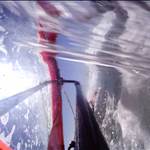
In a lull with a 4.4, this is what I mean by grabbing the mast with a low boom. Normally, I would have the boom a lot higher but it was a really gusty day. Notice also right at the beginning that I am pushing the sail forward to get the whole situation oriented more downwind as you can see the horizon spin a bit. There's much more demonstrations of lighter wind waterstarts with people that have 10x more skill than me out there as well.
You need a sail big enough to lift you off the water "when learning", once you get good can use a smaller sail. That is how I learned, no kicking of the forward leg, just rear foot on tail, sail lifts me up and then I place front foot on board. Front leg in water reduces weight sail needs to lift when at a low angle to the water, as it straightens up is has more wind pressure on it and then can lift your front leg too.
As mentioned above, need to practice in fairly flat water, doing it in waves will be difficult as you have found out.
Can also do an "Easy Beach Start", fast way to get up and going in waves, as long as you have shallow water to stand in. I have described it several times in detail in different posts.
Learn to step start first in shallow water . You can do it in lighter winds .It will teach you all the angles and sail control . Once you can do that , waterstarting is easy .
whilst standing waist deep, hold the rig and lift with your front arm and then do the opposite, this will steer the board into and away from the wind. Do that like 10 times or until you have complete control and then go slightly deeper maybe just a few inches at a time.
Remember push the rig away too and have your arms extended, once you get your back leg on push the rig away even more and bring the board under you as you rise up.
Waves will knock the wind out of the sail and spin the board around so learn this in flat water. You should be able to uphill a Kona so don't waist energy keeping on going with water starts, get on and go for a sail.
The Kona is a big enough board that you won't be able to pull the tail under you with your back foot. You can still use the one-foot method, but you will have to really scrunch your body into a ball (with both arms behind your head and your knees in your face) in order to get the lift out of the water.
If you can plane you can water start.
Best way to learn is buy a board you can just barely uphaul and commit to it. Too much board makes the water start hard and the uphaul too tempting.
Gonna take a lot more than one year to learn to water start unless you live in a place with lots of wind like the gorge. Positioning the board is crucial for beach starting and water starting and you need to be able to this through the sail

The other really important thing is to get onto the board without killing the power in the sail. Stay low and try to keep arms straight and try to keep sail upright.
Waterstarting and beachstarting successfully is all about correct mastfoot pressure. Every learner endures the problem of the board pointing to windward when they put their back foot on.
The best way to understand the dynamics is to gradually progress:
1.Sail along on a floaty board as normal.
2. Take front foot off and dip into the water while still sailing on the same reach.
3.Gradually lower leg further into the water until you can comfortably sail straight with most or all of your leg in.
You have to increase the mastfoot pressure by hanging from the boom and driving weight through the mastfoot plus you need to pull the back leg under your body. This will counter your front legs resistance in the water, and the temptation to push with the back leg, both of which will turn the board upwind.
I guarantee that you will get used to the rig supporting your weight and lifting your body to the boards centre line. If you can manoeuvre and fly the rig initially then the above steps will solve second, and hardest, part of the waterstart.
I practiced getting lifted onto the board on the sand which helped me feel how much lift is needed and when to dump power as I get lifted. It is hard to get a big board and sail into position especially if rough where you are.
Have you tried with your back foot in it's strap?
That's the way I learnt, but it's not a common method.
It helps a lot controlling the board, as you can hook your toes in the strap and pull the back of the board towards you.
That's part of the technique pulling the board towards you and pushing the sail up. The instinctive action is the opposite, the body wants to pull on the sail and push with the feet. This just leads to the board pointing upwind, the sail stalling, and you falling back in the water.
The beach start is the best way to ease into it. Before even getting into beach starts, I would simply practice handing your gear while in shallow waters.
Try and rotate your gear around until your board is slightly upwind and your mast slightly downwind. Then pull on the mast throwing it towards the wind and over your head.
You can see this swinging motion in the video below:
If I read you right, you're trying to waterstart a board meant to be used in flat water in a 1m beach break.
That's hard. I sometimes have to do it with a dead onshore wind and plenty of backwash and it's damn near impossible.
After a while, I give up trying and swim the board out past the shore dump to get up where it's merely big chop to contend with.
Suggestion for you is to find a spot that's sheltered from the waves, but not the wind, and try there. A few 10s of metres downwind of a groyne or low breakwall would be a good spot.
Thank you all for your suggestions so far.Select to expand quoteMr Milk said..
If I read you right, you're trying to waterstart a board meant to be used in flat water in a 1m beach break.
That's hard. I sometimes have to do it with a dead onshore wind and plenty of backwash and it's damn near impossible.
That's right. Is there such thing as a board that's ok in sub-planing conditions, in chop, that could make this easier?
Normally I would try to technique my way out of a situation, but the terrain and conditions are limited unfortunately. Anytime there's wind, there are waves (the spot where I learned could get 15+kts without big waves, and it was great--but I've moved)
...or I could get a roof rack and haul my gear out to a flat water beach?
Select to expand quotedavidskis said..
Thank you all for your suggestions so far.Mr Milk said..
If I read you right, you're trying to waterstart a board meant to be used in flat water in a 1m beach break.
That's hard. I sometimes have to do it with a dead onshore wind and plenty of backwash and it's damn near impossible.
...or I could get a roof rack and haul my gear out to a flat water beach?
Yes. I didn't understand how difficult my home spot was until i went an hour away and sailed with others on protected flat water. Finally learned waterstarting there after getting some advice by people that saw me try and make mistakes.
Select to expand quotedavidskis said..
Thank you all for your suggestions so far.Mr Milk said..
If I read you right, you're trying to waterstart a board meant to be used in flat water in a 1m beach break.
That's hard. I sometimes have to do it with a dead onshore wind and plenty of backwash and it's damn near impossible.
That's right. Is there such thing as a board that's ok in sub-planing conditions, in chop, that could make this easier?
Normally I would try to technique my way out of a situation, but the terrain and conditions are limited unfortunately. Anytime there's wind, there are waves (the spot where I learned could get 15+kts without big waves, and it was great--but I've moved)
...or I could get a roof rack and haul my gear out to a flat water beach?
I looked at Wasaga beach on Google maps. Is the mouth of the creek at the NE end open to the wind but protected from the waves? You only need a small stretch of flat water to learn on.
However, you'll still have the same problem of the board getting knocked around by broken waves once you return to the open beach
Select to expand quoteMr Milk said..
I looked at Wasaga beach on Google maps. Is the mouth of the creek at the NE end open to the wind but protected from the waves? You only need a small stretch of flat water to learn on.
However, you'll still have the same problem of the board getting knocked around by broken waves once you return to the open beach
It has undertow and is considered unsafe. We do have a beach area that's flat(ter) so I can head there (Allenwood beach). But my beach area (beach area 5) is a 7 minute walk away from home which is convenient.
I actually learned the beginner stages in a sheltered harbour, but the wind was never strong enough at the shore to learn a beach start, and generally possible to do an uphaul in the harbour.
Select to expand quotedavidskis said..Mr Milk said..
I looked at Wasaga beach on Google maps. Is the mouth of the creek at the NE end open to the wind but protected from the waves? You only need a small stretch of flat water to learn on.
However, you'll still have the same problem of the board getting knocked around by broken waves once you return to the open beach
It has undertow and is considered unsafe. We do have a beach area that's flat(ter) so I can head there (Allenwood beach). But my beach area (beach area 5) is a 7 minute walk away from home which is convenient.
I actually learned the beginner stages in a sheltered harbour, but the wind was never strong enough at the shore to learn a beach start, and generally possible to do an uphaul in the harbour.
As convenient as beach area 5 is, if you are not succeeding, then you need to try something different. The best location to learn beach and water starting is a place that has good steady 15kt wind, flattish water (small wind chop but no swell), minimal current and gradually deepening water so you can transition from knee deep to thigh deep to waist deep to chest deep beach starts and eventually to overhead deep water starts. Use the instruction videos to learn how to position your sail and board while you can still stand and then transfer this skill to treading water. It will help to use a floatation device when treading water. Practice makes perfect. The rewards of being a confident water starter make the effort worthwhile.
And first of all, learn how to easily handle the rig. Flipping the sail, positioning the sail, learn how the different angles to the wind change the power in the sail. Then learn how to steer the board. Like proper steering, board 360s without touching the board. Upwind, downwind. All that stuff, that sounds boring, comes in handy once you are in the water, trying to get back on the board.
DB2 is right. Learn how to control the board without touching board. Do this in waist deep water. You notice the board will spin on its fin.
Not sure if anyone else has suggested this.
Try a lower volume board if you can. The Kona sits pretty high out of the water and is harder to get under you as you raise up.
When you are in the water with the rig flying the board will be much higher and as you raise up from a water start it won't sink under your feet. Not saying to try a total sinker just a lower volume board.
Then when you get water starts right, move back to the Kona.
Select to expand quoteWind Smurf said..
Not sure if anyone else has suggested this.
Try a lower volume board if you can. The Kona sits pretty high out of the water and is harder to get under you as you raise up.
When you are in the water with the rig flying the board will be much higher and as you raise up from a water start it won't sink under your feet. Not saying to try a total sinker just a lower volume board.
Then when you get water starts right, move back to the Kona.
+1
I just saw an advanced sailor uphauling in the breaking waves. It actually happens more often than one would think!
Select to expand quotedavidskis said..
My problems are:
Getting the gear lined up for a water start is really hard. Often while flying the sail the board ends up far away from me, like not within grabbing distance downwind, after I get back to the boom. (I think I need to walk towards the board when this happens? Should I be able to get the sail to just pull me to the board?)
You almost never touch the board with your hands while waterstarting. When the sail is flying above your head, use the boom to apply pressure on the mastfoot and steer your board. Only when the board is too close when the sail is already flying I sometimes kick the fin with my leg to push the tail of the board away (and the nose more into the wind).
When the sail is flying, try to place the foot of the sail between the two rear footstraps. Like this, you keep the board in the ideal position and it doesn't turn away since the sail holds the board in place.
When a gust comes, apply pressure to the mastfoot to turn the board/nose a bit downwind, put the rear leg in front of the rear footstraps and - very important - pull the board to you by bending the knee a lot. Like this you make sure the board continues downwind, and your body weight is very close to the board, allowing you to step up as if you'd make a big step onto a bench. Only then put the front foot up.
Try in flat water with enough wind first. Like in everything with windsurfing, you need to get the feeling and body-learning by practicing more and more. Don't give up, and don't use the uphaul line :-)
What Imax said.
As shallow as possible. Let your bum touch the floor so you don't struggle with sinking.
Also, wouldn't bother trying with winds under 16 knots. There isn't enough wind to lift you up and if you go to sails over 7m, you will struggle with sail handling too.
hmmmm, I've been out on wave gear, 5.3m sail in 10kts, yes water starting is difficult, but possible. agreed not ideal for learning in though. 15/16kts, is probably about right, enough power but not too much.
Select to expand quotedavidskis said..
Sometimes I can get things kind of lined up, pop my back foot on the board.... But then nothing happens. The sail is usually pretty close to my head, maybe 45 degrees to the water line? If I sheet in with the back hand I round up even though I'm trying to push (or at least not pull) on the mast hand.
I am guessing this is in light winds, getting the sail upright should be your main goal for more power, pointing the boards nose downwind (sail comes along) olso increases the power, 45 degrees between mast and water is not enough in light winds you need at least 60 degrees to climb.
-Sail being close to your head means your arms are not extended enough, one of the main reasons for low angle, you need to extend your front arm almost fully most of the time and try to get a constant pull from it using back hand adjustments while flying the rig above your head looking for a gust to get up.
-Other very important way to increase the angle is to get your body closer to the mastbase (narrower board helps). Once you get the sail flying, extend your arms slowly without mastfoot pressure (so board stays at its place) and let the sail pull you down towards the board while your arms get extended, your goal now is to reach the board with your back foot asap, once you touch the board you can pull the board towards your butt with your back foot (while extending the front arm even more to max), at this point your body is close to board and sail is as upright as it gets so you climb the board vertically with your back foot and pulling down the boom, like rock climbing.
-Lowering your boom to low setting for waterstart practice session will help to increase the angle.
Olso keeping your hands very close to each other on the boom will help with higher angle.
Select to expand quotesboardcrazy said..Wind Smurf said..
Not sure if anyone else has suggested this.
Try a lower volume board if you can. The Kona sits pretty high out of the water and is harder to get under you as you raise up.
When you are in the water with the rig flying the board will be much higher and as you raise up from a water start it won't sink under your feet. Not saying to try a total sinker just a lower volume board.
Then when you get water starts right, move back to the Kona.
+1
+2
Trying to control the position of a long board with the rig only whilst treading water is so much more difficult than a short board.
Practice on the beach or a park. Lay on your back with both feet towards the rail. Pull the mast over the tail and over your head. Practice flying the sail. Then let the sail pull you onto the board. Keep your arms extended. You will learn sail flying and sail control very quickly. When mastered on land, do the same on the water. It's that easy. By the way, I always waterstart with 2 feet on the board. It allows me to come into the board evenly with less knee strain. Good luck!