Don't bother with the 6, it isn't the classic 7 with straight front arm and leg hooked in leaning back.
When really overpowered it can be survival with more front leg bent and sheeted out trying to weather the gust.
The first speed sailing contest i went to you could see the people who were going to crash having more "poo"stance!
Select to expand quote515 said..
Don't bother with the 6, it isn't the classic 7 with straight front arm and leg hooked in leaning back.
When really overpowered it can be survival with more front leg bent and sheeted out trying to weather the gust.
The first speed sailing contest i went to you could see the people who were going to crash having more "poo"stance!
So is a 6 the poo stance?
Select to expand quotetbwonder said..
I thought a No.2 was the poo stance!
Stutter stance
2 2 2 2 2 2 2 2 2 2 2 2 2
Indeed I am here. Thanks for making me laugh, everybody.
Stance is a function of the kit you sail, and it's determined by your footstraps positions on the board, your mast foot position in the track, and by your chosen boom height in relation to your body height.
'6' stance is a bit old school and where you sit down more bent at the middle, and this usually puts you under the rig, often caused by the mast foot being set well forwards. It's actually a good blasting stance when overpowered or when heading downwind, and when you need weight on the board tail, and the mast foot set forwards rakes the rig backwards and also helps take the rig power away from that long slalom fin you are using which is causing control problems. An extreme '6' stance does see you in the lavatory position.
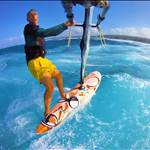
The alternative '7' stance is a more upright one, and better for early planing and for manoeuvring on wave and freeride and freestyle boards. You set the mast foot further back and the front strap goes near the mast, which in turn sets the rig more upright and gets your body weight more on the front foot. With you standing upright, legs straight, you can hold the rig at arms length where it works more efficiently - and hence the body shape takes up the profile of a number 7. Your head sits on top of the number 7 to look where you are going, and this helps when gybing and when riding a wave and constantly changing direction.
When you first change to an upright stance it can be quite 'catapulty' . With the mast set upright, you need to be aware of gusts, and to have your sail rigged well.
Select to expand quoteDavMen said..
A rare pic of Loto giving birth to Caushecan and Amirite.
Select to expand quoteBasher said..
Indeed I am here. Thanks for making me laugh, everybody.
Stance is a function of the kit you sail, and it's determined by your footstraps positions on the board, your mast foot position in the track, and by your chosen boom height in relation to your body height.
'6' stance is a bit old school and where you sit down more bent at the middle, and this usually puts you under the rig, often caused by the mast foot being set well forwards. It's actually a good blasting stance when overpowered or when heading downwind, and when you need weight on the board tail, and the mast foot set forwards rakes the rig backwards and also helps take the rig power away from that long slalom fin you are using which is causing control problems. An extreme '6' stance does see you in the lavatory position.
The alternative '7' stance is a more upright one, and better for early planing and for manoeuvring on wave and freeride and freestyle boards. You set the mast foot further back and the front strap goes near the mast, which in turn sets the rig more upright and gets your body weight more on the front foot. With you standing upright, legs straight, you can hold the rig at arms length where it works more efficiently - and hence the body shape takes up the profile of a number 7. Your head sits on top of the number 7 to look where you are going, and this helps when gybing and when riding a wave and constantly changing direction.
When you first change to an upright stance it can be quite 'catapulty' . With the mast set upright, you need to be aware of gusts, and to have your sail rigged well.
Thanks! Great explanation..
Select to expand quoteMark _australia said..DavMen said..
A rare pic of Loto giving birth to Caushecan and Amirite.
what if i told you
kid not childbearing age
6 stance means break at the hips. This allows for more leverage against the gear into the harness. One can stiffen up legs, arms, tighten up abs to transfer as much sail power to the board.
Upper body leans forward (control) while bum sticks out. This stance works well absorbing chop while maintaining drive.
Overpowered, front arm pushes to keep sail straight (wind wants to flatten it), or extend to seek power when wind is light.
Back remains completely straight and supported fully by the harness.