Hi All,
Felt compelled to invite comment. Found this on YouTube and there seems to me to be some fundamental flaws in the information conveyed and I invite the Windsurfing community to respond (note the number of comments that endorse all the information provided)
Seems a reasonable explanation to me.
Modern boards with your feet in the straps, its still the same concept, a shift in weight to the back or front feet, even though they are strapped.
Speed makes these movements more subtle, and there is help with steering via the board shape and the fins (like you are surfing).
Cheers, Sparky
maybe didnt discuss everything, but as a general wally board sailing overview, seemed pretty right to me 
IMHO: This is a good video for Novices (or none Sailors) who what to just get a sense of major sailing principles without diving into details.
However, this video is mainly focused on displacement sailing (none planing, non foiling) it still confuses plaining foot steering with simple COLR (center of lateral resistance) vs COF/COE (center of force/effort) for steering in displacement mode.
It also is messed up about "no lift". Well, they explain that there is not lift windward, sure but that does not mean there is no lift in other aspects.
I think the comment section of the video is Great. You can learn much more there e.g.: Newton forces (model) vs Bernoulli forces (model).
How to explain it better ?
You have to explain windsurfing in "displacement mode" (like video does to some extent) separately from windsurfing in "planing mode".
How many of you want to Windsurf in displacement mode only ?
I guess most would scream: "I want to plane, foil all the time !"
Also critical is to explain shortening waterline and its effect on sailor moving back and rotating the sail back.
That is why many longboards in the 80s & 90s had such a long (on the fly) adjustable mast track. In the stronger winds they actually act as short boards because the board only touches the water only at the back.
Funny thing "3D Enlightenment" explaining "the Ocean" from the flatfish (bottom feeder) 2D perspective ?!
The problem also is that even in all Windsurfing Books (more than a dozen) I gathered by over 40+ years, they explain only 2 Dimensional Model of Vector Forces.
So let me ask the question: Who and how often you sail with your sail at 90 degree to the water surface ?
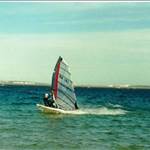
Even on my picture from late 1990s sailing on Botany Bay, you can see that I am hanging out in the harness and the sail is tilted windward therefore one vector of force is parallel to water (like in all literature & videos) and second perpendicular to water downward: MBP & feet and upward from the sail uplift (YES there is the Lift Force UP ! One vector).
Please note that the Racers do tilt sails windward much more than me!
This is also why "Heavy Dudes" love seat harnesses in particular to let the vertical force up vector decrease some of our weight.
Why nobody ever mentions that? I don't know.
It is so critical also for early planing !

Someone may ask, why then we do not tilt our sails more?
The answer is: There is an Optimum (sweat spot, balance) where angle generates max speed forward.
Please also note that wind speed changes with height. Slowest at the surface due to water surface friction.
So for example if at 2m (~6ft) where your head is roughly for tall guys/girls the wind is 5m/s (~11mph) then if it is flat surface like water (factor 0.1 for calculator) then at ~5m (upper sail if you use 490-550 mast mast) height it will be 7mph (~16mph).
Check it out:
wind-data.ch/tools/profile.php?h=2&v=5&z0=0&abfrage=Refresh
Therefore for max speed (or earliest lift on the foil) in low winds you want as tall sail as possible also HA (high aspect).
That is why my favorite sail for light winds is Loft Oxygen 10.8m rigged on 550cm 100% carbon race mast. No lose leech.
That sail is a free race sail and only weights 13lb. Unfortunately I need to repair that sail as it got damaged.
I hope this information helps a better understanding what we actually do on the water and what Laws of Physics (vectors) are involved in 3D not 2D.
Cheers
MarekS