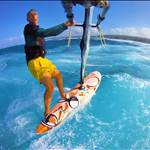
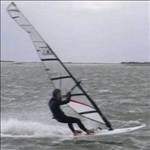
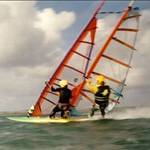
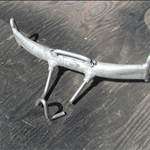
What causes this , I went out today with a 300 weed fin and I kept sliding out , Is this because I'm cutting too hard into the wind .
I find if I go down wind a bit it digs back in.
If I used a larger fin would it happen less.
Still good fun out today Bloody windy
It's probably mostly because of the weed fin shape.. Most raked back fins don't like going up wind.
Try moving the mast forward in the slot. This made a difference for me. Technique plays a part to I think.
Why is the raked shape so bad at going upwind? The only fins I have are weedies, this is upsetting! 
Select to expand quoteHENDO 77 said..
What causes this , I went out today with a 300 weed fin and I kept sliding out , Is this because I'm cutting too hard into the wind .
Put the fin over your knee and see how much you can bend it, if it more than a couple of millimeters, that's part of the problem.
There are some terrible weedies out there.
Some are just reboxed pointers, this can work if the pointer was fairly thick and stiff, but a lot of pointers are thin and flexi, these make horrible weedies, even if they worked quite well as pointers.
If you can get a loan of a tribal, you may notice a lot of difference. If you don't it's probably your technique that's at fault.
Yes a larger fin may help, what size board and sail were you on, how heavy are you?
I find sailing windward rail down can increase spinouts, sailing windward rail up lets the leeward rail do a bit of work.
Reboxing an upright fin changes the chord to thickness ratio, and makes the entry finer, this will increase the chance of the fin stalling at higher angles of attack. Any flex reduces lift, which means a higher angle of attack is necessary to produce enough lift.
Designing a weedy from scratch is the way to go, done well it eliminates the above problems.
But the more rake a fin has the more induced drag it has, as the flow over the fin starts to travel to the tip. So in theory a weedy won't have as good a lift/drag ratio as an upright fin. But a few of us believe, if you're sailing in heavy weed or shallow water, this inhibits the flow around the tip, reducing induced drag.
I was having a few issues today but the fin was a narrow blade, only 16.5cm deep and raked at 55 degrees. I was still getting up wind in the chop. But it worked much better in the shallow flat weed.
Try shifting your back harness line back a little and see if that helps. Weedies aren't the best for going upwind, but too much back hand pressure can cause sliding.
You may also want to check the fin is sitting flush or recessed in the board. The fin will ventilate quite easily if its protruding, even just a little bit.
+1 on moving harness lines farther back. Happened on both sides? Personally, I find flexy fins to give more warning before spinning out.
This is from an article written by Guy Cribb about spin out...
Contrary to popular belief, spin out has very little to do with the fin - unless you are waaaay out of the recommended ball park size, it has far more to do with harness line position or outhaul and downhaul (in this order.) Even if your fin is about 4cm off the recommended size it is still not guilty. Furthermore, contrary to popular belief, spin out is not due to too much side- ways pressure into the fin, in fact the more pressure you put against it in theory the better it works - something to do with low pressure, high pressure and lami- nar flow etc. Spin out is caused when air hits the fin. This can accidentally happen in chop- py water - almost as likely to happen to Antoine Albeau as it is to you. But the most common causes of spin out are these in this order:
1. In first place spin out is caused by the harness lines being too far forward. This causes the back of the sail to open. When the sail opens / sheets out, you reduce mast foot pressure, so the board lifts out of the water, air rushes underneath, hits the fin and you spin out. Positioning the harness lines in the correct place prevent the sail from opening and you radically reduce your chance of spin out - oh, and fatigue.
2. Second place goes to too little outhaul, creating a combination of too much back hand power, thus sheeting out in the gusts, and increased 'vertical lift' lit- erally lifting the board out of the water. Air rushes underneath, hits the fin blah blah blah...
3. In third and almost final place, too little downhaul also causes too much back hand power, especially in the gusts, and this can cause the sail to open, nose to lift blah blah blah. The reason why people spin out when they think about gybing is because they open the back of the sail, lose mast foot pressure, air gets under the board... the rest is history.
So spin out is due to 'nose lift'/board lift/sudden loss of mast foot pressure, and very very rarely anything to do with the fin.
Select to expand quoteSail Repair WA said..
Hi Hendo
What board and sail are you using and what it your level?
Cheers
Jesper
^^^ what he said. Lots of advice, without knowing context.
Dig your back foot toes in hard,lifting your heel - this will help to rail the board up. Very difficult for the board to spin out with the windward rail lifted.
The trick now is to keep it there for as long as possible.
Weed fins are great If there's weed,if not they are very unexciting to use.
Off the wind powered up they can offer more control and possibly more speed than a pointer.
Upwind is where they struggle.
Guy Cribbs spin out points are valid, but he is assuming that misplaced harness lines/improperly rigged sail are the primary cause, which may be true for the novice just learning to plane with a harness and foot straps.
We all spin out / slide out from time to time, either because the fin is too small for the board speed; too much push on the back foot; or bouncing over chop and getting air under the board (need to keep the board stuck to the water).
And some fins are much, much worse than others. Even fins that are the same size and shape with little visual design difference can perform radically different once on the water. I have two brand new (7 years old) Drake fins that came with my 2008 Starboard iSonic 111. They would spin out all the time, total garbage. Replaced with a Tectonics fin that was 1000 times better.
Select to expand quoteMarkSSC said that Guy Cribb said..
Contrary to popular belief, spin out has very little to do with the fin - unless you are waaaay out of the recommended ball park size, it has far more to do with harness line position or outhaul and downhaul (in this order.) Even if your fin is about 4cm off the recommended size it is still not guilty. Furthermore, contrary to popular belief, spin out is not due to too much side- ways pressure into the fin, in fact the more pressure you put against it in theory the better it works - something to do with low pressure, high pressure and lami- nar flow etc. Spin out is caused when air hits the fin. This can accidentally happen in chop- py water - almost as likely to happen to Antoine Albeau as it is to you. But the most common causes of spin out are these in this order:
1. In first place spin out is caused by the harness lines being too far forward. This causes the back of the sail to open. When the sail opens / sheets out, you reduce mast foot pressure, so the board lifts out of the water, air rushes underneath, hits the fin and you spin out. Positioning the harness lines in the correct place prevent the sail from opening and you radically reduce your chance of spin out - oh, and fatigue.
2. Second place goes to too little outhaul, creating a combination of too much back hand power, thus sheeting out in the gusts, and increased 'vertical lift' lit- erally lifting the board out of the water. Air rushes underneath, hits the fin blah blah blah...
3. In third and almost final place, too little downhaul also causes too much back hand power, especially in the gusts, and this can cause the sail to open, nose to lift blah blah blah. The reason why people spin out when they think about gybing is because they open the back of the sail, lose mast foot pressure, air gets under the board... the rest is history.
So spin out is due to 'nose lift'/board lift/sudden loss of mast foot pressure, and very very rarely anything to do with the fin.
Context matters! Guy teaches lots of beginners and intermediates learning to use the harness and foot straps. At that stage, lack of mast foot pressure and sheeting out in gusts are indeed often the primary problem.
But saying it has "very very rarely anything to do with the fin" is a big overstatement. Switching from a stock fin to a similar-sized high quality fin can reduce spinouts by 90-100%, assuming that the windsurfer's techniques is reasonably good. As decrepit said, fin stiffness is one factor, especially for weed fins. But there are other factors, too, like cutouts at the rear, foil shape, and Fangy-fillets.
Similarly, " the more pressure you put against it in theory the better it works" and "Spin out is caused when air hits the fin" are gross simplification. A fin that's roughly the right size will spin out when putting on too much sideway pressure. Some fins give a little warning before that happens, others loose traction very suddenly. The larger the fin, the more dramatic this often is, but there are big difference between different fins at a give size. A fin will indeed work best at close to the maximum pressure that it can take. If you sail a fin with maximum pressure in chop, it's very easy to add just a little bit of extra load that makes it spin out, even without getting extra air under the board. That's why bigger fins can be a good idea in chop; even freestylers, who want their fins as small as possible, often go a couple of centimeters larger in chop.
Using a larger fin may help; finding a better fin of the same size may also help. Going upwind can be reasonably easy with a good weed fin that's large enough, but the angles will never be as good as with a great pointer fin.
I was in the "it's not the fin" camp for a long time. Fins I thought were bad got better when I stopped doing stupid things like going over chop pushing on air instead of water. Then, recently, I popped in an old favorite fin into a current board. I thought the old fave would give a little low in grunt since it has a longer chord (wider).
It didn't add low end and was annoyingly spinny. Swapped back out to stock fin and enjoyed the rest of the day.
Beginners/intermediates will spin, as mentioned above, also by pushing down hard on the heels and digging the windward rail in, especially if powered up. Remembering to flatten the board helps a lot. Pushing hard on a fin into a lull will spin a board, too, more likely going upwind.
Select to expand quoteNCUSAGUY said..
Guy Cribbs spin out points are valid, but he is assuming that misplaced harness lines/improperly rigged sail are the primary cause, which may be true for the novice just learning to plane with a harness and foot straps.
We all spin out / slide out from time to time, either because the fin is too small for the board speed; too much push on the back foot; or bouncing over chop and getting air under the board (need to keep the board stuck to the water).
And some fins are much, much worse than others. Even fins that are the same size and shape with little visual design difference can perform radically different once on the water. I have two brand new (7 years old) Drake fins that came with my 2008 Starboard iSonic 111. They would spin out all the time, total garbage. Replaced with a Tectonics fin that was 1000 times better.
I disagree, because what happens with the fin comes as a consequence from other processes. As Cribb said, "spin out is due to 'nose lift'/board lift/sudden loss of mast foot pressure, and very very rarely anything to do with the fin". This does not exclude the fin, but in most cases something else is the cause of the fin cavitating. Freestylers use very small fins and adapt to them.
+1 absolutely what NCUSAGUY and Boardsufr said above. I could not put it better (or more diplomatically) myself. 
Like wise, other wise I wouldn't be able to intentionally spin out the board, which is very easy to do by just overloading the fin pressure, and nothing else. I would do that to see what it takes with a particular fin, and whether I like it or not. I've always been a bit of a skeptic with some of the Cribb stuff over the years, but I didn't read any of his stuff until long after I was well on my way windsurfing, so I may be tainted.
Freestylers are a funny bunch. My wife sometimes complains that her legs burn when she uses her big freestyle fin - all 18 cm of it. Her first choice is a 15. She never has any spinout problems with speed gear... but perhaps her habit of sinking the windward rail, which is a must on freestyle fins, limits her speed at times when she has to use small weed fins on speed gear.
I always do what Mastbender said, too: push the fin hard enough to get a couple of spinouts early in the session, so that I know how much it can take.
I once heard another very experienced windsurf instructor make a statement similar to Guy Cribb's statement "it's always the sailor's fault". The guy sails 10x better than I ever will, knows more about gear than just about anybody, and is one of the best instructors I have ever met, but that does not mean he is right. Even freestylers who have no problem sailing completely without fins usually have a strong preference towards some fins, and a very strong aversion towards other fins that are known to be bad. The discussion about using Fangy's fillets to make regular delta fins behave better is another point in case. I'm just glad that he never claimed his fins are "100% better in all aspects"  .
.
Sorry guys for the late reply
130 lt starboard carve
5.3 m sail
300mm weed fin
in my second year
in foot straps and harness but all self taught so technique and rigging might be a bit rough
90 kg
I tried a larger fin and moved the mast base full forward plus not as windy and only spun once or twice
Hey thanks heaps for the help
You certainly shouldn't need a 300mm fin with a 5.3. But the 130l board sounds like it may be fairly wide at the tail, so it could be a board trim problem that requires a longer fin to help keep the board flat, instead of windward rail down.
Select to expand quoteboardsurfr said..
The discussion about using Fangy's fillets to make regular delta fins behave better is another point in case. I'm just glad that he never claimed his fins are "100% better in all aspects" .
I filleted a narrow 55d 16.5c blade. I didn't want to protrude over the front of the box so the fillet is small.
I don't think it's had much effect.
I'll try increasing it's diameter and bringing it a bit further forward and see what happens.
Select to expand quoteboardsurfr said..
Guy teaches lots of beginners and intermediates learning to use the harness and foot straps.
But saying it has "very very rarely anything to do with the fin" is a big overstatement. Switching from a stock fin to a similar-sized high quality fin can reduce spinouts by 90-100%, assuming that the windsurfer's techniques is reasonably good. As decrepit said, fin stiffness is one factor, especially for weed fins. But there are other factors, too, like cutouts at the rear, foil shape, and Fangy-fillets.
I lost a bit of faith in Guy being the font of all knowledge after a story from Lake Illawarra a few years ago. He'd been given a locally made "deltoid" too try in the weed there. But whoever gave it to him too try didn't feel the need to explain what it was for. Guy took the fin out, but gybed every time he got close to the weed. He said when he came in that it was the worst fin he'd ever used, probably because it kept spinning out in the chop.
Hi Hendo
like you worked out yourself the fin size was way to small.
You need to match mostly the width of the board and to some extend the width at the tail.
I guess that your 130L board is around 75cm wide. For a Freeride pointer fin all round for this size I'm guessing around 44cm?
The weedfin you can generally sail 2-4 cm less for free riding / 2 years experience.
So around 40cm is a good all round size for a weed fin. This gives you good grip for the board size and your experience.
Taking into to consideration that it is your 2nd year and also your weight. Then this add a bit to how much back foot pressure you put through the board. When you get more experience and can tune the gear better, then you can get away with smaller fins, as you get a bit lighter on the back foot pressure.
You simply just pushed the 30cm to much and it it spinning out.
You did well to move the track forward as this 'release' a bit if pressure in the fin.
Cheers
jesper
Select to expand quoteI once heard another very experienced windsurf instructor make a statement similar to Guy Cribb's statement "it's always the sailor's fault". The guy sails 10x better than I ever will, knows more about gear than just about anybody, and is one of the best instructors I have ever met, but that does not mean he is right.
My golf game is barely average, and that is where my ability lies. Technically, the pros are 100x better than me, but that is no excuse to ignore their instruction. Furthermore, the pro is going to be right more times than Joe average. Windsurfing is no different to their sports, so why do you suggest that these pros are wrong?
That golf instructor might suggest different equipment, more suited to the skill level and physical ability of the golfer. Same with windsurfing fins, some are just bad and if the sailor isn't aware of it (the sailors problem), then he may need help finding the right fin. There are bad fins out there, either because of the design or size or improper use (pointer fin for wave sailing).
Can instruction/technique help minimize the effects of a "bad fin"? Sure, but that's not the ultimate solution. By saying that "it's always the sailors fault" can only be true if it includes the sailor's lack of knowledge or ignorance in finding the solution. If the statement implies that all fins are great and the sailor must learn how to use them, that is really stupid.