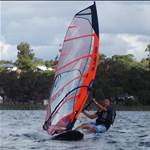
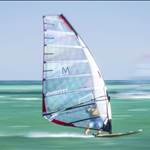
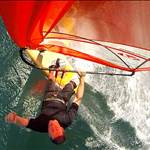
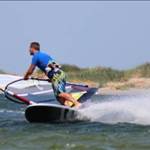
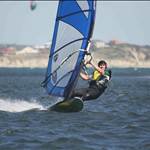
My progress so far has been good even if I said so myself. When I started coming back before winter (April 2013), I was uphauling and falling over lots. Recently, especially with the few seabreeze we've had, I am very easily planing in straps and lines.
Now I LOVE the blast of planing at full speed, being able to so with hardly 3 fingers on the boom.
BUT, as I cannot gybe or tack, I am finding this planing 500m, back and forth endlessly kind of boring  I know that I should be working harder on my gybe/tack but that has me totally frustrated and in pain from falling off.
So yesterday, whilst planing smooth as ever, I decided to cross the river (Lucky Bay to Dalkeith - 2.5km). That scared the absolute S**T out of me as the river was very rough in the middle (3-4' waves) and I was doing jumps unintentionally. Miraculously I stayed on all the across and back, but am not looking forward to that again.
My purpose of this post I guess is to get some sort of direction on what I should be doing / aiming with windsurfing. I have had dark thoughts about those kites. I am still thinking that maybe I should buy a larger volume board to help me with gybes. I know I should take lessons, but the shops are saying no instructors and no wind till December (they said November when I asked in September so I'm not hopeful).
Other thoughts are, is anyone in the same situation as me? Perhaps we can swap some of our gear around to see if that gets us over the humps? Or at least keep tabs on each others progress.
Just learn to gybe. it won't take long. you can do it this season. After that you're free.
GS. Falling off is part and parcel to the learning curve.
This will be my 3rd summer and i'm still nowhere near making even 50% of my gybes.
But when i do make that planing one it makes all those falls worth while.
I think changing up the places you sail will make the day more enjoyable.
Go exploring around Shoalwater islands or the peel inlet one day instead of the river
1- Learn to waterstart, it is much easier than learning to jibe. It will give you satisfaction and make it less painful to fall in the water.
2- Then learn light wind jibes, there are free utube movies from Alan Cadiz.
3 -Then learn to enter the jibe planing, turn the board around and flip the rig without falling.
As far as planing up and down there is a lot to improve regarding speed, stance, control in the chop etc. try sailing with one hand, foot steer....
What size board are you on?
Can you water start?
jibing should be easier on a smaller board. Tacking easier on a larger board ( in my experience) So I probably wouldn't go bigger.
While lessons may be worth while have a look on various websites to get some tips as suggested.
I found Guy Cribbs to be the most helpful.
In addition to the above - gybing racey / slalom boards can be hard. It is a lot harder in chop too.
What board are u on now?
Can you travel? A week in Lancelin could help (flat on the inside, lots of volunteer helpers for tips, able to rent a different board if need to)
Edit: just saw Kode 122.
Perfect! You need a couple of nice days where you don't mind falling in, and somebody to show you some stuff. You will get it
Speaking of tacking shortboards. Are heli tacks doable in all wind speeds? They are very big on teaching them in Vass. (I managed to pull off a few after dozens of attempts but only on a big board and in light winds. Didn't even bother to try them in stronger conditions.)
You need to find someone to sail with. Not necessarily an instructor just some one a bit better than yourself. I found it more interesting if you have someone to pit yourself against and out do. You try harder, try what they do and see where your going wrong. It doesn't hurt to have some one to talk too to ease the boredom as well.
Have a look at the following topic in the SA Windsurfing forum
www.seabreeze.com.au/forums/Windsurfing/South-Australia/Seabreeze-Fuel/
The first 2 videos are on how to duck jybe and how to carve jybe . The others are on some more complicated freestyle moves. The videos are well presented and very instructive. Try the carve gybe first.
C'Mon man. Learn to waterstart and then learn to gybe. You'll fall in a bit. But that's what makes its so cool.
Its not that hard.
Select to expand quoteRagnar said..
Just learn to gybe. it won't take long. you can do it this season. After that you're free.
I guess I'm being very impatient as I learnt harness, straps, beachstart, waterstart, planing earlier than expected. But there was one session a month ago where I did 12 out of 30 slow gybes, and then after that, I am managing 0 out of 10 (as I stop trying  Select to expand quoteStuthepirate said..
GS. Falling off is part and parcel to the learning curve.
This will be my 3rd summer and i'm still nowhere near making even 50% of my gybes.
But when i do make that planing one it makes all those falls worth while.
I think changing up the places you sail will make the day more enjoyable.
Go exploring around Shoalwater islands or the peel inlet one day instead of the river
I think you may be on the money there. I may need to try other places as motivation. Not that I know enough of Lucky Bay & Pelican Point yet. With some dredging going on in Safety Bay, where would be somewhere good to launch from?Select to expand quotepowersloshin said..
1- Learn to waterstart, it is much easier than learning to jibe. It will give you satisfaction and make it less painful to fall in the water.
2- Then learn light wind jibes, there are free utube movies from Alan Cadiz.
3 -Then learn to enter the jibe planing, turn the board around and flip the rig without falling.
As far as planing up and down there is a lot to improve regarding speed, stance, control in the chop etc. try sailing with one hand, foot steer....
1 - I think I have that done - rig recovery has me buggered and half drowning though. I think I need a vest but they look so bulky
2 - So light wind with a small sail? I have a choice of sails from 4.7 - 6.2 but am stuck with 122 l board. I have been watching Alan Cadiz, Jem Hall & Guy Cribb till I'm wishing for an Australian or American voice to tell me what to do :) (No offence to the amazing European sailors :)
3 - hmmm....Select to expand quoteleftfield said..
What size board are you on?
Can you water start?
jibing should be easier on a smaller board. Tacking easier on a larger board ( in my experience) So I probably wouldn't go bigger.
While lessons may be worth while have a look on various websites to get some tips as suggested.
I found Guy Cribbs to be the most helpful.
I am considering doing Guy Cribb's clinic in January 2014, but would hate to spend the money and time and still be frustrated.Select to expand quoteMark _australia said..
In addition to the above - gybing racey / slalom boards can be hard. It is a lot harder in chop too.
What board are u on now?
Can you travel? A week in Lancelin could help (flat on the inside, lots of volunteer helpers for tips, able to rent a different board if need to)
Edit: just saw Kode 122.
Perfect! You need a couple of nice days where you don't mind falling in, and somebody to show you some stuff. You will get it
I've been told I have one of the easiest gybing board - which doesn't instill confidence everytime I stuff it. I can travel but as never been in the ocean, I think Lancelin feels too wild. Maybe I should try Safety Bay?Select to expand quoteDASZIP said..
You need to find someone to sail with. Not necessarily an instructor just some one a bit better than yourself. I found it more interesting if you have someone to pit yourself against and out do. You try harder, try what they do and see where your going wrong. It doesn't hurt to have some one to talk too to ease the boredom as well.
I think that's just it! I don't know anyone and being an anti social, plus when I go sailing, everyone is rigging up and raring to go.
Select to expand quoteSputnik11 said..
C'Mon man. Learn to waterstart and then learn to gybe. You'll fall in a bit. But that's what makes its so cool.
Its not that hard.
Its the falling on the same spot of my shins 85 times in 3 hours which hurts. Maybe I need some cricket gear
Mate, the speed you're learning, you're just getting a bit thrown that gybing is tough. You'll get it and then you'll be duck gybing and naiing lay downs. You should never stop trying stuff.
Make some windsurfing friends and share the journey. Get tips from them and where possible share what you have learn't also.
And remember, windsurfing is a water sport, falling in is half the fun.
hey grumpy, your like me just want things to happen, i started this past christmas and i end up in Maui with the surf Fx boys learnt more in ten days then i did in 6 months sailing at home. learn to water start someone will teach you in 15mins and I'm like you i sink to the bottom so i wear a impact vest it make life a lot easier. I'm going through the jibe thing now just keep with it, it will come just jibe close to shore.
Select to expand quoteStuthepirate said..
GS. Falling off is part and parcel to the learning curve.
This will be my 3rd summer and i'm still nowhere near making even 50% of my gybes.
But when i do make that planing one it makes all those falls worth while.
I think changing up the places you sail will make the day more enjoyable.
Go exploring around Shoalwater islands or the peel inlet one day instead of the river
stu we must work on that %50 
Select to expand quotejsnfok said..Stuthepirate said..
GS. Falling off is part and parcel to the learning curve.
This will be my 3rd summer and i'm still nowhere near making even 50% of my gybes.
But when i do make that planing one it makes all those falls worth while.
I think changing up the places you sail will make the day more enjoyable.
Go exploring around Shoalwater islands or the peel inlet one day instead of the river
stu we must work on that %50
Yep. Pretty disappointing.
This summer is the time. 75% of gybes and a forward loop is the goal
Select to expand quoteGrumpySmurf said..
I've been told I have one of the easiest gybing board - which doesn't instill confidence everytime I stuff it. I can travel but as never been in the ocean, I think Lancelin feels too wild.
Lancelin is flat on the inside for a few hundred metres. Right on the beach is FLAT flat and windy so you can concentrate on all the transition movements, whilst the boards carves itself (no bumps). That's why I suggested it.
Hey GS every new move in windsurfing take's practice and practice and more practice but a larger board with smaller sail
allows for more control and balance but it will come, the more you do the more you learn just don't give up.
Also come down to Safety Bay great bunch of sailors with an enormous amount of talent even this weekend is the Safety Bay Windsurfing Club day on Sunday from 12 come down say hello and get the networking going .
Simon Bornhoft is coming in December fantastic instructor check out his website.
www.windwise.net/?Itemid=1017
Check out the web link for SBWC
safetybaywindsurfingclub.org.au/SBWC2011/Home.html
Pyro
Select to expand quotepowersloshin said..
2- Then learn light wind jibes, there are free utube movies from Alan Cadiz.
Alan Cadiz videos have been removed from youtube, but they can be purchased from Alan Cadiz's business Hawaiian Sailboard Techniques HST. Highly recommended and worth every cent if you want to improve your sailing.
Clarence
Get a GPS and join the GPS Team Challenge : gpsteamchallenge.com.au/
Then you can challenge yourself in 6 disciplines, and will have a goal to make a personal best in each one.
I'm only fairly new to the game, and yes back and forth can get a tad boring. You have to start working on the gybes mate. I kinda suck at them but there's a sweet feeling as you charge down-wind, unhook step the rear foot over the rail and drive through the turn fully powered up. And when you pop out the other end still planning and you'll be smiling like a Chester cat. If that ain't enough, find a spot with waves / swell, and hit em at 20 plus knots. Getting air-time is hectic and will either kill you or make you feel like the king of the World.
Sadly we have to go through the basics to get to the good stuff, but that's just part of windsurfing. Windsurfing ain't about being dragged around- You are the pilot, and every skill is hard earnt. Ultimately how good you become depends on your outlook and drive. Just sort out those core essentails (waterstart, gybes and tacks) then freakin go off!'
Disclaimer- any injuries sustained due to ill advice above are solely the sailors responsibility...
Recommend Guy Cribbs courses - he specialises in helping people like you learn to/ perfect your gybes..Dry land practise will help enormously and you don't have to fall in !
practice moves before you hit the water . rig up a small sail and attach it to your board on the beach minus the fin.
Practice the rotation of the sail and really focus on where you put your hands.
Do it over and over again and soon your body will start doing the right thing simply from muscle memory.
The idea here is to get the sail swinging from one side to the other in a nice smooth motion without stalling half way around.
Make it easier.
Go to somewhere with flat shallow water and enough wind to plane comfortably. Spend the whole time there practising.
Learn the waterstart first. That way you won't be bothered so much from falling in.
In flat shallow water you can get the technique quicker. Then you have to bend your knees more and try to do the same thing in choppy water.
Select to expand quoteGrumpySmurf said..
I have had dark thoughts about those kites.
Grumpy,
The level of response you have had in less than 2 days gives you an indication how supportive the windsurfing community is. We love our sport. We understand the frustration you are going through. However the rewards are within reach - don't give up, just keep at it.
You are lucky enough to live in the windsurfing mecca of WA. Maximise your time on water. Practice a new skill each time you get on the water. We all never stop learning.
Stay away from the dark side!
Grumpy, I think I may be a little like you, basically like my own company and 9 times out of 10 am sailing by myself. I enjoy doing this but when I can, I join up with the other sailors who are about 2 hours away. Now that is fun, just blasting up and back is great when you are with other riders. It is a different atmosphere. I think you should get to know the other riders in your area, not only can they give you pointers, you will find it so much more fun. If they aren't so talkative when rigging up, try to catch up out on the water when they are having a break. As for kiting, from what I have heard after 6 months you will be bored silly, stick to something that is a real challenge to learn, sure it is hard but that is what makes it worthwhile.
Select to expand quoteRoar said..
practice moves before you hit the water . rig up a small sail and attach it to your board on the beach minus the fin.
Practice the rotation of the sail and really focus on where you put your hands.
Do it over and over again and soon your body will start doing the right thing simply from muscle memory.
The idea here is to get the sail swinging from one side to the other in a nice smooth motion without stalling half way around.
And make sure you are learning the right way right from the start as fixing bad habits later on is the pits.. If possible get someone to video you so you can check you are doing it right ( or go to a guy cribb clinic)
Select to expand quoteStuthepirate said..
This summer is the time. 75% of gybes and a forward loop is the goal
Damn that forward loop. I think I need to sacrifice a session to completely attempting a forward, and nothing else.
The trouble I'm finding is speed. I want to be just planing when I attempt one, and I usually find myself in 4th gear when a piece of chop presents itself. I'm going too fast. For a first attempt.
I've hijacked this thread, but similar to dedicating an entire session to forwards (that are apparently easier than a gybe) you might like to seriously dedicate an entire session to only gybing.
Find a short, flat run to dedicate gybing practice to, like I have/had on the Gold Coast with all its sandbanks (see y'all at Christmas).
200m runs are best for getting your gybes right.
Make yourself try to tack or gybe at the end of each run. Every time you jump off you are losing an opportunity to practice.
Practice somewhere where it is shallow at both ends (Melville is best or Pelican Point close in) so you don't get exhausted climbing back on and uphauling or waterstarting, but don't let that tempt you to just jump off!
Do get some instruction before trying countless ones on your own. Unless you are a natural athlete you will only get frustrated and practice in bad habits.
Windforce have instruction available at Pelican Point on weekends now. Book in for an improvers course. They provide easy gear to learn on too.
Friends and others at the beach are helpful but a trained instructor knows how to teach in the most efficient way.
I know all this because I tried to teach myself. Years later I am still unlearning bad habits and still not good at gybing.
BTW, well done at making it all the way across the river and back. It dies get quite choppy out in the middle and it feels like you are a long way from shore.