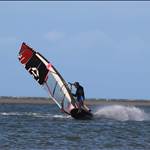
There's lots of comments in windsurfing about the light weight of modern sails, including in the current Naish thread. I thought I may as well grab some other sails out of the shed and weigh them, out of interest
Hobie Miracle 20 racing jib, 5.1m = 2.45kg bulletproof dacron
Laser Radial mainsail, 5.7m - 1.85kg with battens
Windsurfer One Design, 6m mylar 2.22kg with battens
Windsurfer One Design, 6m dacron, 1.58kg with battens (the original windsurfer sail)
Tasar dinghy mainsail with full battens, 8.3m, 2.7kg (mylar/kevlar)
28' offshore racing yacht No 1 headsail, about 20.6m, 4.9 kg (mylar scrim)
18 Foot Skiff headsail, about 10.8m, battens removed, 3.9kg (kevlar)
Considering most 6m windsurfer sails seem to be about 3.6kg, it's interesting that they are actually pretty heavy compared to other sails of similar weight and, ironically, double the weight of the first windsurfer sail. It's also not as if the flat-water windsurfer sails get very rough treatment compared to the loads on the Hobie (twin traps and 185kg of boat, plus a design oriented towards durability for one design racing), the 28' yacht (where sails bounce around the ocean dragging tons of boat and then are dragged down and crushed down a hatch at midnight) or the 18 Foot Skiff.
There's no real moral here, it's just interesting. Having said that, maybe it can be said that these figures show how easily people get used to various weights, and also that windsurfer sail design and construction is not really ahead of the design and construction of boat sails as is sometimes claimed.
I keep seeing posts about sail weights and wonder at the relevance.
I have more problems with the fat bastard hanging of my boom.
Select to expand quoteelmo said..
I keep seeing posts about sail weights and wonder at the relevance.
I have more problems with the fat bastard hanging of my boom.
The last time I used your rig was last year 
interesting topic considering the marketing BS on sail weight as if that's going turn average joe windsurfer into a superstar..
anyway, few things to note,
I think modern sails have more profile from battens compared to say one design. one design is just a bag that filled up with air and did a pretty good job. same with the flat water stuff weight comes from 6/7 battens on freerace/slalom sails plus if there are battens. maybe.
Select to expand quotehardie said..elmo said..
I keep seeing posts about sail weights and wonder at the relevance.
I have more problems with the fat bastard hanging of my boom.
The last time I used your rig was last year
Sorry I was referring to the Fatter bastard who normally hangs of the boom
Some of the later NP racing sails from around 2012 till current the monofilm is too thin.
Results in more sail repairs replacing panels.
The older pre 2012 NP racing sails had thicker monofilm and many are in better condition than the newer models.
The more battens the sail has - the less likely the sail is to pop a panel.
Chris, you maybe interested in 2 other 'small' raceboard sails. I recently replaced my tattered MOD 7.4m2 sail with a price reduced Bic Techno OD 7.8m2 sail. Although the new Bic sail is very well built, obviously to survive many hours of regatta use, it's quite
heavy. Whilst the old MOD sail weighed in at 3.65kg complete, the Bic sail is 4.85kgs !! The additional 1.2kgs is very noticeable whilst sailing, particularly in tacking & gybying manoeuvres. I'm in favour of 'lighter the better' generally, but as it's one design you have no choice. I can't imagine what the 'larger' raceboard sails, ie; 9.5m2, feel like in those transitions, let alone trying to uphaul them in moderate to strong winds.
Select to expand quoteI can't imagine what the 'larger' raceboard sails, ie; 9.5m2, feel like in those transitions, let alone trying to uphaul them in moderate to strong winds.
My 9.5m2 Severne Raceboard sail is 5.5kg, and can feel pretty heavy after a couple of races, even in light winds.
Interesting that the 9.5m2 Demon sail is supposed to be 4kg. I think the difference is its made from technora style cloth instead of mylar.


workin on it ...
hope my AHD SL-2 132 counts as new
joewindsurfer.blogspot.com/2016/08/ahd-sl-2_1.html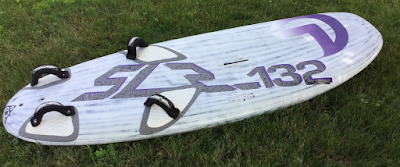
Downhaul loads on windsurf sails are massive and hence they are built heavy to cope with that. The mast sleeve also has to be well reinforced to cope with the loads and abrasion. Dinghy sails of the same size are built nowhere near as strongly.
^ The material makes a difference too. Dacron is lighter than monofilm.
They occasionally come out with light weight stuff but it carries a premium and doesn't necessarily wear well.
Aerotech used to offer sails with cuben fibre reinforcing years ago.
There are few manufacturers offering film laminated sails with individually optimally placed reinforcing fibres like Avanti and Severn Pros. They are very light.
I prefer lighter sails (throw around wave sails) but I'm a bit leary about their durability.
Once upon a time sails were made from canvas. Then they got wet. I am glad that someone thought of a better idea than that.
Select to expand quoteMarkSSC said..
Once upon a time sails were made from canvas. Then they got wet. I am glad that someone thought of a better idea than that.
Dacron sails were a bit like that but we didn't know any better. They were just about indestrustable apart from the window. I love new sails but a tiny woopsy ( or just looking at them sideways ) and they blow up ! Unless it's X,ply. If your lucky and quick with tape a tiny , tiny, and I mean tiny hole will blow out a panel.
Keeping some X,ply sticky film in the car is a good idea.
actually have a HotSailsMaui SpeedFreak 8.5 made with dacron - new type
supposed to weigh 5 kilos, but feels like MUCH less
especially for an 8.5 !!
joewindsurfer.blogspot.com/2014/07/hot-sails-maui-speedfreak-85-hsm-spf-85.html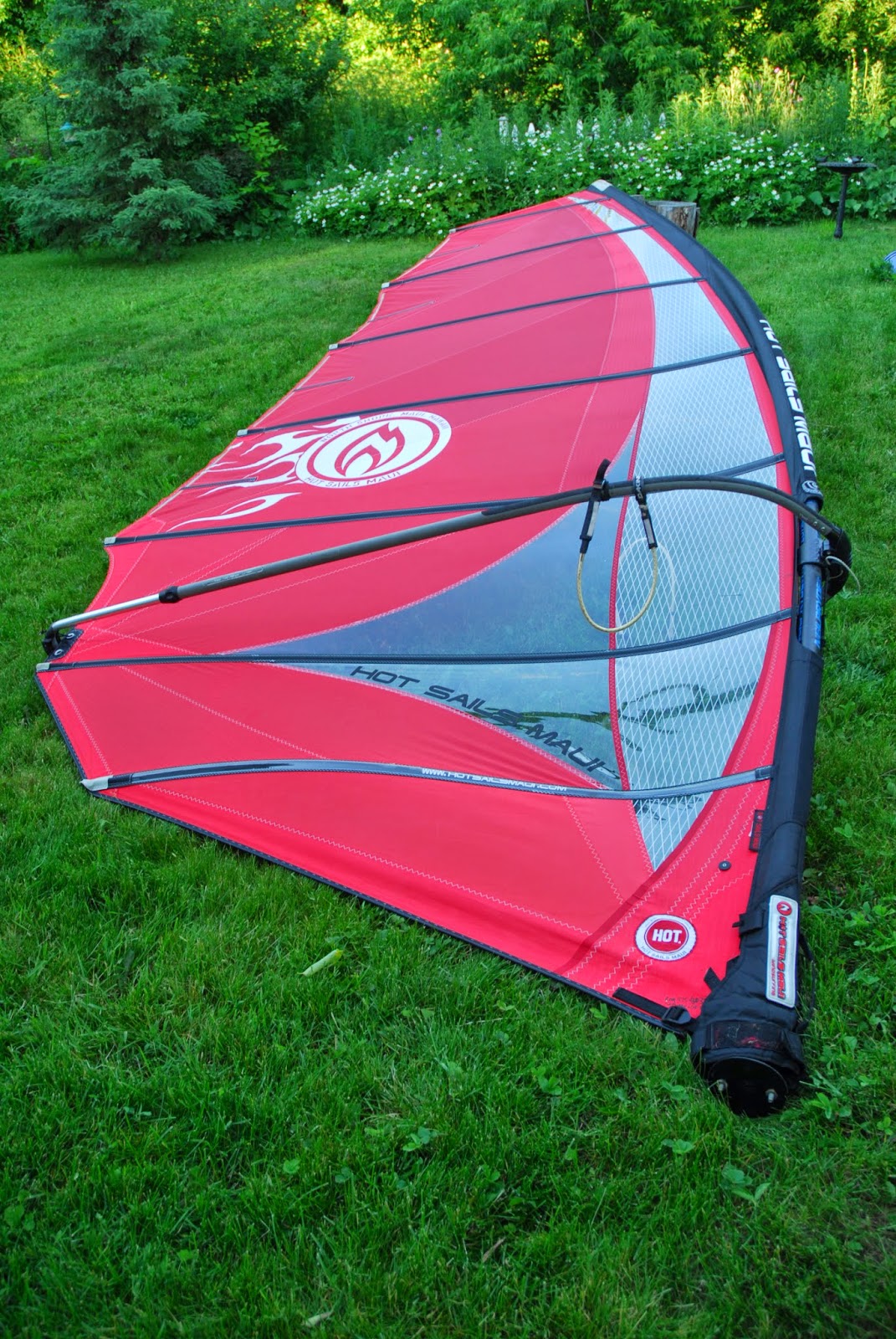
Select to expand quoteShifu said..
Downhaul loads on windsurf sails are massive and hence they are built heavy to cope with that. The mast sleeve also has to be well reinforced to cope with the loads and abrasion. Dinghy sails of the same size are built nowhere near as strongly.
The downhaul loads on boat sails can be very high too. On a fast cat for example the downhaul is trying to bend a wing mast that may be about 180mm from front to back, and is vastly stiffer than a board mast. And the overall loads on the boats must be much higher - the leverage of three guys trapezing off wings on a skiff are vastly higher than the leverage of one guy hanging onto a boom, and that leverage goes into the rig, the clews, the leaches, etc.
An offshore yacht sail cops a far harder beating in terms of abrasion than most windsurfer sails; probably all of them. You don't flog a slalom sail against a mast with fittings sticking out of it, then get three guys dragging it down, around the deck, squashing it into the cabin, pulling it out again, folding it, kicking it down and then standing on it, etc.
The downhaul loads on a big boat sail are frightening and measure in the tons. That is all transmitted into two little cringles. Even on the 18' cat cat we're running a mainsheet system with a breaking load of 1100kg, and that's loading directly against that 2.45kg jib which is also taking the load of 180kg of boat and two crew. That sounds like a lot more load than a windsurfer sail.
wonder why no viable alternative to monofilm - whilst mast and board material progressed ...sails are mostly monofilm
Select to expand quoteChris 249 said..
An offshore yacht sail cops a far harder beating in terms of abrasion than most windsurfer sails; probably all of them.
Don't know about slalom sails but I doubt a yacht sail would survive going over the falls at Jaws. Windsurf sails regularly seem to be able to survive that punishment.
Dacron may be light but it stretches and losses shape very quickly. Competitive Windsurfer OD sailors bought a new sail before each regatta. The sails were also not very stable with the centre of effort moving around with every gust and getting back winded when over powered.
The next development was a dacron / mylar laminate in the 80s. These sails solved the stretching problem, but the laminate was very fragile. Full rotational battens and cams solved the stability problem.
Then came monofilm in the early 90s followed by scrim and other exotics this century.
Most of the additional weight of modern windsurfing sails compared to dingy, cat and yacht sails is associated with the higher ratio of battens to sail surface area in windsurfing sails. In a windsurfer, the rider is the rigging that holds up the mast. This job is easier when sail shape remains powerful and stable during gusty wind conditions. Battens give the sail the desired stability.
There are specific applications where a lighter windsurfing sail is desirable (eg down the line wave sailing). These sails have less battens eg the 4, 3 and even 2 batten.
Select to expand quoteChris 249 said..
Shifu said..
Downhaul loads on windsurf sails are massive and hence they are built heavy to cope with that. The mast sleeve also has to be well reinforced to cope with the loads and abrasion. Dinghy sails of the same size are built nowhere near as strongly.
The downhaul loads on boat sails can be very high too. On a fast cat for example the downhaul is trying to bend a wing mast that may be about 180mm from front to back, and is vastly stiffer than a board mast. And the overall loads on the boats must be much higher - the leverage of three guys trapezing off wings on a skiff are vastly higher than the leverage of one guy hanging onto a boom, and that leverage goes into the rig, the clews, the leaches, etc.
An offshore yacht sail cops a far harder beating in terms of abrasion than most windsurfer sails; probably all of them. You don't flog a slalom sail against a mast with fittings sticking out of it, then get three guys dragging it down, around the deck, squashing it into the cabin, pulling it out again, folding it, kicking it down and then standing on it, etc.
The downhaul loads on a big boat sail are frightening and measure in the tons. That is all transmitted into two little cringles. Even on the 18' cat cat we're running a mainsheet system with a breaking load of 1100kg, and that's loading directly against that 2.45kg jib which is also taking the load of 180kg of boat and two crew. That sounds like a lot more load than a windsurfer sail.

 Looking forward to more reviews.
Good on ya for doing the technical stuff......
Most of the sails you have are dacron or mylar, most dacron is measures in ounses. Ie: 3.6oz. This is usually the weight per square yard and therefor the bigger the sail the more it will weigh.
The battens also have a large effect on weight, the batten pockets are usually made from the same cloth the sail is made from and therefore the heavier the cloth the more the pockets weigh.
Battens too in older sails were solid fibre glass whereas now they are hollow carbon rods with only the ends that are solid.
Thing is older sails weren't as high performance but lasted years longer.......
The amount of panels and stitching is usually irrelevant as its just a tiny part of the sail........
yacht sails are usually heaps stronger than windsurfing sails as they do push something that weighs in excess of 2 tons along....
The new yacht racing sails though are made as light as possible usually D4 or 3DL, the 3DL being moulded and lighter again.
An old school yacht sail is tough as old boots......I have seen sails from the Victory in Portsmouth that are 250 years old, have been shot by cannon fire and still look ok.......Jaws is nothing to them......
Interesting thread.
The original windsurfer sails were very simple – basically triangles of cloth with short battens to stabilise the leech.
As windsurf rigs developed the stability came from increasing the number of battens, and then from the use of downhaul to stabilise the rig via panel tension. Extra cloth/materials were added to take downhaul loads and the twin luff/cambered sails move this idea on further. That does make a big slalom sail relatively heavy for its square meterage.
(Watch out that this rig weight is in neutral when you sail along and, if the rig feels heavy, it's often just badly rigged or with a poor mast match. )
The true rig weight issue only becomes important when you carry the sail to the water, or when manoeuvring through gybes or on a wave face etc.
What is going on now is a greater awareness of total rig weight, and that means all components in the windsurf rig are being looked at, from sail weight to masts, boom and extension weights – and you might add to that list an understanding of what happens when your rig gets wet.
If you look at some brands, you can now get 5m or even 6m wave sails which weigh under 3kgs, which dry quickly when wet, and which have minimal seams to absorb water. If you rig that sail on a 1.4 kgs mast, with a 2kgs boom and 0.5kgs mast extension, then your total rig weight can easily be less than 7kgs.
I've got some of my Severne (S1 pro) rigs down to about 6kgs. It feels like I can sail longer with them (and maybe that's just in my head). But you then really notice the change if you go back to someone else's heavier gear.
Select to expand quoteBasher said...
Interesting thread.
The original windsurfer sails were very simple – basically triangles of cloth with short battens to stabilise the leech.
As windsurf rigs developed the stability came from increasing the number of battens, and then from the use of downhaul to stabilise the rig via panel tension. Extra cloth/materials were added to take downhaul loads and the twin luff/cambered sails move this idea on further. That does make a big slalom sail relatively heavy for its square meterage.
(Watch out that this rig weight is in neutral when you sail along and, if the rig feels heavy, it's often just badly rigged or with a poor mast match. )
The true rig weight issue only becomes important when you carry the sail to the water, or when manoeuvring through gybes or on a wave face etc.
What is going on now is a greater awareness of total rig weight, and that means all components in the windsurf rig are being looked at, from sail weight to masts, boom and extension weights – and you might add to that list an understanding of what happens when your rig gets wet.
If you look at some brands, you can now get 5m or even 6m wave sails which weigh under 3kgs, which dry quickly when wet, and which have minimal seams to absorb water. If you rig that sail on a 1.4 kgs mast, with a 2kgs boom and 0.5kgs mast extension, then your total rig weight can easily be less than 7kgs.
I've got some of my Severne (S1 pro) rigs down to about 6kgs. It feels like I can sail longer with them (and maybe that's just in my head). But you then really notice the change if you go back to someone else's heavier gear.
Welcome Basher
good point.
Swing weight is also important.
My old sails all used to rig on a 460 mast that weighed a ton.
Leech twist also mean you can de-power and sail longer with the same sail.
Select to expand quoteR1DER said...Basher said...
Interesting thread.
The original windsurfer sails were very simple – basically triangles of cloth with short battens to stabilise the leech.
As windsurf rigs developed the stability came from increasing the number of battens, and then from the use of downhaul to stabilise the rig via panel tension. Extra cloth/materials were added to take downhaul loads and the twin luff/cambered sails move this idea on further. That does make a big slalom sail relatively heavy for its square meterage.
(Watch out that this rig weight is in neutral when you sail along and, if the rig feels heavy, it's often just badly rigged or with a poor mast match. )
The true rig weight issue only becomes important when you carry the sail to the water, or when manoeuvring through gybes or on a wave face etc.
What is going on now is a greater awareness of total rig weight, and that means all components in the windsurf rig are being looked at, from sail weight to masts, boom and extension weights – and you might add to that list an understanding of what happens when your rig gets wet.
If you look at some brands, you can now get 5m or even 6m wave sails which weigh under 3kgs, which dry quickly when wet, and which have minimal seams to absorb water. If you rig that sail on a 1.4 kgs mast, with a 2kgs boom and 0.5kgs mast extension, then your total rig weight can easily be less than 7kgs.
I've got some of my Severne (S1 pro) rigs down to about 6kgs. It feels like I can sail longer with them (and maybe that's just in my head). But you then really notice the change if you go back to someone else's heavier gear.
Welcome Basher
I wonder how this will go.