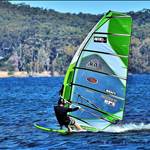
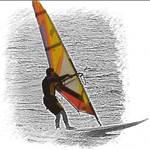
often people say how sail steering dont work when planing.
It seems that is not true..
Nico say when lift heels bords start turn downwind but he counter that with raking sail more back..
Will change direction slightly, but not "turn" like a jibe.
More likely, with sail rake changes, you will trip and catch a rail or start to stall.
Ideal trim is not to be messed with.
Select to expand quotefpw9082 said..
often people say how sail steering dont work when planing.
It seems that is not true..
Nico say when lift heels bords start turn downwind but he counter that with raking sail more back..
What happend if you keep board flat and rake sail forward and backward,will board turning?
Yes, I will move the sail forward to bear off in light winds with a big sail. Even more when using weedies. Using your feet to steer seems less effective on the wide boards in low but planning speed. Worth playing with
Select to expand quotefpw9082 said..
often people say how sail steering dont work when planing.
It seems that is not true..
Nico say when lift heels bords start turn downwind but he counter that with raking sail more back..
What happend if you keep board flat and rake sail forward and backward,will board turning?
Nico is absolutely right, you can steer with board and sail simultaneously and use both to cancel each other out and stay in a straight line with an altered board trim. It's fun to play with this effect on very flat water like Lake George. Even with a small weed fin you can feel the acceleration if you get the leeward rail slightly depressed (which would normally carve you downwind), lean the rig back slightly to keep going straight and start to generate some vertical lift from the fin. Obviously you need to be well powered up and it is quite a small window of trim to keep flying a small fin without stalling it, but when you get it  . If you are not powered up enough to gain vertical lift off the fin this approach is generally slower and less efficient.
I also you sail steering to both initiate a bearaway and sometimes when pulling up from a bearaway in chop. It can often be too shallow and dangerously choppy to try to carve hard upwind without losing the fin, raking the rig back will help you round-up without upsetting the board trim.
Select to expand quotekato said..fpw9082 said..
often people say how sail steering dont work when planing.
It seems that is not true..
Nico say when lift heels bords start turn downwind but he counter that with raking sail more back..
What happend if you keep board flat and rake sail forward and backward,will board turning?
Yes, I will move the sail forward to bear off in light winds with a big sail. Even more when using weedies. Using your feet to steer seems less effective on the wide boards in low but planning speed. Worth playing with
I cant steer my formula board with foot toe/heel pressure.
What can I do to bear off ,hook in and in straps?
I dont talk about jibe,only steering when in straps
Select to expand quoteLeeD said..
Will change direction slightly, but not "turn" like a jibe.
More likely, with sail rake changes, you will trip and catch a rail or start to stall.
Ideal trim is not to be messed with.
What do you mean by stall?
Select to expand quotefpw9082 said..LeeD said..
Will change direction slightly, but not "turn" like a jibe.
More likely, with sail rake changes, you will trip and catch a rail or start to stall.
Ideal trim is not to be messed with.
What do you mean by stall?
I tell you what, for someone who sails a formula board and try's to contradict people when they answer a question and then doesn't know what the word " Stall " means, I'd say you were on the wind-up.
Select to expand quoteMadge said..fpw9082 said..LeeD said..
Will change direction slightly, but not "turn" like a jibe.
More likely, with sail rake changes, you will trip and catch a rail or start to stall.
Ideal trim is not to be messed with.
What do you mean by stall?
I tell you what, for someone who sails a formula board and try's to contradict people when they answer a question and then doesn't know what the word " Stall " means, I'd say you were on the wind-up.
Stall is aviation term,when flow separate from low pressure side of wing,airfoil
That i know.
Stall in a windsurfing context is the board losing speed, in this case from an inefficiently held sail at the wrong angle, even though the wind is sufficiently strong.
Select to expand quoteLeeD said..
Stall in a windsurfing context is the board losing speed, in this case from an inefficiently held sail at the wrong angle, even though the wind is sufficiently strong.
But has rake with stall?
You can stall the sail if you sheet in too much,when angle of attack is too large
Too much rake loads the tail, lightens the nose, you wheelie....stall.
Too upright a rig...after you are dialed...weights the nose, lessens your ability to hold the sail, your nose slaps, board slows...you stall.
For a mid sized board say 110 litres do not agree with digging your heels in but it could work on a formula board.
For going upwind when you are NOT planing - stand as close to the windward rail as possible digging the rail in.
For planing its the opposite - lift your backfoot heel / dig your backfoot toes in to get the wind under the board so it flys and simultaneously move as much of your upper body weight to the nose of the board. The more weight you can apply thru your harness FORWARD keeping your mast as upright as possible the higher you will go.
Low cut sails like he is using can easily drag in the water killing your upwind performance.
Lighter guys are not so disadvantaged upwind compared to downwind
On topic, let's clear a few things up here.
No-one ever said you can't steer with the sail when planing. When we plane we keep the board heading in a straight line with subtle movements of the rig which work in conjunction with our foot and weight movements on the board.
The confusion maybe comes from the bigger differences between planing and non-planing. For example, when not planing - or slogging - we can't really talk about carving the board. Instead we use extreme sail movements to turn a slow-moving board, or else we sink the tail to do a flare jibe turn.
When planing fast however we use carving technique to turn the board most efficiently whilst still using rig placement which add to our body weight positioning.
So when not planing the rig movement is more significant, but when planing the board carving is the dominant factor in big turns.
This video (linked to in the opening post) is about heading upwind. Unlike Nico, I think heading upwind is more fun than heading down wind - but then I'm not a speed sailor or free rider. Sailing upwind can be tactical or more of a challenge.
The key to heading upwind is to take the most efficient course that gets you there quickest - and that will depend on how high you can point, how fast you can go, and whether your chosen course uses a favourable current and works with the chop or wave length on offer.
Bearing off makes you go faster upwind but not necessarily in the right direction. Pointing too high can make you feel you are heading upwind well but in truth you might be sliding sideways a lot without realising that.
So the path taken upwind is often a compromise between pointing high and footing off fast but in a broader direction.
Once you have found the right/favourable angle on the wind your driving technique is important as that is what keeps the board planing fast, and so concentration is everything. To control the power in the sail you can feather the sail slightly when over-cooked in gusts, and that allows you to point higher as long as you don't lose planing speed.
Steering, as already explained, is done with a subtle combination of feet and rig movements. I tend to work the board with the waves and chop, snaking the fastest path around waves and lumps - rather than piling nose first into them.
The key thing missed in this video is that we deliberately rail the board to knife through some chop, and so you must also move the rig back and forwards in conjunction with this railing to keep the board on your chosen path. As you lift the rail slightly with your windward foot, you probably shift the rig back a bit, but all this is done without thought.
By railing the board, you don't hit waves so hard with the board nose, and there's no need to sail the board with the nose in the air (which the video wrongly suggests). And that means you can keep your weight a lot more forwards for efficient upwind work, with less chance of spinout as you load the fin.
On some free ride and wave boards, the board also goes upwind partially on the rail, as much as with 'lift' from the fin, so you may find most of your weight is on the front foot.
Select to expand quoteBasher said..
On topic, let's clear a few things up here.
No-one ever said you can't steer with the sail when planing. When we plane we keep the board heading in a straight line with subtle movements of the rig which work in conjunction with our foot and weight movements on the board.
The confusion maybe comes from the bigger differences between planing and non-planing. For example, when not planing - or slogging - we can't really talk about carving the board. Instead we use extreme sail movements to turn a slow-moving board, or else we sink the tail to do a flare jibe turn.
When planing fast however we use carving technique to turn the board most efficiently whilst still using rig placement which add to our body weight positioning.
So when not planing the rig movement is more significant, but when planing the board carving is the dominant factor in big turns.
This video (linked to in the opening post) is about heading upwind. Unlike Nico, I think heading upwind is more fun than heading down wind - but then I'm not a speed sailor or free rider. Sailing upwind can be tactical or more of a challenge.
The key to heading upwind is to take the most efficient course that gets you there quickest - and that will depend on how high you can point, how fast you can go, and whether your chosen course uses a favourable current and works with the chop or wave length on offer.
Bearing off makes you go faster upwind but not necessarily in the right direction. Pointing too high can make you feel you are heading upwind well but in truth you might be sliding sideways a lot without realising that.
So the path taken upwind is often a compromise between pointing high and footing off fast but in a broader direction.
Once you have found the right/favourable angle on the wind your driving technique is important as that is what keeps the board planing fast, and so concentration is everything. To control the power in the sail you can feather the sail slightly when over-cooked in gusts, and that allows you to point higher as long as you don't lose planing speed.
Steering, as already explained, is done with a subtle combination of feet and rig movements. I tend to work the board with the waves and chop, snaking the fastest path around waves and lumps - rather than piling nose first into them.
The key thing missed in this video is that we deliberately rail the board to knife through some chop, and so you must also move the rig back and forwards in conjunction with this railing to keep the board on your chosen path. As you lift the rail slightly with your windward foot, you probably shift the rig back a bit, but all this is done without thought.
By railing the board, you don't hit waves so hard with the board nose, and there's no need to sail the board with the nose in the air (which the video wrongly suggests). And that means you can keep your weight a lot more forwards for efficient upwind work, with less chance of spinout as you load the fin.
On some free ride and wave boards, the board also goes upwind partially on the rail, as much as with 'lift' from the fin, so you may find most of your weight is on the front foot.
I have dvd from Alan Cadiz,and he say when planing board dont response for sail steering any more...
Confusion starts here...
For practical purposes, and beginner advice, he is correct. He teaches, so is focused on beginner shortboarding.
In regard to sail steering,
A) when the resultant force from the sail is directed more across the board then adjusting the rig fore and aft works well
B) when the resultant force is directed more from ahead or behind then adjusting the rig across the board comes more into play.
We all do it this way but what amazes me is that very few (if any) seem to recognise or talk about B.
Select to expand quoteTGale said..
In regard to sail steering,
A) when the resultant force from the sail is directed more across the board then adjusting the rig fore and aft works well
B) when the resultant force is directed more from ahead or behind then adjusting the rig across the board comes more into play.
We all do it this way but what amazes me is that very few (if any) seem to recognise or talk about B.
I think that understand only people with physics background..nice observation