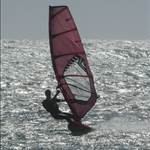
Since living in WA since 2005 I've purchased waves sails in the sizes 4.2, 4.7, 5.3 & 5.6
Every 3yrs I've updated my sails from Naish, North, RRD, Severne.
So if sails are getting more powerful, efficient and faster, each redesign why each season am I still using the 4.7 & 5.3, about 75% of the time in WA. Surely I should be using 3.7 and 4.2 by now as my prime sails.
Sails are getting easier to handle, stable and more confident inspiring, but more powerful or faster not sure.
In my case I use a '23 4.5 Blade in conditions I would previously have used an older 4.7 ('15 Blade). So that's less than 5% in all those years but the sails in general have improved more than what that number might indicate. I also use a '22 4.7 and I technically don't need the 4.5. The 4.7 has such a massive range that I could easily eliminate my 4.5 and 5.0 if I wanted.
So instead of going smaller, you would not need as many sails.
You have some larger gaps but if you wanted, you could go from 4.2, 4.7, 5.3 & 5.6 to 4.0, 4.5, and something like 5.3 and eliminate one sail.
In WA, I could get away with 4.2, 4.7, 5.5 and would also make it easier to decide what to rig ;)
I've recently got back into windsurfing after a bit more than a decade out and I'm still using my old sails, including a 2008-ish KA Koyote 6.6. I'd love to know how a new similar sail feels in comparison. My brother has recently got a 6.5 Severne Gator, which is not exactly the same style of sail, but I'm keen to give it a try.
Select to expand quoteQ51R said..
So if sails are getting more powerful, efficient and faster, each redesign why each season am I still using the 4.7 & 5.3, about 75% of the time in WA.
Who is saying that?
Select to expand quoteQ51R said..
Since living in WA since 2005 I've purchased waves sails in the sizes 4.2, 4.7, 5.3 & 5.6
Every 3yrs I've updated my sails from Naish, North, RRD, Severne.
So if sails are getting more powerful, efficient and faster, each redesign why each season am I still using the 4.7 & 5.3, about 75% of the time in WA. Surely I should be using 3.7 and 4.2 by now as my prime sails.
Sails are getting easier to handle, stable and more confident inspiring, but more powerful or faster not sure.
Has that observation been seasonally adjusted for global warming in Perth ?
Select to expand quoteSurferKris said..Q51R said..
So if sails are getting more powerful, efficient and faster, each redesign why each season am I still using the 4.7 & 5.3, about 75% of the time in WA.
Who is saying that?
Marketing physicists
Let's have a few comments about sail power.
The power of a sail is a function of the sail area, but also of the drive it creates through its foil shape.
So a sail will feel more powerful if it is bigger in measured area, or if it is cut fuller for better acceleration.
A higher leech will also make a sail feel more powerful, for a given sail area.
This gets more complicated when the skilled sailor is on board, because a flatter cut sail can get going just as early if the sailor knows how to pump the rig, and then that flatter foil may actually prove to be faster once planing.
People have indeed said that modern wave sails often 'feel' more powerful for the measured size, or that four batten wave sails feel more powerful than five batten ones.
But that concept of 'feel' varies between sailors of differing expertise. Some say a sail feels more powerful when it is badly rigged, and what they actually mean is that they are fighting the rig more. A well-rig sail often feels lighter in the hands.
It's actually difficult to measure the power of a sail in any meaningful way, but you can compare sails of a different size by sailing them back to back.
To pick out one brand, on our beach we've noted that those sailing Ezzy wave sails are now using smaller sizes than they used to.
Select to expand quoteBasher said..
Let's have a few comments about sail power.
The power of a sail is a function of the sail area, but also of the drive it creates through its foil shape.
So a sail will feel more powerful if it is bigger in measured area, or if it is cut fuller for better acceleration.
A higher leech will also make a sail feel more powerful, for a given sail area.
This gets more complicated when the skilled sailor is on board, because a flatter cut sail can get going just as early if the sailor knows how to pump the rig, and then that flatter foil may actually prove to be faster once planing.
People have indeed said that modern wave sails often 'feel' more powerful for the measured size, or that four batten wave sails feel more powerful than five batten ones.
But that concept of 'feel' varies between sailors of differing expertise. Some say a sail feels more powerful when it is badly rigged, and what they actually mean is that they are fighting the rig more. A well-rig sail often feels lighter in the hands.
It's actually difficult to measure the power of a sail in any meaningful way, but you can compare sails of a different size by sailing them back to back.
To pick out one brand, on our beach we've noted that those sailing Ezzy wave sails are now using smaller sizes than they used to.
"then that flatter foil may actually prove to be faster once planing"
Based on what theory?
Select to expand quotepeterowensbabs said..Basher said..
Let's have a few comments about sail power.
The power of a sail is a function of the sail area, but also of the drive it creates through its foil shape.
So a sail will feel more powerful if it is bigger in measured area, or if it is cut fuller for better acceleration.
A higher leech will also make a sail feel more powerful, for a given sail area.
This gets more complicated when the skilled sailor is on board, because a flatter cut sail can get going just as early if the sailor knows how to pump the rig, and then that flatter foil may actually prove to be faster once planing.
People have indeed said that modern wave sails often 'feel' more powerful for the measured size, or that four batten wave sails feel more powerful than five batten ones.
But that concept of 'feel' varies between sailors of differing expertise. Some say a sail feels more powerful when it is badly rigged, and what they actually mean is that they are fighting the rig more. A well-rig sail often feels lighter in the hands.
It's actually difficult to measure the power of a sail in any meaningful way, but you can compare sails of a different size by sailing them back to back.
To pick out one brand, on our beach we've noted that those sailing Ezzy wave sails are now using smaller sizes than they used to.
"then that flatter foil may actually prove to be faster once planing"
Based on what theory?
I question this too. The flatter foil my just be more stable in higher apparent wind, so not fighting you as much, so 'feels' faster???
Flatter sails 'can' be a little faster upwind, related to the reason above, but are usually slower downwind due to less power. Better to go for a smaller but deeper sail off the wind for a better power to drag ratio.
From what I understand, thinner foils are better for higher speeds. Basher and sailquick may be thinking of different things here - beam reach vs. deep downwind. At 30 knot wind, the sail sees a wind of 42 knots if sailing at 30 knots on a beam reach (90 degrees to wind). If you go down to a full speed run at 130 degrees to the wind, and accelerate to 40 knots, the wind the sail sees actually drops to 31 knots. Pinching upwind at 25 knots, 65 degrees gives an apparent wind of 47. Hence the adjustable outhaul.
Select to expand quoteaeroegnr said..
Marketing physicists
I haven't seen that claim from Severne for instance.
In test from windsurf (uk) for instance, they don't claim any increase in power either, from what I have seen/remember.
Same here. Lots of jargon gets thrown into sales pitches, but never heard claims of "increased power", or anything of the like.
A sail from years ago is probably more "Powerful" but that meaning has changed.
I would use the term "More efficient".
The older sails had a tighter leech which created more power but had no release factor and therefore only had a limited range of use and over powered the fin quicker. Modern sails with their lighter construction and twistier leeches don't have more power but do offer far more control and a wider range and are more comfortable to ride. I have rode sails that sail they are "Power Wave" sails but their shape is in rotation rather then seam shaping so in theory they still need some wind to inflate them away from the mast and although they are powerful, they don't seem as powerful as a sail with pre shaped seams but a sail with pre shaped seams will feel heavier when its at stand still.
Basically its a feel thing, if it feels ok for the conditions that you are sailing in then its good for you.
I seemed to remember reading "added power"...maybe we're talking about different things because I was looking at foil specific sails but the language was there on the Hyperglide 5, for instance. Not sure what is true going from 4 to 5 (and 6) as I haven't had those sails...maybe they did increase power but it's hard to sort marketing speak from reality.

Well, from one year to another they can make the draft deeper for more power, nothing strange in doing that. Especially since the foil sails are still fairly new designs.
I'm still wondering what the original post is talking about.
Select to expand quoteboardsurfr said..
From what I understand, thinner foils are better for higher speeds. Basher and sailquick may be thinking of different things here - beam reach vs. deep downwind. At 30 knot wind, the sail sees a wind of 42 knots if sailing at 30 knots on a beam reach (90 degrees to wind). If you go down to a full speed run at 130 degrees to the wind, and accelerate to 40 knots, the wind the sail sees actually drops to 31 knots. Pinching upwind at 25 knots, 65 degrees gives an apparent wind of 47. Hence the adjustable outhaul.
Whilst I agree that the function of outhaul is for changing the angle of attack of the luff from deeper to shallower for the apparent wind angle conventional wisdom in pretty much all other forms of sail based racing belie the premise that flatter is faster up or down wind. Big boats cary a variety of head sails that are specifically deep for downwind the obvious extreme examples are spinnakers or asymmetrics. Up wind head sails do flatten out with wind strength (and reduce in size as well) not for speed but for control. Fast skiffs who have the same luxury as windsurfers of having different sized rigs for different wind strengths rely on big deep asyies rigged as far forward as possible on a bowsprit to maximise the forces on the hull for off the wind.
We have only one sail at a time, no options of moving its direct forces forward on our gear (apart from the small track) so where does that leave us?
Well we mostly sail square reaching (90 degrees to the wind) or dive off wind in to a broad reach and have to slog up wind on a close reach to get back to point A which is usually very slow and quite painful. You don't see flat rigs at Luderitz. Race boarding may be an exception racing up wind, and Wavesailing is a totally different beast due to the wave power, angle of the break, upwind riding vs downwind riding etc.
Our gear is tuned for reaching, has deep draft, some even have cambers and is NOT flat because mostly we sail with it that way.
In Formula windsurf we use the outhaul as the "gas-pedal". We trim the outhaul a lot on the upwind leg, in order to have enough pressure on the fin in order to point higher against the wind. One has to be extremely overpowered in order to use a flattish sail, and even then the flatter sail is more twitchy and harder to sail.